Short answer: A shower-hinge cycle-test claim is useful only when it identifies the tested hinge, door setup, procedure and acceptance conditions. A cycle count without those details cannot establish suitability for a different door or predict its service life.
A buyer interviews the test report
Buyer: Which product was actually tested?
The report should identify the model and relevant drawing revision. Note the hinge arrangement, mounting configuration and any accessories included in the specimen. Start with the shower hardware range, then compare the offered item with the hinge selection guide.
Buyer: What door did the hinge move?
Ask for the specified door mass, dimensions, glass configuration and fixing arrangement. If the report uses a test fixture rather than a complete door, its construction and relevance should be explained. CRL’s shower-hardware information illustrates why selection belongs to a defined hardware configuration.
Read the conditions before the headline number
| Report question | Evidence to look for |
|---|---|
| What was tested? | Model, revision and specimen identification |
| Under what conditions? | Door or fixture setup and procedure |
| How many specimens? | Sample count and individual records |
| What was observed? | Defined functional and physical checks |
| What constituted acceptance? | Stated criteria and reported deviations |
An illustrative claim such as “50,000 cycles” is incomplete by itself. This number is an example of report wording, not an Elim rating or a recommended test target. The selected procedure must determine the meaningful conditions and endpoint.
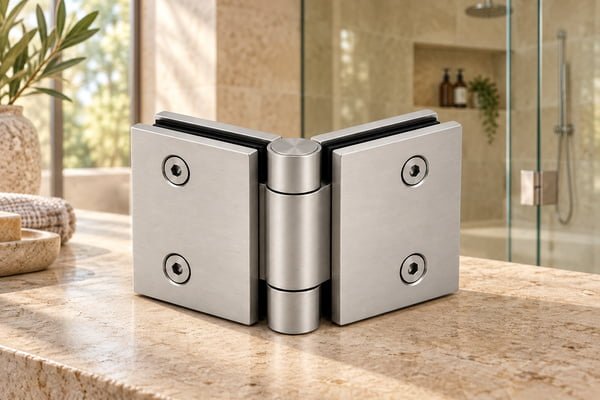
Catalogue illustration: Matte Silver 90 Degree Glass-to-Glass Shower Door Hinge — Finish Concept. Shown as a component reference, not an installation drawing or test result.
Ask about function after cycling
Buyer: Did the hinge merely keep moving?
Request the observations required by the procedure, including any relevant changes in closing behaviour, alignment, looseness or visible damage. Do not add an arbitrary acceptance threshold after seeing the result.
The hotel-shower hinge guide helps frame operating conditions and service access. The glass-cutout revision guide addresses a separate risk: a tested hinge is still the wrong component if its fixing interface does not match the prepared panel.
CRL’s frameless-shower catalogue is a product-selection reference. ASTM C1048 concerns heat-strengthened and fully tempered flat glass; it is not a hinge cycle-test certification. Keeping the scope of each document clear makes the procurement file easier to audit.
Check how measurements were recorded
Where a result relies on force, movement or dimensional measurements, ask for the measurement method and suitable instrument records. NIST’s traceability guidance explains why traceability concerns a measurement result rather than a vague equipment label.
If material identification is part of the specification, request that evidence separately. ASSDA’s grade-confirmation guidance describes considerations for identifying stainless material. A grade check cannot replace a functional endurance test.
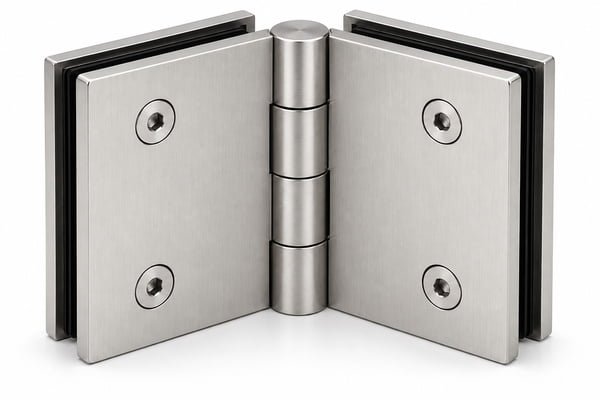
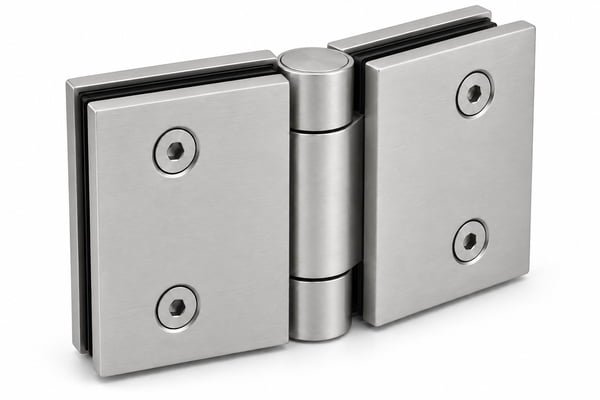
Catalogue illustration: 135 Degree Glass-to-Glass Shower Door Hinge. Shown as a component reference, not an installation drawing or test result.
Distinguish laboratory evidence from installation approval
Buyer: Does a passing report approve every shower door?
No. Confirm that the proposed door and installation fall within the evidence and manufacturer instructions. Changes in geometry, hardware quantity or fixing configuration require review by the responsible parties.
CPSC’s tempered-glass safety information provides background on glass hazards. U.S. Access Board bathing-room guidance addresses accessibility in its applicable context. Neither document should be presented as proof that an unspecified hinge has passed cycle testing.
Define the supplier’s document package
Request the report reference, complete test scope, product drawing, installation instructions and approved substitution process. If a summary is offered, establish how the relevant full report can be reviewed. Redacted commercial information should not obscure the model identity or acceptance basis.
Ask how production goods remain connected to the approved design. GS1’s traceability framework offers a structure for linking product and batch records, but the supplier must describe its actual process.
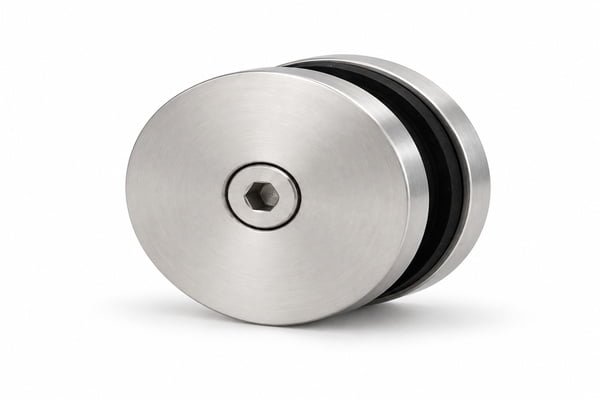
Catalogue illustration: Round Shower Glass Clamp. Shown as a component reference, not an installation drawing or test result.
Preserve a decision that can be revisited
Record the accepted report revision beside the purchase-order model. If the supplier proposes a different hinge, compare its configuration with that evidence before release. Keep unresolved differences visible, even when the substitute has a similar appearance. The useful decision is acceptance for a defined configuration, with a named reviewer and a documented basis.
The purchasing decision
Classify the response as usable evidence, incomplete evidence or evidence for a different configuration. Record the reason. This is more useful than giving every certificate the same check mark.
Review required documents against the published capabilities. Use OEM/ODM review for a modified hinge interface or other custom requirement. Send the door schedule and evidence checklist with your shower-hardware enquiry, asking suppliers to identify exactly which requested documents accompany the quotation and shipment.