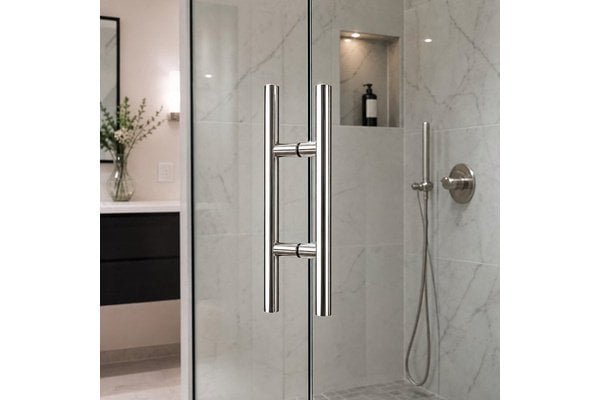
Release rule: A shower-glass cutout template must identify the exact hardware model, drawing revision, units, orientation and glass specification. The glass processor, hardware supplier and purchaser should work from the same accepted file. A clear revision record is more valuable than a folder full of similarly named PDFs.
How a revision error reaches production
An enquiry starts with a reference hinge. A later quotation substitutes another model, but the glass processor receives the first template. The hardware and glass orders are individually legible; together, they describe different interfaces. This is a coordination failure that a controlled release process can prevent.
Begin with the selected component in the shower systems range. Assign the model reference before preparing glass. A picture from an earlier order is useful context, but it should not become the manufacturing instruction by default.
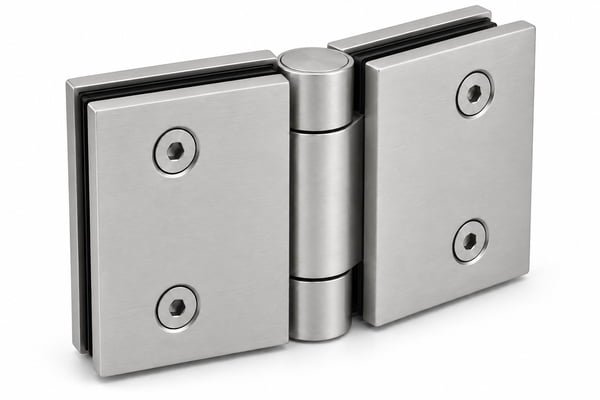
Catalogue illustration: Matte Silver 90 Degree Glass-to-Glass Shower Door Hinge — Finish Concept. Shown as a component reference, not an installation drawing or test result.
What belongs on the release sheet?
| Field | Required purpose |
|---|---|
| Hardware model | Identifies the actual ordered component |
| Drawing revision | Separates current geometry from old files |
| Units | Prevents scaling and conversion assumptions |
| Glass specification | Defines the panel being prepared |
| Orientation | Distinguishes inside, outside and handed conditions |
| Dimensions | States hole, cutout and reference-edge geometry |
| Approval | Identifies who released the combination and when |
Consult the 90-degree versus 135-degree hinge guide when distinguishing configurations. The angle in a product name does not describe the complete cutout. Review the hinge product reference together with its current model-specific documentation.
CRL’s shower catalogue illustrates the importance of product-specific documentation. External templates are examples of how information is presented; they should not be used to manufacture glass for an unrelated fitting.
Establish a simple version handoff
Use one accepted release folder and clearly mark superseded files. The purchase order should reference the drawing revision, not just a broad product family. If the supplier proposes a change, require a marked comparison and a new acceptance record before either order proceeds.
Ask the processor to confirm receipt of the correct file and units. A template printed on paper should not be assumed to retain its intended scale. Agree whether manufacturing is controlled by stated dimensions or a validated digital file, and document the verification method.
For a unit-check example, 1/4 inch equals 6.35 mm, not 6 mm. That conversion is not a recommended hole size; it demonstrates why rounding a supplied dimension can change the interface. Preserve the drawing’s specified precision and ask for clarification rather than silently converting a manufacturing value.
NIST’s traceability guidance supports meaningful dimensional records. It does not mean that a document bearing a calibration reference automatically proves every feature was checked correctly.

Catalogue illustration: 135 Degree Glass-to-Glass Shower Door Hinge. Shown as a component reference, not an installation drawing or test result.
Coordinate the parts that share the panel
The hinge is not the only interface. Handle holes, clamp positions and support details can all affect fabrication. Use the complete shower-hardware kit guide to build a panel-level schedule instead of releasing separate uncoordinated templates.
CRL’s pull-handle range is an external example of another component family requiring its own interface information. Where access requirements apply, review the Access Board’s bathing-room guide and door guidance with the project team. Those references concern the installation context, not a universal cutout pattern.
The CPSC tempered-glass alert provides important safety background. Do not plan to correct a fabrication mismatch by casually drilling or modifying finished tempered glass. Resolve preparation requirements with the responsible processor before manufacturing.
Use a first-off review as a release checkpoint
Where appropriate, agree a first-off check of the specified glass and complete hardware interface. Record the actual models and revision used. A successful fit of a different sample does not approve the production combination.
Discuss custom geometry through OEM/ODM review. Ask which dimensions and assembly checks can be documented using the available manufacturing capabilities. Keep the verification scope explicit: fit review is not automatically a structural, durability or water-performance test.
Carry identity through shipment
Label panels and hardware sets with the same location references used on the accepted drawings. Protect identifying labels during packing and record replacements or revisions made after approval.
Use ISTA’s procedures as a reference when selecting relevant transport evaluation. Trade.gov’s export-document overview supports consistent shipment paperwork. Neither source can replace the controlled drawing or the product-specific installation instructions.
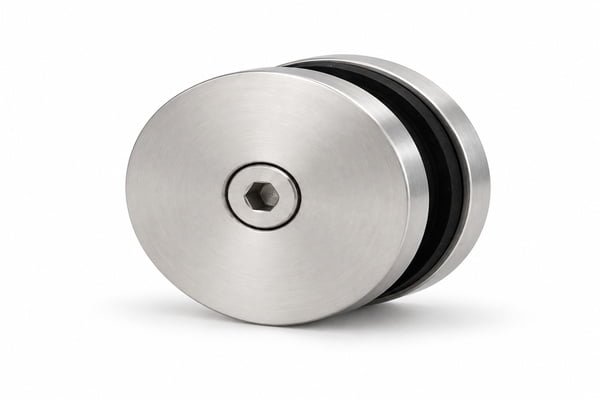
Catalogue illustration: Round Shower Glass Clamp. Shown as a component reference, not an installation drawing or test result.
Production-coordination FAQ
Can an old template be reused? Only after confirming the hardware, glass configuration and revision remain applicable.
Does a model name alone identify the cutout? No. Obtain the current drawing and its revision.
Who should receive the release pack? The purchaser, hardware supplier, glass processor and relevant installer or project reviewer.
What should the enquiry include? Panel schedule, selected hardware, current drawings and identified open questions. Send the coordinated drawing package for review before bulk production begins.