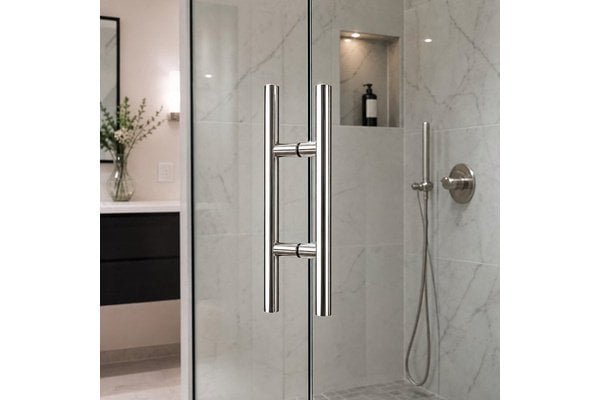
Range-planning answer: Build a shower-handle assortment around customer use, glass preparation and installation interfaces. Back-to-back pulls and knobs can serve different preferences, but neither should be selected only by finish. Record hole requirements, projection, grip, supplied fixings and the intended enclosure configuration for every SKU.
Start with the buyer, not the colour chart
A residential installer, hotel contractor and retail showroom may need different product mixes. Review the shower systems range, then define the customer groups the assortment will serve. The purpose is to make selection easier, not to stock every visual variation.
CRL’s pull-handle range is an external example of the variety available in this category. It does not establish which configurations Elim supplies. Use an accepted product drawing and quotation to define the actual stocked item.
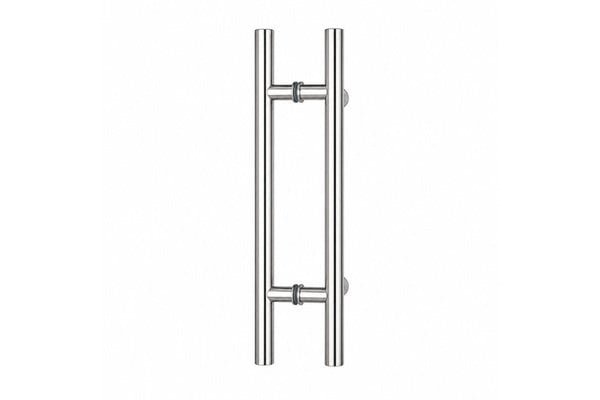
Catalogue illustration: Complete ladder-style shower door handle. Shown as a component reference, not an installation drawing or test result.
A useful assortment matrix
| Range segment | Buyer question | Catalogue information to show |
|---|---|---|
| Back-to-back pull | Can users grip it comfortably from both sides? | Projection, shape and fixing interface |
| Compact knob | Does the intended use suit the grip and clearance? | Profile and glass-preparation detail |
| Coordinated finish | Does it match the accepted hardware set? | Finish reference and sample identity |
| Replacement item | Will it fit the existing prepared glass? | Hole pattern and compatible configuration |
The shower-hardware kit guide helps keep the handle in context with hinges, seals and other components. A matching finish does not prove matching glass preparation or unobstructed movement.
Resolve glass preparation before stocking
For a pull, identify the hole-centre distance, hole dimensions and glass-contact parts. For a knob, identify its own preparation and supplied fixings. Do not assume a compact component needs no detailed drawing.
The ladder-style handle reference provides a concrete configuration for discussion. CRL’s shower catalogue offers an external documentation example. Use the selected model’s current template rather than copying dimensions from a photograph or from a similar-looking supplier’s part.
The CPSC glass alert provides relevant safety background. A prepared tempered panel is not something to casually modify to fit a replacement handle. Coordinate changes with the responsible glass processor before placing the order.

Catalogue illustration: Ladder-style shower handle cross-fixing detail. Shown as a component reference, not an installation drawing or test result.
Include usability in the commercial decision
Ask who will use the enclosure and under what conditions. Test the proposed sample’s grip and clearance in the intended arrangement. Where US accessibility requirements apply, consult the Access Board’s bathing-room guidance and door and gate guidance for the applicable scope.
Do not describe a product as universally accessible because it resembles a pull shown in a guide. Applicability and the complete installation matter. A showroom description should distinguish design intent from verified project compliance.
Use the hotel shower-hardware article to think through project-room consistency and future replacement access. A commercial buyer may prefer fewer, well-documented interfaces over a larger range with uncertain compatibility.
Manage finishes and replacement continuity
Approve a physical finish sample alongside the other visible hardware. The finish-care guide helps connect the sold appearance to the instructions delivered with it. ASSDA’s stainless cleaning guidance is relevant only to suitable stainless surfaces; coated finishes need their own approved care instructions.
Keep product identity stable when a supplier changes a fixing or glass-contact component. Record the revision and its effect on replacement compatibility. For private-label requirements, discuss OEM/ODM options without assuming every requested configuration is an existing stock item.
Put practical information on the order
Specify the model, drawing revision, finish sample, quantities and included components. Distinguish a pair, a set and a single piece so the commercial unit cannot be misunderstood. For example, ten back-to-back sets are not automatically ten individual grip pieces.
Select protective packaging evaluation using ISTA procedures, and align shipment descriptions with Trade.gov’s document guidance. These are logistics references, not claims that a particular package has already passed testing.

Catalogue illustration: Shower handle glass-contact fixing detail. Shown as a component reference, not an installation drawing or test result.
Wholesale FAQ
Should knobs and pulls share one specification? They may share a range structure, but each model needs its own interface and component details.
Can a new finish use the same product reference? Preserve enough identification to distinguish finishes and any revisions affecting replacement.
What should an assortment enquiry include? Target users, enclosure types, preferred interfaces, finish references and estimated quantities. Send your range plan so Elim Hardware can review a focused assortment rather than an unstructured list of images.