Brass and stainless steel shower hinges can both be viable purchasing options, but the body material alone does not establish door capacity, corrosion performance or operating life. Compare the complete hinge, its finish, mechanism and documented glass compatibility. This guide is for distributors choosing a dependable range rather than a material label.
Separate body, finish and mechanism
“Brass” can describe a body material or a decorative colour. “Stainless” may refer to a body, a cover or another component. Ask for the actual construction of the hinge being quoted. Browse the shower hardware system, identify the model and request a component-level material description.
The CRL shower hardware catalogue shows manufacturer-specific constructions and applications. Its shower hardware FAQ provides further system context. These are comparison references, not evidence that an Elim hinge has the same material, capacity or adjustment arrangement.
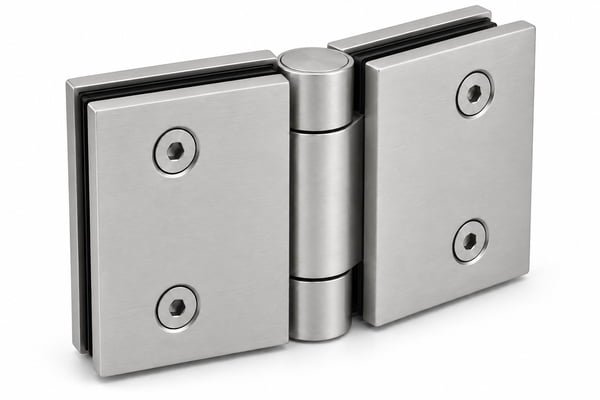
Catalogue illustration: Matte Silver 90 Degree Glass-to-Glass Shower Door Hinge — Finish Concept. Shown as a component reference, not an installation drawing or test result.
Compare the purchase specification
| Question | Brass-body option | Stainless-body option |
|---|---|---|
| Material | Specify the actual alloy or supplier designation | Specify the actual grade and product form |
| Finish | Identify plating or other treatment | Identify polish, brushing or applied treatment |
| Mechanism | Record pivot, spring and adjustment details | Record pivot, spring and adjustment details |
| Glass interface | Match cutout, thickness and gasket | Match cutout, thickness and gasket |
| Evidence | Request model-specific operating data | Request model-specific operating data |
The common rows matter more than a claim that one material is universally superior. Stainless product information from Outokumpu helps with grade context. ASSDA’s grade-confirmation guidance explains why appearance alone is not a reliable material-identification method.
Think in complete door assemblies
The hinge selection must match the door geometry, glass preparation and mounting condition. Do not transfer a stated capacity from a visually similar hinge or multiply a single-hinge value without the manufacturer’s system guidance. Our hinge cycle-test checklist explains how to read operating evidence with the tested configuration in mind.
For an illustrative hotel order, group doors by actual width, height, glass build-up and mounting arrangement before counting hinges. Fifty doors do not necessarily mean fifty identical hardware sets. Record any handed or geometry-specific variants and keep the glass fabrication drawing linked to the hinge revision.
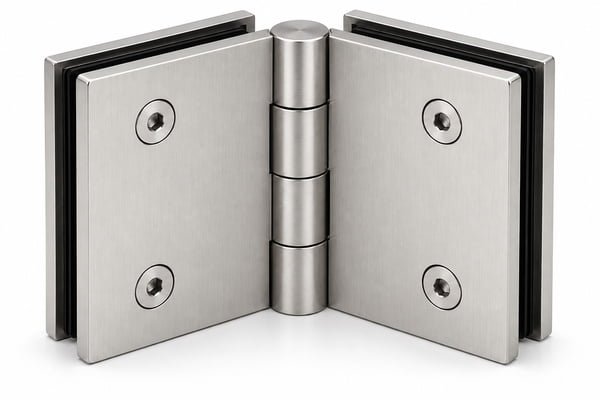
Catalogue illustration: 135 Degree Glass-to-Glass Shower Door Hinge. Shown as a component reference, not an installation drawing or test result.
Finish selection belongs in the same decision
A brass body may receive an applied finish; a stainless body may also be coated or otherwise finished. Approve the actual visible finish and maintenance instructions. Our shower finish comparison helps separate colour, process and appearance. ASSDA finish guidance offers external stainless context without proving the performance of a particular coating.
Consider cleaning chemicals, water exposure and access to crevices in the maintenance brief. ASSDA cleaning guidance is relevant to stainless surfaces, while the hinge supplier should identify care instructions for the complete assembly. A cleaner acceptable for one exposed metal may be unsuitable for another finish or mechanism.
Read corrosion evidence carefully
If salt spray evidence is supplied, match the specimen, finish and evaluation criteria to the ordered model. ASTM B117 describes a test practice; its name is not a universal service-life rating or a pass criterion for every hinge. Our salt spray report guide explains the questions to ask before comparing test-hour claims.
Do not promise that a hinge will last a stated number of years merely because a sample completed a laboratory exposure. Operating conditions, maintenance and the full construction remain relevant. A material decision should therefore include the documentation and replacement arrangements, not just the headline alloy.
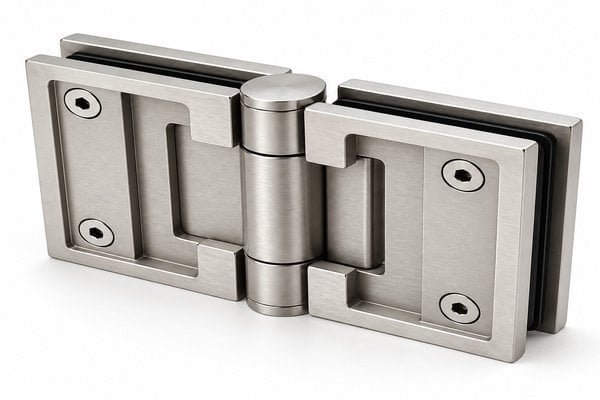
Catalogue illustration: Heavy-Duty Shower Door Hinge. Shown as a component reference, not an installation drawing or test result.
Compare whole-order cost
Put unit price, approved finish sample, spare gaskets, replacement availability and inspection scope in one comparison. Where two models use different cutouts, include the cost and risk of changing glass drawings. A lower-priced hinge can become expensive if it complicates replenishment or mixes incompatible parts across a project.
Is stainless always the premium option? Not in every application. Compare the specified construction and evidence against the buyer’s requirements.
Does a brass-coloured hinge have a brass body? Not necessarily. Obtain the material description separately from the finish name.
NIST conformity-assessment guidance helps distinguish supplier descriptions from testing and certification. Discuss OEM range development, review manufacturing capabilities, and request a model-by-model comparison. Send door drawings, finish requirements, quantities and destination conditions so the quotation addresses the actual assembly.