A shower hardware salt-spray report should identify the specimen, test method, exposure and acceptance criteria. A statement such as “tested for 240 hours” is incomplete without those details and cannot be converted directly into years of bathroom service. This evidence checklist is for importers comparing finish-quality claims.
Start with the test’s actual scope
ASTM B117 is a practice for operating salt-spray apparatus. A reference to the method is not, by itself, a product-specific pass criterion or a warranty. Ask which edition and procedure the laboratory used, and where the acceptance requirement came from.
Identify the ordered product in our shower hardware range. Was the tested specimen the complete fitting, a representative component or a separately prepared coupon? A report for one of these cannot silently be described as covering all the others.
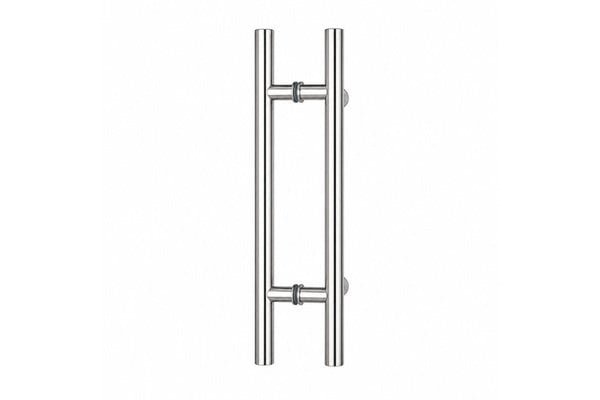
Catalogue illustration: Complete ladder-style shower door handle. Shown as a component reference, not an installation drawing or test result.
Read the report in this order
| Report item | What the buyer should establish |
|---|---|
| Specimen identity | Model, material, finish system and batch relationship |
| Preparation | Cleaning, masking, edges and any intentional scribe |
| Exposure | Named method, duration and recorded conditions |
| Evaluation | Observed surfaces, assessment method and inspection timing |
| Acceptance | Agreed limits and their specification source |
| Result | Actual observations and conclusion for that specimen |
NIST’s conformity-assessment overview helps distinguish testing from certification. A laboratory logo does not enlarge the report’s stated scope. Read the sample description and conclusion, including qualifications, instead of checking only the cover page.
Compare like with like
Suppose one report describes a flat coated coupon after 240 hours and another describes an assembled hinge after 96 hours. The larger hour count does not automatically identify the better hinge. The specimen, finish, preparation, method and acceptance criteria may differ.
These durations are examples for comparison logic, not recommended thresholds or Elim test results. Ask for comparable evidence or record the limitation. Do not invent a conversion such as a fixed number of test hours equalling a fixed number of service years.
Identify the actual finish system
Our shower finish comparison helps separate appearance names from the manufacturing finish. A colour description such as matte black does not identify substrate, pretreatment or coating system. The ASSDA finish resource gives broader surface terminology context.
Ask whether the production process and specimen preparation match the delivered batch. If the supplier changes a finish process, review whether the existing report still applies. Record the proposed substitution rather than treating an identical colour as proof of equivalence.
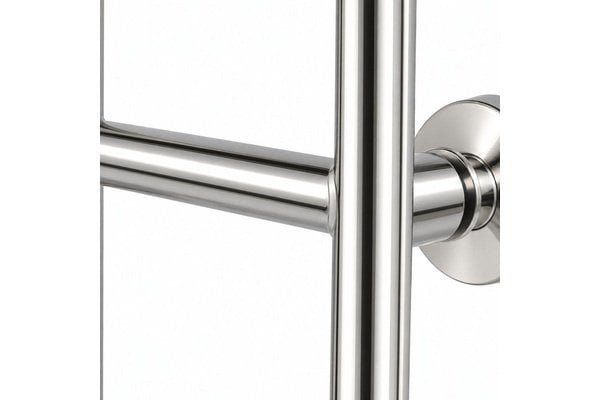
Catalogue illustration: Ladder-style shower handle cross-fixing detail. Shown as a component reference, not an installation drawing or test result.
Do not confuse different corrosion questions
ASSDA’s tea-staining information and pickling and passivation resource address different aspects of stainless surface condition. A salt-spray result should not be used as a catch-all explanation for every stain, cleaning issue or assembly defect.
The ASSDA cleaning guide provides maintenance context. Obtain care instructions appropriate to the complete supplied fitting and its finish. Exposure to unsuitable cleaners in service is a separate question from the exact laboratory conditions described in a report.
Connect evidence to shipment inspection
Use our shower sampling-plan guide to define routine checks for the delivered lot. A finish test does not replace checks for product identity, dimensions, kit completeness and appearance. If sampling specimens for laboratory testing is part of the contract, define how they are selected and traced.
The GS1 traceability framework supports the general recordkeeping discussion. NIST measurement traceability guidance addresses measurement evidence, which is different from identifying the product batch. Keep both relationships clear where required.
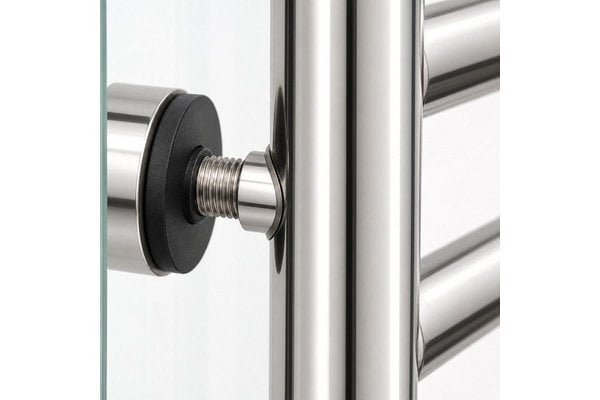
Catalogue illustration: Shower handle glass-contact fixing detail. Shown as a component reference, not an installation drawing or test result.
Build a useful enquiry and complaint record
For custom finish requirements, use OEM development with the requested method and acceptance criteria attached. Review the manufacturing capabilities and ask the quotation to state what testing is included, who performs it and which specimens it covers.
Our warranty evidence checklist helps organise a later investigation. Preserve the product code, batch, installation conditions, cleaning history and photographs. Do not attribute a field problem solely to a test-hour figure without examining the actual evidence.
Does passing the agreed test mean corrosion-proof? No. Report the defined laboratory result and its scope, without extending it into an unsupported universal service claim.
What should a buyer request first? The complete relevant report, specimen identification and the acceptance specification, rather than an isolated marketing number.
To request a finish-specific quotation, provide the intended environment, product schedule, finish reference and required evidence. This makes laboratory testing a clear contractual deliverable rather than a vague promise of high corrosion resistance.