Quick answer: Curved glass railing hardware must match the actual glass radius, thickness build-up and support geometry. A fitting that accepts the nominal thickness may still contact curved glass incorrectly. Order from a coordinated drawing that identifies the glass supplier, hardware interfaces and structural responsibilities.
For project buyers reviewing glass balustrade hardware, the expensive mistake is treating a curved panel as a flat panel with a different outline. Curvature changes where clamps bear, how covers sit and how neighbouring panels meet. This checklist helps procurement teams ask useful questions before manufacturing starts.
Start with the geometry, not the finish
Specify whether the radius is measured to the inside face, outside face or another defined surface. Include arc length, chord length, panel height and the direction of curvature. A radius without its datum is incomplete. An architectural plan should also show which face is the public side.
The CRL architectural railing catalogue is a useful component reference, but catalogue illustrations do not establish suitability for a different curved assembly. Compare the proposed junctions with the principles in our glass railing corner guide; a curved run and an angled junction need different fabrication information.
| Drawing entry | Why the buyer needs it |
|---|---|
| Radius and reference face | Prevents ordering to the wrong curve |
| Panel thickness build-up | Identifies the actual contact envelope |
| Clamp position and orientation | Coordinates bearing faces and glass preparation |
| Joint width and end conditions | Controls assembly clearances |
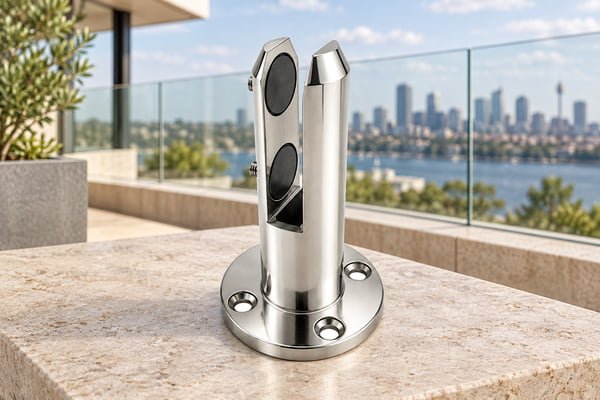
Catalogue illustration: Reflective Silver Round-base Glass Spigot with Circular Pads. Shown as a component reference, not an installation drawing or test result.
Identify the complete glass specification
Write out the glass construction rather than only a total thickness. For laminated glass, distinguish the individual plies and interlayer. Kuraray’s glass interlayer information explains the product category; it does not certify an unspecified Elim assembly. Our laminated glass clamp checklist covers the related ordering fields.
Avoid promising that a gasket will compensate for any curvature. Ask for the permitted contact geometry and the relevant installation detail. The CPSC tempered glass alert also provides useful safety context when discussing glass selection and failure behaviour. Final glass design belongs with the qualified project team.
Separate three approvals
The glass fabricator should approve the panel geometry and preparation. The hardware supplier should identify the matching component arrangement. The responsible designer should approve system performance. A purchase order should name these three deliverables rather than placing them under an ambiguous “approved drawing” heading.
For performance evidence, ASTM E2353 addresses testing of glass railing systems. Use our railing test report checklist to compare the tested arrangement with the proposed one. A report for a straight configuration is not automatically evidence for every curved configuration.
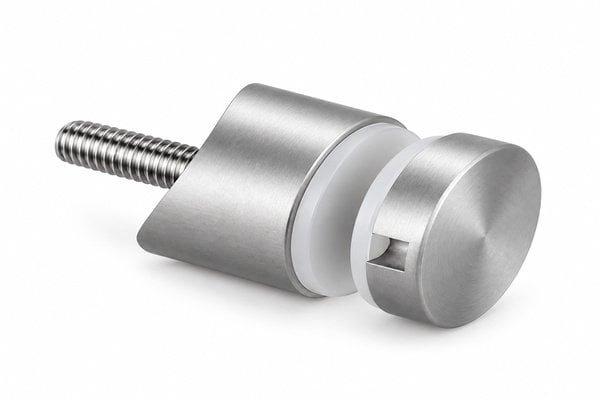
Catalogue illustration: Matte Silver Stepped-cap Cylindrical Glass Standoff. Shown as a component reference, not an installation drawing or test result.
Turn the design into an inspectable sample
Request a representative junction sample, including glass contact parts, covers and fasteners. It should demonstrate fit at the intended orientation. Record the sample identifier and drawing revision so the factory can reproduce it. The Hilti technical guide library is a reference for anchor design information where compatible anchors are being considered; substrate and fixing decisions remain project-specific.
For a dimensional inspection, state the method and acceptance tolerance. NIST’s traceability guidance helps distinguish a measurement record from a general claim that equipment is calibrated. This is especially useful when several suppliers measure from different datums.
Discuss non-standard interfaces through Elim’s OEM/ODM enquiry, attaching the drawing and sample scope. Include quantity by panel type so a repeated section is not priced like a one-off corner.
Budget for finish and transport
Exposure affects finish selection. Consult IMOA’s coastal stainless guidance when salt is present, then specify the required material and finish on the order. Review manufacturing capabilities against the actual process needed, rather than assuming every catalogue fitting can be modified.
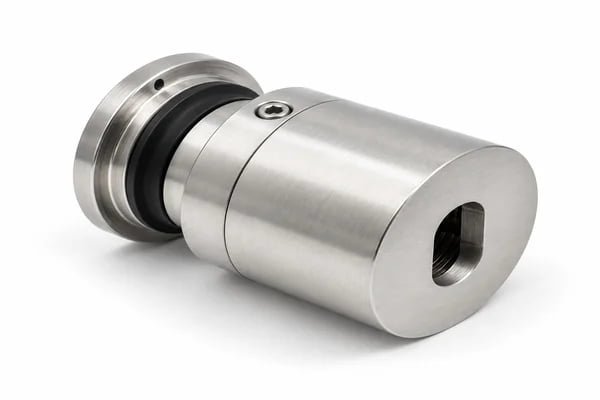
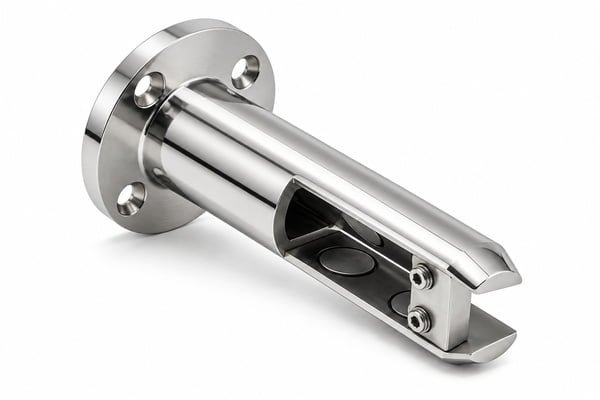
Catalogue illustration: Set-Screw Glass Pool Fence Standoff. Shown as a component reference, not an installation drawing or test result.
Curved panels and protruding hardware also need a packing plan. ISTA test procedures can inform the agreed transport evaluation; they are not evidence that a shipment has already been tested. Separate fragile glass-contact components and identify matching kits by panel reference.
Buyer questions
Can standard fittings be used? Sometimes, but only when their documented contact and fixing geometry accommodates the specified curved glass.
What should accompany the RFQ? A dimensioned layout, glass build-up, exposure, quantities and responsibility schedule. Send the project package with these details to obtain a quotation that can be compared line by line.