Buyer answer: Approve glass railing hardware dimensions in their finished condition. A coating can alter a close-fitting joint, while polishing can remove material. Specify which surfaces receive the finish, which are masked, and how the completed assembly will be checked.
For distributors buying glass balustrade hardware, the expensive mistake is approving colour separately from fit. Two components can match the colour sample yet fail to assemble. This guide treats appearance and dimensional control as one purchasing decision.
Start with the mating surfaces
Mark the interfaces that actually locate or retain the parts: cover-to-body seats, threaded connections, gasket pockets and connector bores. Decorative faces and functional faces need different acceptance criteria. A thick edge deposit on a hidden lip can matter more to assembly than a small colour variation on an exposed face.
Use the base shoe finish comparison to distinguish finish families. The Aluminum Anodizers Council’s anodized finish guidance, QUALICOAT specifications and a coating manufacturer’s architectural powder resources address different processes. None supplies a universal allowance for every Elim component.
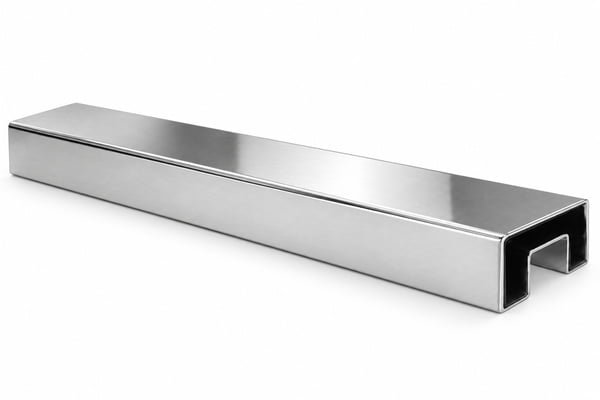
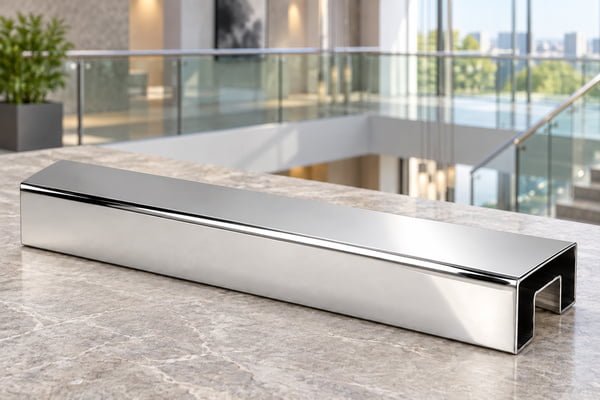
Catalogue illustration: Reflective Silver Square Slotted Glass Handrail Tube. Shown as a component reference, not an installation drawing or test result.
Put the requirements on one drawing
| Drawing item | Buyer instruction | Acceptance record |
|---|---|---|
| Mating diameter or width | State finished dimension and tolerance | Measured result |
| Internal thread | Identify finish and masking requirement | Approved gauge result |
| Gasket pocket | Preserve specified seating geometry | Assembly photograph |
| Visible surface | State finish code and reference sample | Visual comparison |
| Hidden contact face | Define permitted coating coverage | First-article record |
A useful hypothetical calculation shows the issue: a 0.05 mm deposit on each of two opposing faces reduces a slot by 0.10 mm. This is arithmetic, not a recommended coating thickness. Actual build, process growth and variation must come from the selected finish supplier.
The hardware tolerance checklist helps connect those dimensions to the mating parts. Do not resolve a tight fit by automatically increasing the force used during assembly.
Separate polishing from added coatings
Brushed and polished stainless surfaces are not equivalent to an added powder layer. Ask what the finishing operation changes and where inspection occurs. ASSDA’s surface finish resources provide terminology for stainless finishes; the order still needs a measurable product-specific definition.
Request one finished assembly using the actual gasket, screw and cover. An unfinished machining sample cannot establish the final fit. If several finish colours are ordered, include each process route in the sample plan rather than assuming one sample represents all variants.
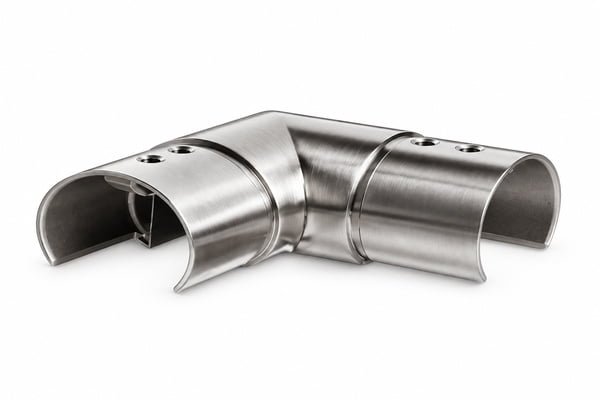
Catalogue illustration: Horizontal Corner Connector for Round Slotted Handrail. Shown as a component reference, not an installation drawing or test result.
A practical first-article review
- Check the drawing revision against the purchase order.
- Record the finish process and batch reference.
- Measure the nominated interfaces after finishing.
- Assemble the parts using the specified method.
- Check that covers seat and tools reach the fasteners.
- Retain the accepted sample and inspection record.
Use measurement traceability principles when deciding how inspection equipment will be controlled. A reading without a method, datum or instrument reference is difficult to compare between factories. For larger orders, agree an acceptance sampling approach rather than inspecting whichever carton happens to be open.
Before requesting custom hardware production, also review installation tool access. A coating-related fit change may become visible only when the complete assembly is installed near a wall.
Manage changes after approval
A new coating subcontractor, masking method or polishing sequence should trigger a review of the affected interfaces. Keep finish batch identification with the product lot; GS1 traceability guidance offers a general framework for linking such records. Avoid mixing visually similar covers from different revisions in a single spare-parts bin.
For a multi-finish order, create a matrix with one row per part and one column per finish. Mark whether the interface dimension is unchanged, separately inspected or controlled by a different drawing. This avoids the common assumption that the polished sample also approves a coated variant. If the supplier proposes masking a thread, request a drawing note showing the masked extent and the acceptance condition at the transition. Retain photographs of that transition with the sample record.
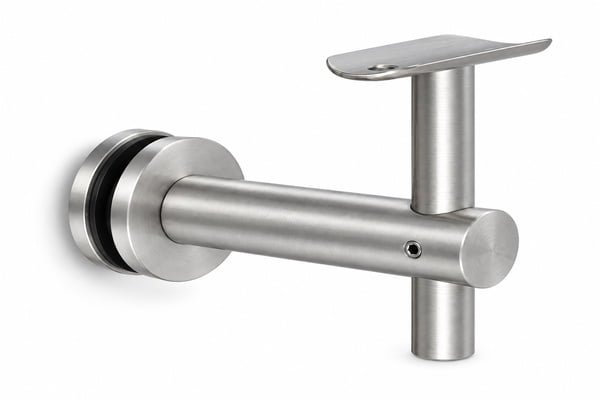
Catalogue illustration: Matte Silver Straight-arm Glass-mounted Handrail Bracket. Shown as a component reference, not an installation drawing or test result.
Questions procurement teams ask
Can one colour sample approve the whole order? It can approve appearance within agreed conditions, but it does not establish finished dimensions or assembly compatibility.
Should every surface be coated? Only according to the approved finish drawing. Functional surfaces may need masking or a different treatment.
Does a finish certificate prove railing performance? No. Conformity assessment concerns the particular requirement assessed; a finish record is not a complete railing load report.
Review the published manufacturing capabilities, then send the component drawing and finish schedule. Include quantity by finish, mating-part references and the proposed acceptance method so quotations cover the same scope.