A laminated glass clamp order needs the complete glass build-up, the matching gasket and retention arrangement, and evidence for the assembled railing. Total thickness alone does not establish compatibility. This specification guide is for importers coordinating separate glass and hardware suppliers.
Start with the glass schedule
Write each glass ply and the interlayer separately. For example, 6 mm glass + 1.52 mm interlayer + 6 mm glass gives a nominal 13.52 mm build-up. This is an arithmetic example, not a recommended railing specification. It cannot automatically replace a clamp designation for 12 mm monolithic glass. The actual thickness tolerance and interlayer type still matter.
The Kuraray interlayer overview identifies different laminated-glass interlayer families. Product-specific engineering documentation must determine their suitability. Use our glass balustrade hardware range to identify candidate components, then compare them with the project glass schedule.
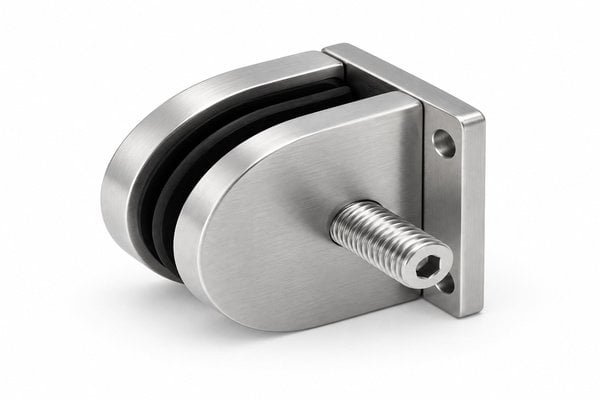
Catalogue illustration: Flanged D-shaped Glass Clamp. Shown as a component reference, not an installation drawing or test result.
What belongs on the purchase specification?
| Field | Useful purchasing entry | Common omission |
|---|---|---|
| Glass | Ply thicknesses, treatment and interlayer identity | Only stating total thickness |
| Clamp | Model, mounting orientation and drawing revision | Selecting by appearance |
| Gasket | Part code, profile and supported glass build-up | Describing it only as rubber |
| Retention | Approved pin or other retention arrangement | Assuming friction is sufficient |
| Evidence | Test configuration and applicable design review | Accepting an unrelated report |
Our gasket comparison helps frame material questions, but gasket profile and compression cannot be inferred from a material name. The Parker elastomer handbook is useful background for discussing elastomers; it is not approval for a particular glass-clamp gasket.
Coordinate the holes before glass production
If the assembly uses a retention pin, its geometry must match the approved glass fabrication drawing. Keep hole position, edge distance and drawing revision together. Do not plan to drill finished tempered glass on site; the CPSC tempered-glass alert explains the relevant safety issue.
Ask the glass processor to acknowledge the exact revision, and send the same document to the hardware supplier. A pin diameter without its position and tolerances is an incomplete instruction. Our safety-pin specification guide explains the information needed for that interface.
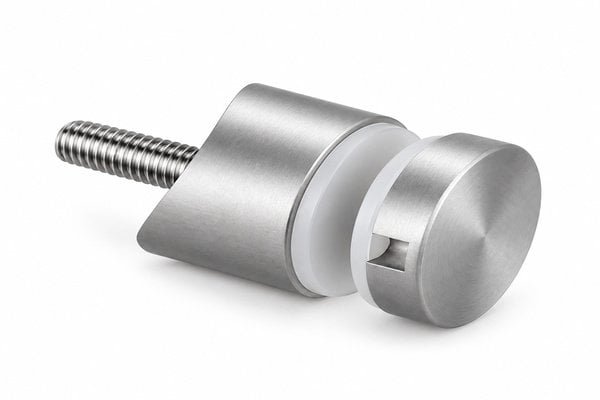
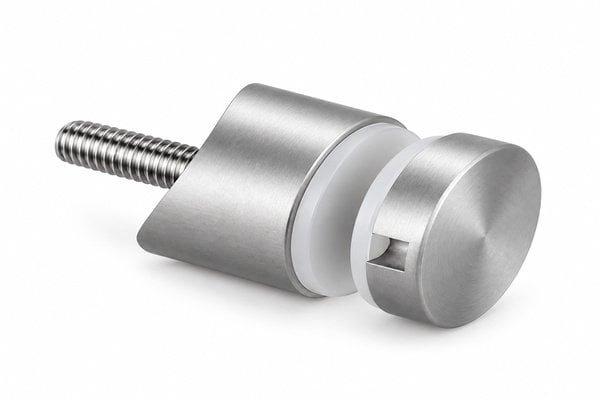
Catalogue illustration: Matte Silver Stepped-cap Cylindrical Glass Standoff. Shown as a component reference, not an installation drawing or test result.
Evaluate the complete assembly
A component catalogue does not establish the performance of the assembled barrier. Review the glass, clamp spacing, post arrangement, fixings and boundary conditions together. AGWA’s discussion of glass selection and the scope of ASTM E2353 provide external context. The responsible designer must determine which requirements apply to the actual project and jurisdiction.
Use the railing test-report checklist to compare the reported configuration with the order. Ask whether any post-breakage assessment required for the project covers the proposed glass build-up. A report for a different interlayer or support arrangement needs a documented applicability review, not a salesperson’s assumption.
Approve a sample set, not a loose clamp
Request one identified assembly containing the clamp, gaskets, retention parts and fixing instructions. Record measured interfaces with suitable equipment; NIST traceability guidance explains the measurement principle. Photograph the labelled components and retain the approved reference separately from saleable stock.
For a revised design, use our drawing-based development service. Include the glass schedule with the enquiry so the sample discussion addresses the actual interface. The manufacturing capabilities page describes the available process scope, rather than evidence that this particular assembly has passed a project test.
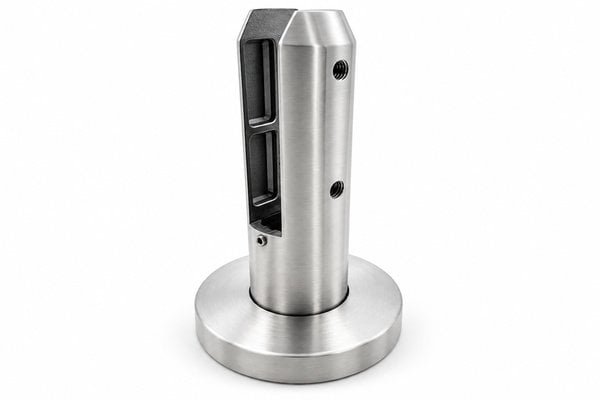
Catalogue illustration: Round-base Glass Spigot with Rectangular Pads. Shown as a component reference, not an installation drawing or test result.
Receiving and release checklist
Check carton identification against the accepted model and revision. Keep gasket sets in labelled bags. Ask the supplier to protect mating faces and separate metal components from glass-contact materials. ISTA procedures offer a framework for specifying appropriate packaging evaluation.
Before release, record who reviewed dimensional conformity, glass compatibility and project evidence. These are separate decisions. NIST’s conformity-assessment explanation helps distinguish inspection, testing and certification rather than treating the terms as interchangeable.
Can one clamp serve several laminate thicknesses? Only within its documented combinations of glass and gasket sets. A similar fit during an informal trial is insufficient.
What should a distributor stock? Stock complete, clearly coded combinations, with replacement gaskets tied to the same model. Avoid mixing visually similar loose inserts.
For a quotation, send the glass build-up and assembly drawing, clamp quantities, finish and destination. A complete input package makes the supplier’s response easier to compare and reduces changes after glass fabrication starts.