Compare glass railing hardware quotes using the same completed railing length and the same component schedule. Dividing a supplier’s headline total by metres is meaningful only after corners, end conditions, fasteners, packing and delivery scope have been aligned. This worked buying exercise is for importers and quantity surveyors; the figures are illustrative, not Elim prices.
Start with one common bill of materials
Take a hypothetical 20-metre railing package. Record straight runs, changes of direction, ends, transitions and any gates separately. Keep glass, installation and engineering outside a hardware-only comparison unless every bidder includes them. Our glass balustrade range shows the component families that may need separate lines.
A spigot, clamp and standoff are not interchangeable units in a price spreadsheet. Read the spigot-versus-standoff procurement guide before mixing alternative systems in one cost column. Alternatives can still be compared, but their quantities and scope must reflect their own coordinated designs.
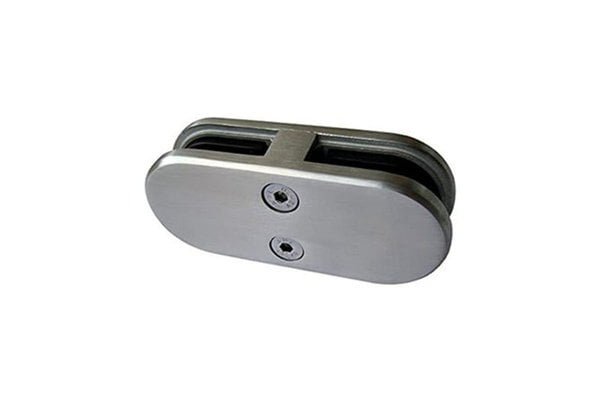
Catalogue illustration: Complete inline glass-to-glass connector clamp. Shown as a component reference, not an installation drawing or test result.
A simple cost-per-metre example
| Illustrative cost item | Supplier A | Supplier B |
|---|---|---|
| Scheduled hardware | 1,000 currency units | 920 currency units |
| Omitted fittings added back | 0 | 120 |
| Agreed protective packaging | 80 | 90 |
| Comparable delivery allowance | 120 | 130 |
| Comparable package total | 1,200 | 1,260 |
| Total divided by 20 metres | 60 per metre | 63 per metre |
Supplier B’s starting price is lower, yet its completed comparison is higher. This arithmetic does not predict market prices or installation costs. It shows why a purchasing sheet needs an “included, excluded, or provisional” column beside every line.
Use a consistent currency and conversion date. State whether tax, duties and insurance are included. Avoid mixing a delivered quote with an ex-factory quote simply because both totals are labelled “hardware.”
Price the difficult interfaces separately
Corners and short return panels can change the number of connectors without changing the total length very much. Use our standard and custom corner comparison to identify which junctions require special review. Ask bidders to price each special interface as a named line rather than distribute it invisibly across straight-run components.
The CRL glass-fitting catalogue offers a useful example of model-specific component distinctions. Its product details are not an Elim specification. Likewise, review IMOA’s coastal guidance when exposure changes the material discussion, rather than assuming every silver-looking finish is equivalent.
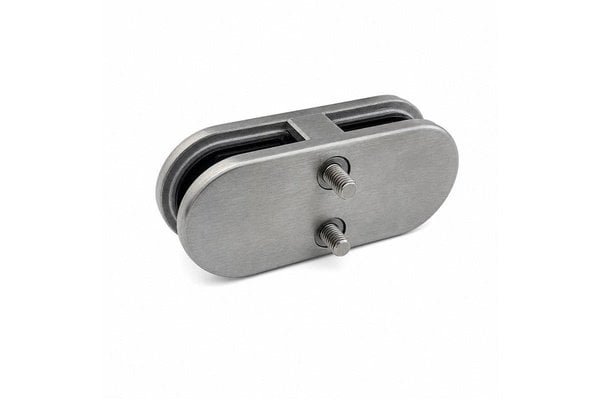
Catalogue illustration: Inline glass connector clamp viewed at an angle. Shown as a component reference, not an installation drawing or test result.
Do not hide packaging and inspection costs
Our glass railing hardware packaging guide explains why finish protection affects the usable quantity received. Ask for the unit pack, carton count and replacement policy in the quotation. ISTA’s packaging-test overview can help frame a transport-validation request, but a reference to ISTA alone is not proof that a package was tested.
For international orders, Trade.gov’s export-document guide is a starting point for discussing documents with the logistics team. Confirm the actual shipment requirements separately. Inspection charges should also specify what is being checked, by whom and with which records; NIST’s traceability policy provides background on measurement traceability.
Build a transparent comparison worksheet
Add five columns: drawing revision, quantity, unit, inclusion status and quoted amount. Give each bidder the same worksheet. Where quantities remain provisional, show that uncertainty explicitly instead of treating the lowest estimate as an agreed saving.
Keep safety and fixing evidence in a separate approval field. The CPSC tempered-glass guidance and Hilti technical-guide library are background references for those conversations, not substitutes for reviewing the proposed assembly. Use GS1’s traceability framework when specifying how approved component codes travel into delivery records.
Keep a separate risk note for each provisional line. For example, an unresolved corner fitting should name the drawing decision that will fix its price. This makes a later variation traceable and allows purchasing to distinguish a genuine scope change from an omitted item.

Catalogue illustration: Glass-to-glass connector clamp fixing detail. Shown as a component reference, not an installation drawing or test result.
When should a buyer choose the higher quote?
A higher comparable price may be justified by a complete scope, fewer provisional items or a clearer replacement arrangement. Record the reason instead of awarding points for unsupported quality claims. Conversely, a lower complete quote can be competitive without requiring an invented explanation for the difference.
Should installation waste be a fixed percentage? Use the project’s component schedule and agreed spare quantities; do not apply an arbitrary allowance to every item.
Can custom parts be priced per metre? They can be included in the final average, but keep their individual quantities visible. Request OEM review, examine the proposed manufacturing route, and send the comparison schedule for a quotation that can be checked line by line.