
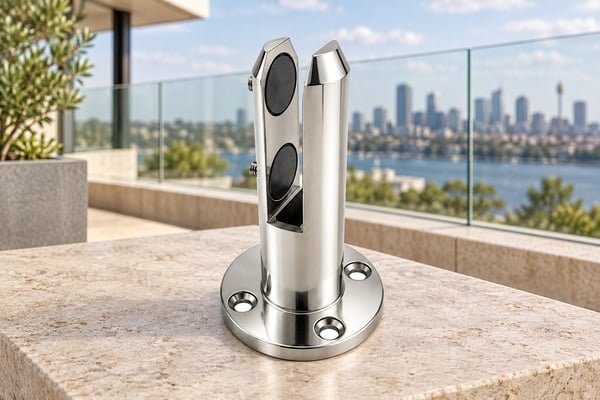
Quick answer — glass spigots vs standoffs: Choose between glass spigots and standoffs by the glass preparation and structural fixing required. Spigots clamp near the panel base; standoffs connect at individual points. For B2B quotations, compare the complete installed assembly, including glass processing, liners, anchors and access, rather than the visible metal component alone.
For B2B buyers comparing glass balustrade hardware, these checks turn the catalogue shortlist into a complete purchasing specification.
Compare the connection before comparing the quotation
| Procurement question | Spigot arrangement | Standoff arrangement |
|---|---|---|
| Where is the fixing? | Commonly at the panel base | At specified points on the panel |
| What needs coordination? | Clamp, liner, base and substrate | Glass hole, spacer, cap and substrate |
| Which drawing matters? | Base fixing and glass seating | Hole pattern and point-fixing assembly |
| What can change cost? | Anchors, covers and installation access | Glass processing, backing and access |
These are comparison prompts, not interchangeable engineering details. The AGWA notice on AS 1288 identifies an Australian glass-selection framework; the applicable project requirements still need confirmation. Separately, the CPSC tempered-glass safety alert provides safety context, not a load approval for either hardware option.
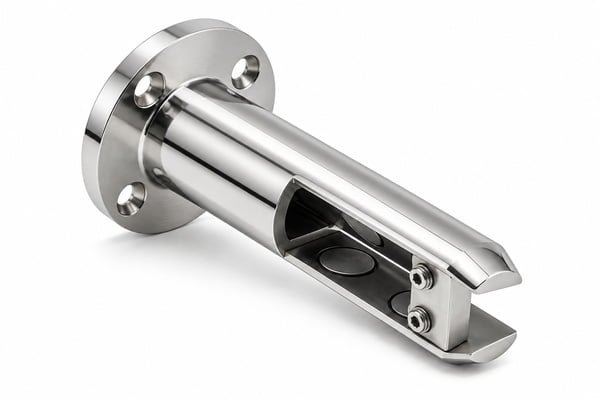
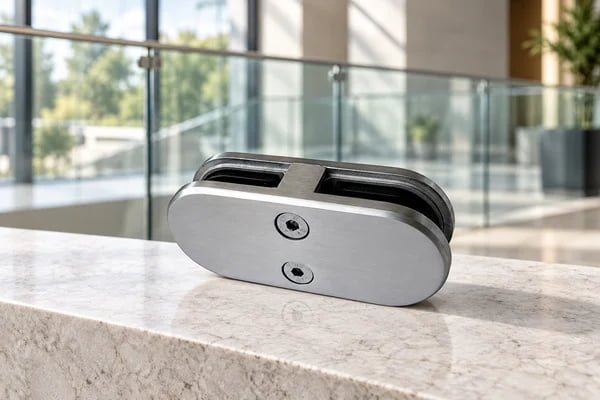
Catalogue reference: Reflective Silver Round-base Glass Spigot with Circular Pads. Appearance does not establish dimensions or performance.
Option A: review a spigot as an assembly
Elim catalogue comparison: The round-base spigot and stepped-cap standoff linked in this article represent different connection families in Elim’s catalogue. Their finish descriptions identify appearance; they do not establish equal anchorage or guard performance. Catalogue references: round-base glass spigot.
Buying decision: Price one identical panel layout two ways. Add hardware, glass processing, anchors and installation labour to each quotation. Choose the lower complete cost only after both arrangements satisfy the project design; a cheaper fitting can produce a more expensive installation.
Record the substrate, available edge distance, waterproofing and access for tightening. Use the project engineer’s fixing schedule rather than assuming a stainless body validates the anchorage. Hilti’s technical-guide library illustrates why anchor selection belongs to the specific substrate and fastening system.
Can a 12 mm glass spigot also serve as a balcony guard?
Not automatically. CRL’s FWCR12PS is a useful counterexample: its published specification identifies 12 mm tempered glass and duplex 2205 stainless steel, but excludes guard-rail applications. Those are CRL product facts, not Elim ratings.
| Selection field | What this example demonstrates |
|---|---|
| Glass thickness | 12 mm is a specific compatibility value |
| Material | Duplex 2205 is a grade, not a finish name |
| Intended use | A glass-clamping component can still exclude guards |
For an Elim spigot-versus-standoff enquiry, separate a ground-level screen from a fall-protection balustrade. Put the intended use beside the panel thickness in the first quotation line. A visually similar component with the right glass thickness is not necessarily an acceptable substitute.
Source: CRL FWCR12PS product specification. Reference checked 27 September 2026.
Request a matched quotation: Send the panel thickness, screen or guard application, and mounting sketch for an itemized spigot-versus-standoff quotation..
Option B: review the complete standoff interface
For a cylindrical glass standoff, request the full assembly rather than ordering a cap by diameter alone. Identify the spacer, bolt, washer, isolation components and supporting connection. Match the approved glass preparation to the exact assembly revision.
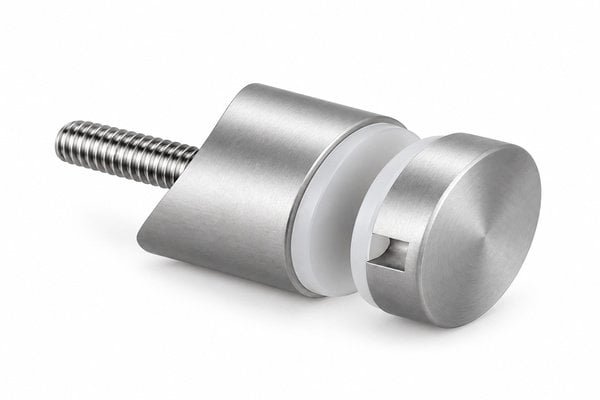
Catalogue reference: Matte Silver Stepped-cap Cylindrical Glass Standoff. Appearance does not establish dimensions or performance.
Compare lifetime requirements, not just finish names
Specify the environment, cleaning access and material grade separately from the colour. ASSDA’s tea-staining guidance and IMOA’s coastal-exposure discussion show why exposure and surface condition matter. Neither source certifies the corrosion performance of the pictured Elim models.
Require a finish reference that purchasing, production and inspection can all identify. Include visible-face expectations and how protected surfaces will be handled on site. ASSDA’s exterior-cleaning guidance can support maintenance planning without turning one cleaning schedule into a universal promise.
For a practical approval sequence, combine the interface review with the distributor buying guide. Use drawing-based OEM development when the standard connection cannot satisfy the agreed geometry. Customization should produce a controlled drawing, not an informal note attached to a product photo.
Put both suppliers on the same quotation basis
Request separate lines for hardware, liners, fasteners, glass preparation, packing and inspection. Identify exclusions explicitly. Consult ISTA’s procedure overview when selecting distribution testing and Trade.gov’s export-document guide when coordinating shipment records.
As an illustrative comparison, quote the same 20-panel layout to both suppliers, with the same drawing revision and delivery destination. Do not assume either layout needs a particular number of supports until the project design establishes it. This keeps the commercial comparison useful without inventing a structural rule.
Continue the same project: Ordering Glass Clamps in Bulk: Glass Thickness, Gaskets and Mounting Compatibility covers the next related purchasing decision in this system.
Buyer questions
Can a standoff replace a spigot on an existing drawing? Not as a simple purchasing substitution. The glass preparation, support conditions and installation method may change and require design review.
Does 316 stainless steel make either option suitable for every site? No. Grade is only one part of exposure, geometry, maintenance and system selection.
What should accompany the enquiry? Send the panel layout, glass specification, substrate, interface drawings, finish reference, quantities and destination through the project quotation form. Ask for an itemized assembly proposal with a clear revision number.
Comments (4)