Choose glass-to-glass or wall-mounted shower hinges from the support arrangement of the entire enclosure. A wall-mounted hinge connects to an appropriate wall support; a glass-to-glass hinge relies on the supporting glass arrangement. Neither category is a universal upgrade over the other.
This decision guide is for distributors selecting shower hardware for different project layouts. It keeps support, templates and installation access ahead of finish selection.
Route A: the door is supported from the wall
Identify the substrate, fixing positions and available plate footprint. The wall finish alone does not establish a suitable support. Our wall-to-glass hinge guide explains the information buyers should obtain before approving a model.
Check the actual mounting instructions and the permitted door configuration. A familiar hinge body can be offered with several wall-side plates, so the full model code belongs on the purchase order.
Route B: the door is supported from glass
Identify how the fixed panel itself is supported and how the hinge connects to it. CRL’s 90-degree hinge example and 135-degree hinge example illustrate model-specific arrangements. Their names do not establish suitability for another manufacturer’s enclosure.
The CRL shower hardware catalogue is a broader reference for component families. Use the exact selected model’s drawing and limits, including the glass preparation and intended geometry.
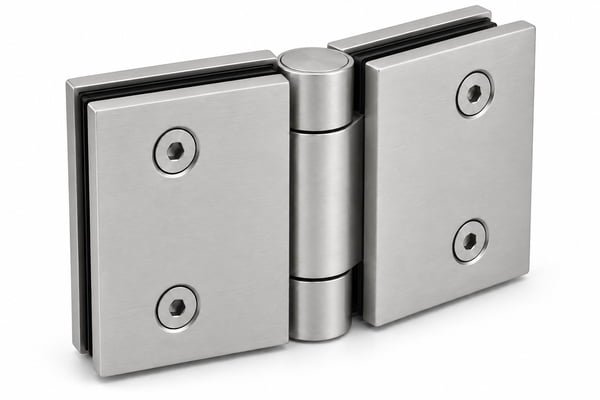
Catalogue illustration: Matte Silver 90 Degree Glass-to-Glass Shower Door Hinge — Finish Concept. Shown as a component reference, not an installation drawing or test result.
| Decision field | Wall-mounted | Glass-to-glass |
|---|---|---|
| Supporting interface | Wall and approved fixing | Supporting panel and its system |
| Preparation | Wall fixing plus door template | Door and supporting-panel templates |
| Space review | Plate and tool access | Panel relationship and hinge clearance |
| Supply record | Exact wall-side configuration | Exact angle and configuration |
Check the opening, not just the closed view
Draw the required movement and the relationship to adjacent panels, handles and seals. Our hinge offset guide helps explain alignment issues. The CRL shower hardware FAQ provides manufacturer context; it is not a substitute for the chosen model’s instructions.
Check whether the installer can reach the necessary fasteners in the proposed arrangement. A connection that fits in the final drawing can still be difficult to assemble if another panel blocks the tool path.
Keep the glass templates controlled
Use our glass cutout revision guide to connect each panel to the correct template. Do not describe two hinges as interchangeable solely because their plates are similarly sized. The CPSC glass safety alert provides useful safety context for the glass discussion.
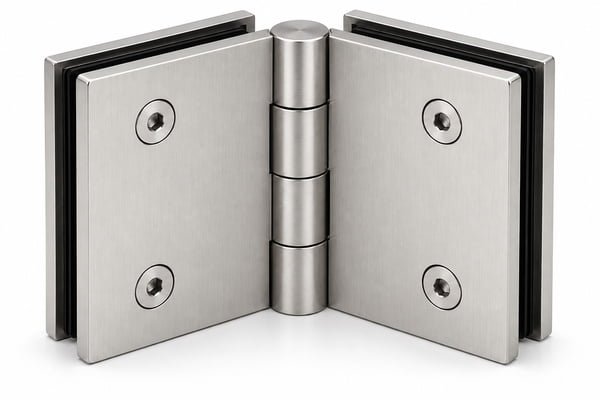
Catalogue illustration: 135 Degree Glass-to-Glass Shower Door Hinge. Shown as a component reference, not an installation drawing or test result.
If the layout changes from wall-mounted to glass-supported, review the complete enclosure rather than replacing only the hinge code. Glass preparation, fixed-panel support and installation sequence may also change. Record the approved revision before ordering glass or releasing hardware.
For a non-standard interface, submit the layout through OEM/ODM development. Include the proposed support arrangement, panel details and quantities so the supplier can identify what requires review.
Match the project requirements
Where accessibility provisions apply, the US Access Board bathing-room guide provides a scoped US reference. The local project requirements still govern. Hardware selection should preserve required clearances and operation in the completed enclosure.
Agree the dimensional sample checks. NIST measurement traceability guidance helps structure a reliable record. Review the relevant manufacturing capabilities, and distinguish a fit sample from functional testing. The NIST conformity assessment overview explains why these evidence types should be described separately.
For mixed project orders, group the packing list by enclosure type and repeat the hinge configuration beside each quantity. Include the correct template reference for each group. Ask receiving staff to verify one identified kit against the schedule before distributing it to installers. This reduces picking errors without treating a visual check as a substitute for technical acceptance.
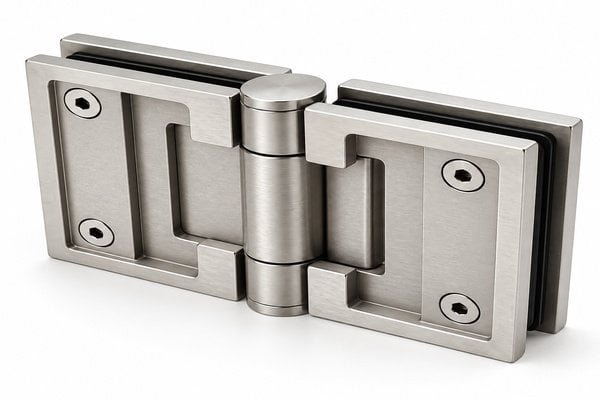
Catalogue illustration: Heavy-Duty Shower Door Hinge. Shown as a component reference, not an installation drawing or test result.
Build a stock range that installers can identify
Separate model codes by support arrangement, angle, plate configuration and finish. Store the correct template with each code. A picking photograph is helpful, but it should support the code rather than replace it.
Which is stronger? The category name alone cannot answer that. Compare the documented complete configuration and its application limits.
Can we change the type after glass fabrication? Only after checking the existing preparation and the revised enclosure design; do not assume reuse is possible.
What belongs in the RFQ? Layout, supporting structure, glass specification, movement requirements and quantities. Send that information so the quotation covers a coordinated enclosure arrangement instead of an isolated hinge shape.