Choose round or square shower support bars as complete systems with compatible end fittings, not as interchangeable lengths of metal. Profile dimensions, wall thickness, connector engagement and the approved enclosure layout determine the actual assembly.
For wholesalers selecting shower systems, the useful comparison is between complete bar-and-connector kits. Appearance matters, but it should not hide differences in stock, cutting and installation requirements.
Compare the whole kit
A manufacturer’s support-bar range and shower hardware catalogue can identify available configurations. Check the exact system documentation rather than transferring a dimension from a similar-looking product.
| Selection factor | Round profile | Square profile |
|---|---|---|
| Basic section description | Diameter and wall thickness | Side dimensions and wall thickness |
| Connector interface | Selected round-system fit | Selected square-system fit |
| Visual coordination | Curved profile language | Rectangular profile language |
| Cutting requirement | Approved length and end preparation | Approved length, orientation and end preparation |
| Stock control | Dedicated compatible kit codes | Dedicated compatible kit codes |
Neither shape is automatically stronger or more suitable. The actual section, material, connections and application determine performance.
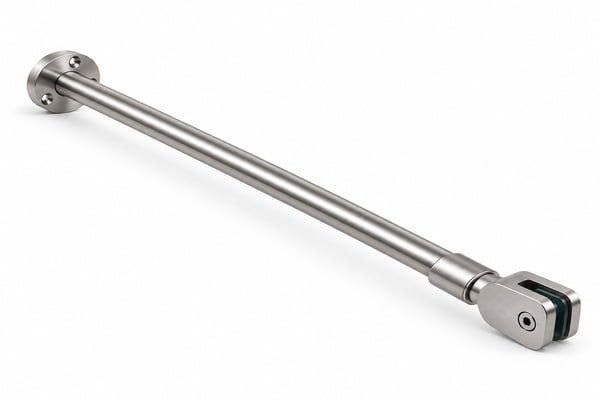
Catalogue illustration: Complete glass-to-wall shower support bar with both end fittings. Shown as a component reference, not an installation drawing or test result.
Define the length correctly
Our support-bar length guide explains why overall bar length and installed distance can differ. The connector engagement and adjustment arrangement affect the cut schedule. Ask which dimension the supplier quotes and which reference faces define the installation.
Do not assume the entire visible connector length contributes to usable engagement. Request the assembled section and approved cutting instructions. Any site cutting should preserve the required end condition and finish treatment.
Match the connector family
A fixed end, swivel end and ceiling connection can have different geometry and intended uses. The fixed and swivel connector guide discusses that distinction. A matching finish is not evidence that connectors from two ranges fit the same bar.
A glass-clamp catalogue shows another component family in the enclosure. A clamp or glass fitting should not be assigned a support-bar function unless the selected system documentation supports it.
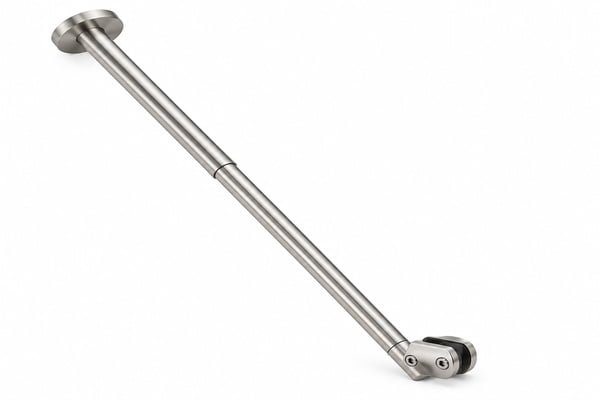
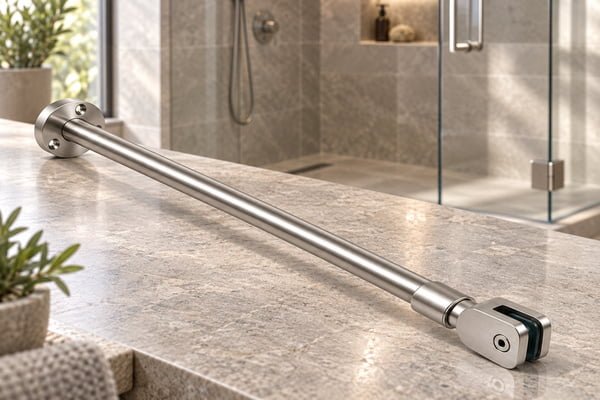
Catalogue illustration: Adjustable Glass-to-Ceiling Shower Support Bar. Shown as a component reference, not an installation drawing or test result.
Coordinate the glass and support layout
Identify the glass construction and the approved connection locations. The CPSC glass alert provides safety background, while ASTM C1048 is a reference for specified heat-treated flat glass. Neither supplies a universal layout or support-bar load rating.
Use the complete enclosure design to establish where support is needed. The bar’s profile shape alone cannot determine whether it is suitable for the panel size, mounting arrangement or intended use.
Inspect the interface dimensions
Record the profile dimensions and connector fit requirements from the approved drawing. For square sections, include any corner geometry that affects engagement. For round sections, distinguish the specified diameter from an informal fit check with one connector.
NIST traceability guidance supports meaningful measurement records. Use an agreed sampling plan for incoming inspection. A kit that assembles once should not be treated as proof that every profile and connector in a mixed shipment is compatible.
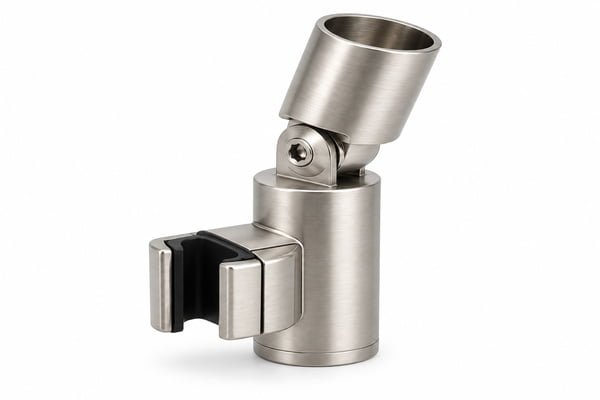
Catalogue illustration: Adjustable Shower Support Bar Bracket. Shown as a component reference, not an installation drawing or test result.
Plan a practical wholesale range
Keep round and square kits separately identified, with compatible replacement ends and clear instructions. Avoid selling an unlabelled universal accessories pack when the parts belong to distinct systems.
The mockup guide can help establish a representative sample for each kit. Check fastener access, connector orientation and the intended appearance before releasing photography and sales descriptions. The display sample should represent the actual supplied configuration.
Ask the supplier to define the available standard lengths, cut-to-size scope and replacement-part policy. Do not create catalogue sizes from market conventions unless the supplier confirms that those options are actually offered.
Buyer questions
Can a round bar be replaced with a square one on site? Only after reviewing the complete connection and support arrangement. It is not merely a decorative substitution.
Can spare ends be shared between systems? Only where the manufacturer explicitly identifies compatibility. Similar nominal dimensions are insufficient.
Which shape is best for a distributor? The one that matches the target enclosure range, documented specifications and service-stock strategy. Some ranges justify both, with clear separate kit identities.
Use the manufacturer’s technical FAQ for model-specific questions. Submit special layouts through OEM review, check manufacturing capabilities, and request complete-kit pricing by profile, finish and length. This produces a clearer commercial comparison than a price per bare bar.