Choose fixed or swivel shower support bar connectors from the approved geometry and assembly requirements. A swivel fitting can provide a defined adjustment range, but it is not a universal solution to misalignment. Fixed fittings also require the correct bar, glass and mounting interfaces. This comparison is for distributors and enclosure fabricators.
Start with the connection path
Identify what the bar connects: wall to glass, glass to glass, or another documented arrangement. Browse the shower system components and request the complete assembly drawing. The CRL support-bar range shows examples of fixed, adjustable and swivelling fittings with different applications.
Our support-bar length and mounting guide explains why the nominal bar length is only one input. Add the end-fitting geometry, engagement and installation access. Do not order a long bar and assume any two end fittings can be combined with it.
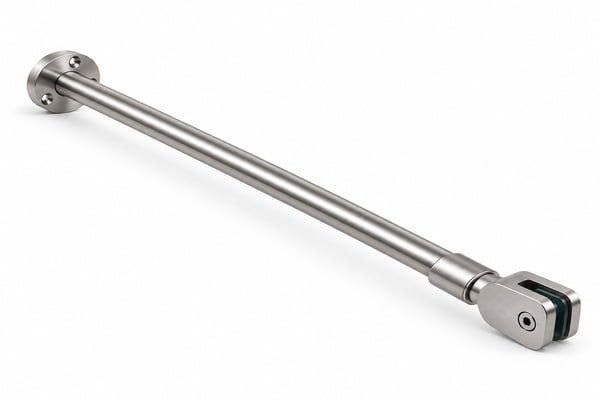
Catalogue illustration: Complete glass-to-wall shower support bar with both end fittings. Shown as a component reference, not an installation drawing or test result.
Compare the two approaches
| Question | Fixed connector | Swivel connector |
|---|---|---|
| Geometry | Match the stated angle and orientation | Match the documented adjustment range |
| Bar interface | Confirm profile and engagement | Confirm profile and engagement |
| Locking | Follow the specified securing method | Confirm how the selected position is secured |
| Glass interface | Match preparation and contact parts | Match preparation and contact parts |
| Access | Allow installation and inspection space | Allow adjustment and locking-tool space |
The CRL shower catalogue and technical FAQ provide manufacturer-specific context. They do not approve an assembly made from unrelated components. A familiar product family name is not enough to establish compatibility across different bar profiles or fitting versions.
Adjustment has boundaries
A swivel range should be stated with its reference direction and any relevant limitations. Do not infer it by rotating a loose display sample. The installed fitting may have engagement, locking or access requirements that are not obvious before assembly.
For an illustrative comparison, a project drawing can show the required bar line and the available mounting faces without assigning an unverified angle. Ask the supplier to identify a documented fitting combination that matches those conditions. If it cannot, revise the layout rather than forcing the connector beyond its intended range.
Protect the glass interface
Identify glass thickness, any required holes or notches, and the specified gaskets or contact components. The CPSC tempered-glass alert is important if an alternative fitting would require changes to finished glass. Resolve the preparation before the glass order is finalised.
Our U-channel-versus-clamp guide discusses another fixed-panel support decision. A support bar should be reviewed as part of the complete enclosure arrangement, not treated as an independent cure for an unsuitable panel-support detail.
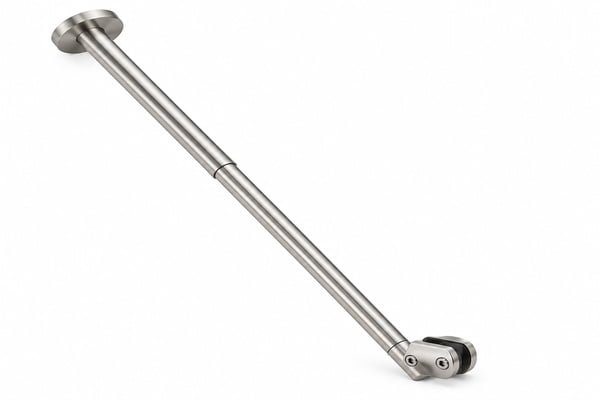
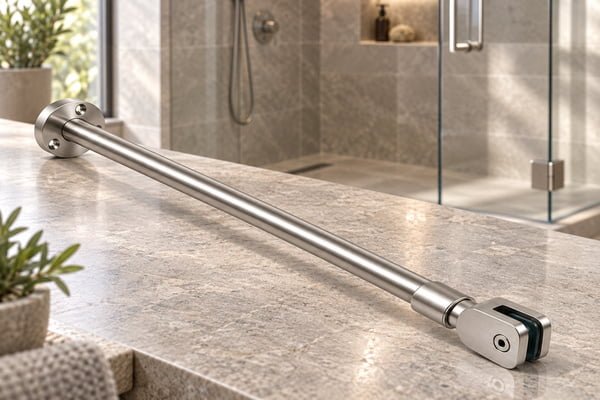
Catalogue illustration: Adjustable Glass-to-Ceiling Shower Support Bar. Shown as a component reference, not an installation drawing or test result.
Check access and the user’s space
Review the bar and connectors against the door’s operating envelope and the intended use of the enclosure. Where accessibility requirements apply, use the relevant project rules; the US Access Board bathing-room guide is one jurisdiction-specific reference. Do not assume a tidy installation photograph demonstrates compliance.
Our hardware mockup guide helps organise a representative fit review. Include the actual connector, bar profile and tool access. Record whether the check covered geometry, appearance or another defined requirement so the mockup is not mistaken for a performance test.
Maintain the selected arrangement
Follow the complete assembly’s cleaning and maintenance instructions. ASSDA cleaning guidance offers context for stainless surfaces, but the fitting’s finish and mechanism may need specific care. Avoid introducing a lubricant or cleaner without checking its suitability for the assembly.
Record controlled dimensions using appropriate measurement traceability. Keep the approved drawing and fitting identifiers with the project handover, especially where a swivel position could later be altered during maintenance. Any adjustment should follow the documented procedure.
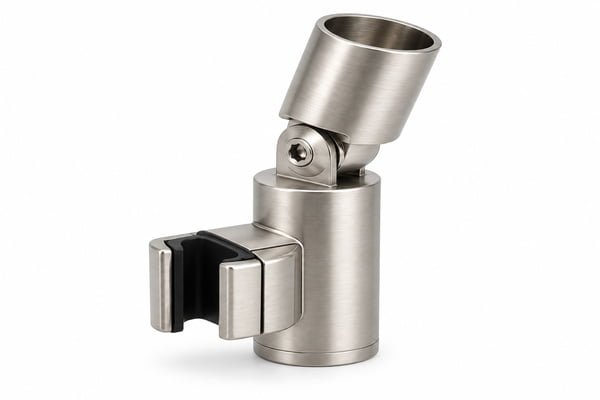
Catalogue illustration: Adjustable Shower Support Bar Bracket. Shown as a component reference, not an installation drawing or test result.
Buying questions
Is a swivel connector always more versatile? It may cover specified geometry, but the range, locking and compatible components still limit its use.
Can a fixed fitting be bent to fit? Do not introduce an unapproved modification. Request an appropriate component or revised detail.
Does a successful fit prove the support arrangement is adequate? No. NIST conformity-assessment guidance helps distinguish fit inspection from the required performance evidence.
Discuss special combinations through OEM enquiries, review manufacturing capabilities, and request a complete support-bar quotation. Include the enclosure drawing, glass preparation, bar profile and installation access. Compare usable assemblies rather than isolated connectors with similar finishes.