Quick answer: A2 and A4 are stainless fastener material groups, not complete strength specifications. A4 commonly offers better resistance in chloride exposure, but neither label guarantees suitability for every coastal, poolside or concealed connection. Specify the full fastener designation and the environment.
This buyer’s guide is for importers ordering screws, bolts and nuts with stainless railing systems. It separates the material decision from joint design so that a material upgrade does not accidentally introduce a different strength class or incompatible nut.
Read the full designation
Bossard’s stainless fastener reference distinguishes stainless groups and chemical composition. Procurement should preserve the complete designation supplied by the engineer, including the applicable mechanical property class and product standard. “Stainless bolt” is not an adequate purchase description.
Record diameter, pitch, length, head type, drive and nut type alongside grade. The material certificate checklist helps connect the delivered lot to the ordered specification. Decorative colour, magnet response and a supplier’s generic brochure are not substitutes for that identification.
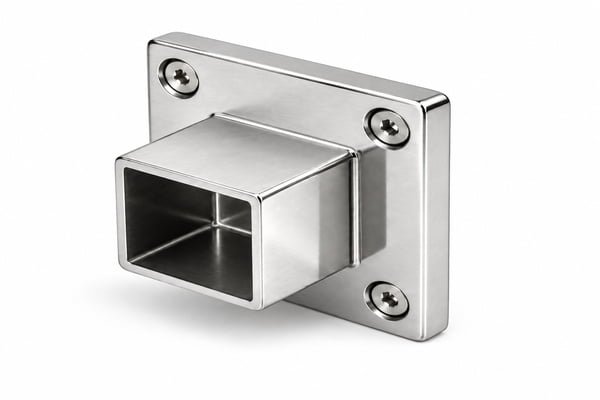
Catalogue illustration: Square Tube Wall Flange Connector — Reflective silver appearance concept. Shown as a component reference, not an installation drawing or test result.
Match the environment before comparing price
| Exposure question | Why it matters | Information to request |
|---|---|---|
| Indoor or exterior? | Wetting and contamination differ | Location and cleaning access |
| Coastal salt exposure? | Chlorides can concentrate | Distance, shelter and maintenance |
| Concealed washer joint? | Water may remain trapped | Drainage and interface detail |
| Dissimilar supporting metal? | Galvanic interaction is possible | Isolation arrangement |
| Aggressive cleaning chemicals? | Surface resistance may be affected | Cleaning product instructions |
IMOA’s coastal guidance is useful background for exposure assessment. A protected location can still collect salt without regular rain washing. ASSDA’s crevice corrosion explanation also shows why geometry matters alongside grade.
Avoid a partial material upgrade
Changing the visible bolt while leaving an unidentified nut and washer does not create a documented fastener set. List every item in the joint and review its function. For mixed-metal assemblies, use the stainless-to-aluminum connection guide and galvanic corrosion guidance to identify the interfaces requiring attention.
Isolation components must remain compatible with the structural joint. A soft washer selected only to separate metals may alter bearing behaviour or preload. Have the complete arrangement approved rather than adding accessories independently on site.
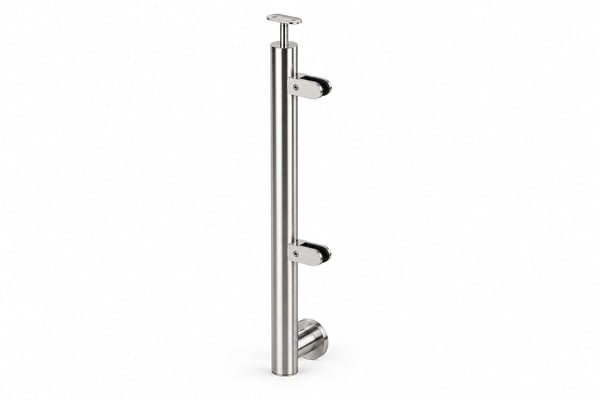
Catalogue illustration: Reflective Silver Side-mounted Glass Railing End Post. Shown as a component reference, not an installation drawing or test result.
Keep tightening instructions with the kit
A grade label does not provide a universal torque value. Friction, lubrication, geometry and mating materials influence tightening. ASSDA’s galling guidance addresses stainless thread seizure, while Bossard’s preload calculator demonstrates the inputs required for a fastening calculation.
The railing bracket fastener guide can help prepare the kit schedule. Include whether screws are supplied dry or treated, and preserve the approved assembly method. A distributor should not replace one lubricant with another without checking its effect on the specified tightening procedure.
For custom component orders, quote the fastener set as a controlled assembly rather than as a bag of unspecified accessories.
Receiving checklist for a distributor
Check package labels against the order; verify the required markings where applicable; compare certificates to the lot; inspect thread condition; and separate mixed deliveries before stocking. Keep inspection records connected to the actual cartons.
If identity is disputed, grade confirmation methods provide a basis for discussing appropriate testing. Choose the method with a qualified provider because different techniques answer different questions. GS1’s traceability standard supplies a general framework for preserving lot links through distribution.
Use a purchase schedule with separate columns for material group, property class, dimensions, finish and certificate requirement. Require the quotation to answer every column. If one bidder writes only A4 while another provides a full designation, the offers are not yet equivalent. Resolve that difference before comparing unit prices. Keep the approved schedule with the purchase order and use it again for replenishment, so a future buyer does not unintentionally simplify the specification to stainless steel.
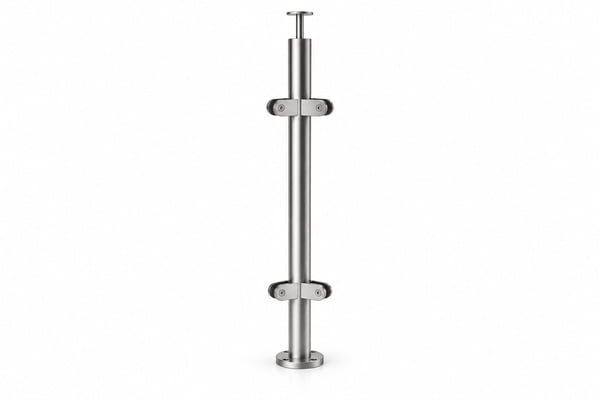
Catalogue illustration: Round Corner Glass Railing Post. Shown as a component reference, not an installation drawing or test result.
Common purchasing questions
Is A4 always the best choice? It may be appropriate for greater chloride resistance, but selection still depends on the environment, design and specification.
Can A4 replace A2 without review? Review the complete designation and joint requirements. Similar dimensions alone do not establish interchangeability.
Can fasteners be ordered separately later? Yes, provided the replacement specification retains the original dimensions, material and mechanical requirements. Keep the approved kit record accessible.
Review Elim’s manufacturing capabilities, then send a fastener schedule for quotation. Include the service environment and quantity by size so the offer can be evaluated on a consistent basis.