

Document check: A stainless steel material certificate is useful only when the buyer can connect it to the material and parts being shipped. Check the issuer, material designation, reported results, batch identification and traceability records. Keep material evidence separate from finished-product inspection and project performance evidence.
A realistic desk-audit scenario
An importer receives an attractive railing sample and a PDF labelled “material certificate.” The sample looks correct, but the PDF refers to a different material form and gives no connection to the purchase order. Accepting that document would leave the central question unanswered: what does it actually prove about this shipment?
Begin with the ordered stainless steel railing components. Identify which parts require material evidence and which evidence the contract specifies. A tube, a cast connector and a fastener may come through different supply chains. One certificate should not silently stand in for all three.
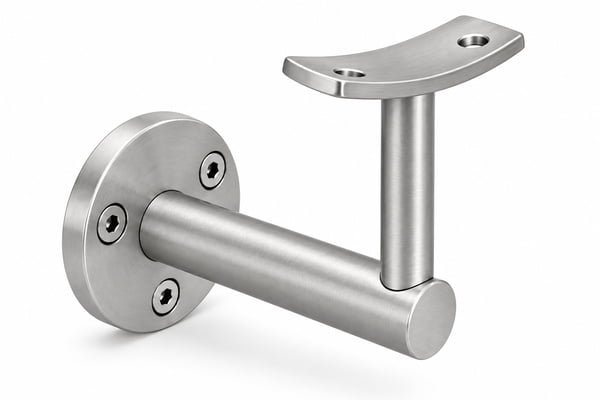
Catalogue illustration: Curved Saddle Wall Handrail Bracket — Matte silver appearance concept. Shown as a component reference, not an installation drawing or test result.
Five checks before document approval
1. Identify the document’s purpose
Distinguish a manufacturer’s material record, an independent test report, a company management-system certificate and a product assessment. They answer different questions. For example, Outokumpu’s certificate directory organizes certificates and approvals by facility; it should not be read as evidence for an unrelated supplier’s finished railing.
2. Match the material designation
Compare the purchase-order designation with the document, including any specified grade variant or governing material specification. ASSDA’s grade-confirmation guide is useful when planning identification checks. A finish description such as “brushed stainless” does not supply a material grade.
Use the railing finish-matching guide to keep appearance approval distinct from material acceptance. Both may be required, but neither substitutes for the other.
3. Follow the batch connection
Ask how material identification survives cutting, machining, polishing and packing. The evidence could include receiving records and production-batch references appropriate to the agreed traceability scope. Request the actual link to the order instead of a general assurance that all products are traceable.
| Record | Match against | Typical unresolved issue |
|---|---|---|
| Material document | Required designation and material form | Correct-looking PDF for another input |
| Production record | Supplier batch and ordered part | No connection after processing |
| Inspection record | Drawing revision and sample identity | Result attached to an obsolete drawing |
| Packing record | Carton labels and shipment | Different lots combined without identification |
4. Read the results and their scope
If testing was commissioned, identify the method, sample and stated limitations. NIST’s traceability policy helps distinguish measurement traceability from proof that a product is fit for purpose. A traceable measurement does not answer every performance question.
5. Resolve discrepancies before shipment
Give each discrepancy an owner and required response. Do not replace a missing report with a generic online data sheet. Such a sheet may explain a material, but it cannot document the supplied batch.
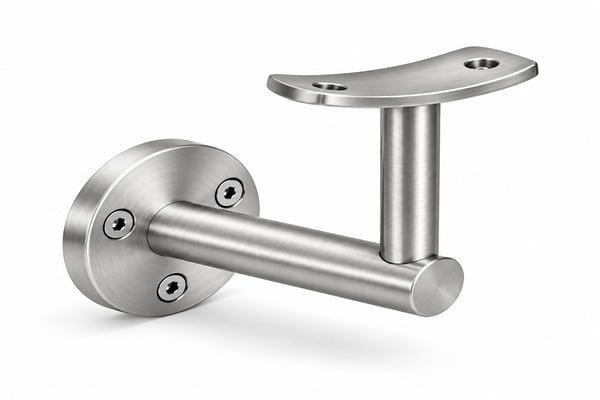
Catalogue illustration: Curved Saddle Wall Handrail Bracket — Fine-brushed silver appearance concept. Shown as a component reference, not an installation drawing or test result.
Keep product evidence in separate folders
Use the tube and connector matching article for dimensional-interface questions, and the welded versus mechanical guide for assembly questions. The material certificate does not establish the fit of those interfaces or the performance of an assembled railing.
ASSDA’s passivation guidance supports a separate surface-process discussion. IMOA’s coastal information helps describe the intended environment. Neither reference is a certificate for the shipment. Label supplier statements, sample observations and external technical background distinctly in the review record.
Ask about available manufacturing and inspection capabilities early enough to include the required deliverables in the quote. If additional testing or documentation has a cost or lead-time effect, it should be visible before order placement.
Close the loop with shipment records
Commercial paperwork should use consistent order, part and batch references. Trade.gov’s export-document overview provides logistics background, while GS1’s traceability standard offers a framework for recording relationships between identified items and events. Neither requires buyers to pretend a traceability system exists when it has not been established.
Agree packaging evaluation appropriate to the distribution route using ISTA’s procedure information. For custom parts, attach the accepted OEM/ODM specification to the release package so documentation follows the final design.
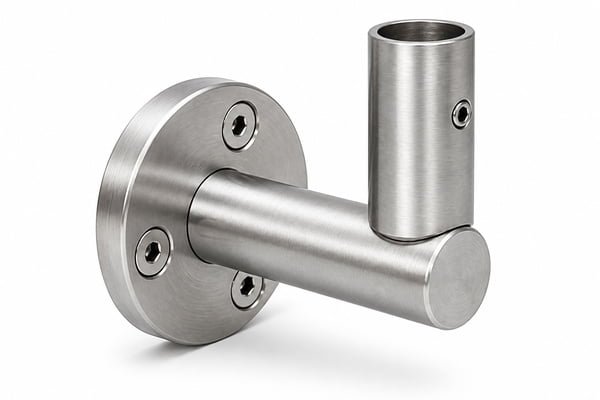
Catalogue illustration: Upright Socket Wall Handrail Bracket — Reference silver appearance. Shown as a component reference, not an installation drawing or test result.
Importer FAQ
Does a grade certificate prove railing capacity? No. Material identity and assembly performance are different evidence requirements.
Can public data fill a missing batch record? No. Public data provides context, not traceability to delivered parts.
What should be requested with the quote? A document list tied to the purchase specification. Send your required evidence schedule so Elim Hardware can review the scope before production planning.

Comments (2)