Choose the connection around the work: Welded and mechanical railing connections should be compared as complete fabrication, installation and maintenance arrangements. Welding can create a continuous assembly but requires controlled fabrication and finish restoration. Mechanical joints can simplify some site work, yet introduce mating tolerances, fasteners and inspection requirements.
This comparison is for contractors sourcing stainless steel railing systems. It does not assign a universal strength ranking. The responsible designer must approve the complete connection for its loads, geometry, environment and governing requirements before purchasing releases it.
Put both options on the same drawing
Show the same rail geometry, support locations and receiving construction. Identify which operations happen in the workshop and which happen on site. A comparison is misleading when one price includes finished assemblies while the other covers loose components only.
Catalogue items such as a tube flange connector or socket bracket illustrate mechanical interfaces, but their appearance does not establish structural approval. Use the tube and connector matching guide to collect the mating dimensions before requesting a proposal.
| Decision | Welded arrangement | Mechanical arrangement |
|---|---|---|
| Fabrication | Weld preparation, process and finishing | Machining, fit and fastener selection |
| Site access | Equipment and work controls may be needed | Tool access and assembly clearance matter |
| Appearance | Weld finishing must match adjacent surfaces | Joints and fixing heads may remain visible |
| Repair | Cutting or local fabrication may be necessary | Parts may be separable if access is preserved |
| Inspection | Approved weld and surface requirements | Approved fit, engagement and assembly checks |
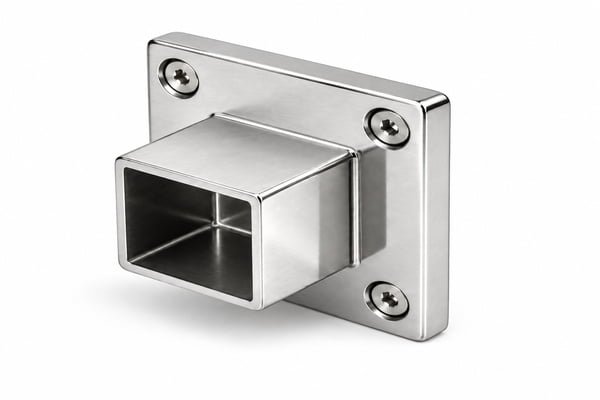
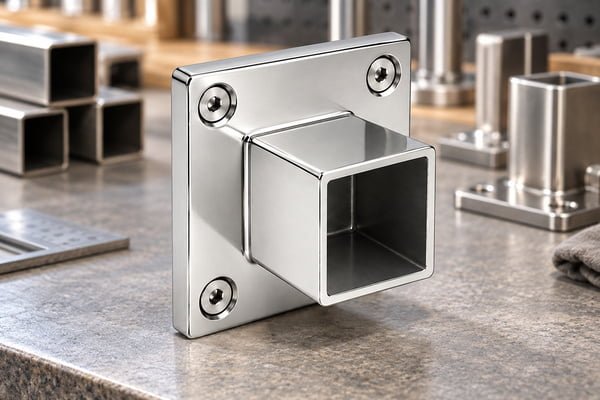
Product reference: Square Tube Wall Flange Connector — Reflective silver appearance concept. Match the supplied configuration to the approved drawing.
Price the labour that moves between locations
Imagine a quotation with $800 of workshop joining work and $300 of site finishing. A mechanical alternative has $500 of added fittings, $250 of workshop preparation and $450 of site assembly. The comparison is $1,100 versus $1,200 for those listed activities, not $800 versus $500. These are hypothetical figures, excluding design, transport and other project costs.
Ask each supplier to use the same scope table. Include protection, setting out, access equipment, rework allowance and inspection. Record exclusions explicitly. A lower fitting price may transfer work to the installer rather than reduce the complete installed cost.
Treat surface restoration as a defined operation
Stainless fabrication needs contamination control and appropriate finishing. ASSDA’s pickling and passivation guidance explains why surface treatment after fabrication is a technical decision, not simply a cosmetic polish. Specify the intended finish and the acceptance sample for the completed joint.
Use grade-confirmation guidance for material identity and coastal-exposure guidance for environmental selection. Neither is a substitute for a connection design. If the project uses mechanical stainless fasteners, address the risks described in ASSDA’s galling guidance before the assembly team improvises a lubricant or torque value.
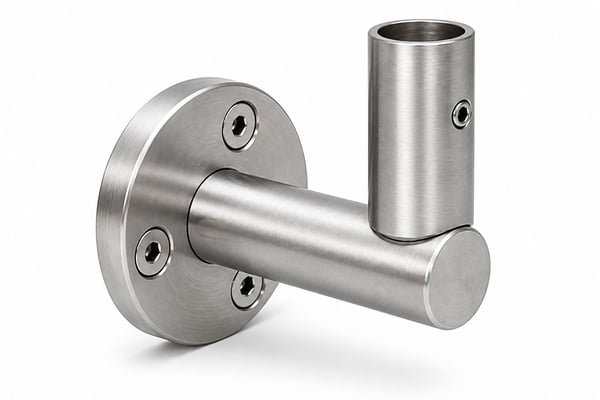
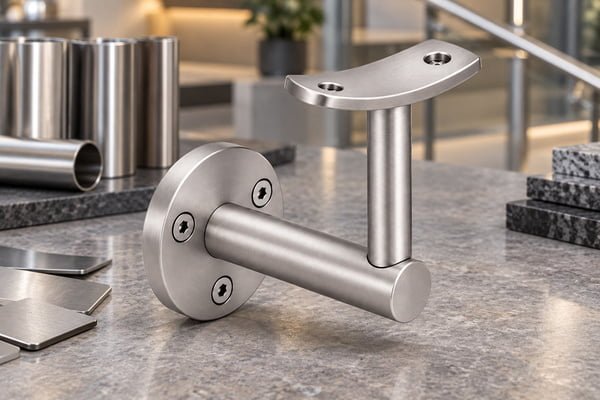
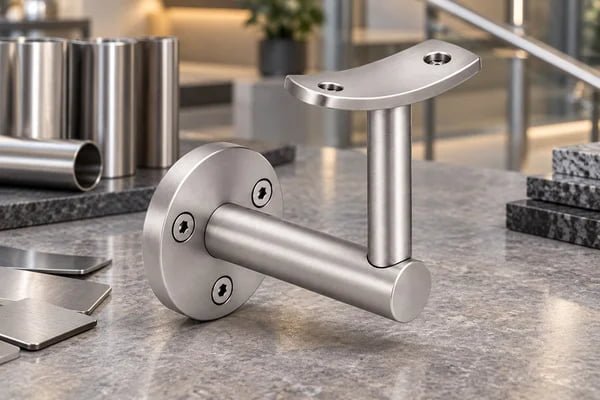
Product reference: Upright Socket Wall Handrail Bracket — Reference silver appearance. Match the supplied configuration to the approved drawing.
Inspect a representative assembly before production
Build one sample containing the actual rail, connector, supports and finish transitions. Measure the approved interfaces and assess access with the intended tools. Ask the installer to identify the operations that become difficult after adjacent finishes are complete.
The exposed and concealed base-plate comparison is relevant where covers hide the fixing arrangement. A removable joint has limited service value if a cover cannot be removed without dismantling the surrounding work. Record the proposed inspection and replacement sequence beside the sample photographs.
For fixing into the building, consult the applicable manufacturer’s anchor technical information. For accessible stair applications, the US Access Board’s stairway guidance illustrates another set of requirements that may affect rail layout. Apply only the rules relevant to the actual project and jurisdiction.
Plan maintenance before signing the order
Ask how a damaged rail section will be isolated, supported and replaced. Specify which parts are intended to be reusable and which must be replaced during service. Preserve access to the connection and maintain a record of the installed configuration.
Care instructions should match the finish; stainless cleaning guidance is a useful starting point. Shipping protection should preserve the approved appearance and mating surfaces. Discuss distribution testing using the ISTA procedure overview, especially for long or preassembled sections.
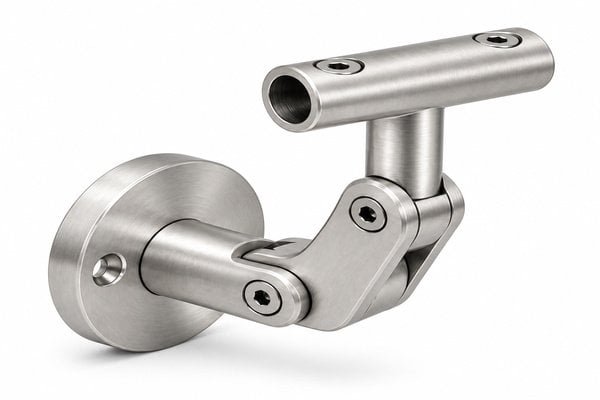
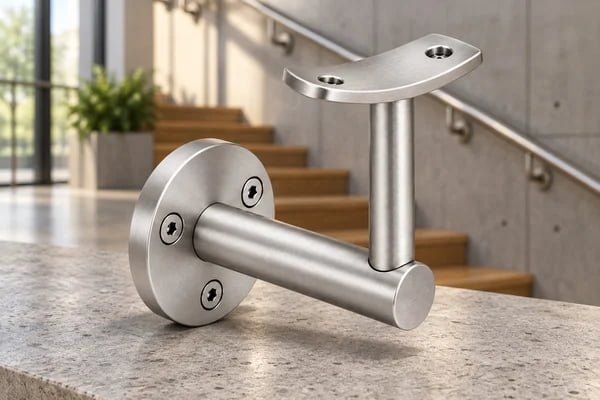
Product reference: Articulated Wall Handrail Sleeve Bracket — Satin silver appearance concept. Match the supplied configuration to the approved drawing.
Are mechanical joints always faster? No. Fit, access, component count and installer familiarity determine assembly time.
Does welding eliminate tolerance problems? No. Fabrication distortion and the surrounding installation still require controlled dimensions.
Which arrangement is cheaper? Compare the same approved scope, including fabrication, installation and future access.
Review feasible manufacturing routes through Elim’s capabilities, then send the connection drawings for quotation. Request separately priced options with the same acceptance requirements rather than a generic welded-versus-bolted price comparison.