The practical approach: Pack railing hardware by the installer’s work sequence, while retaining individual component and batch identification. A floor kit should tell the receiving team where it belongs, what it contains and which drawing revision it follows. It should not conceal missing parts inside a convenient-looking carton.
This delivery playbook is for contractors buying stainless steel railing systems for projects with repeated floors or zones. The objective is fewer site searches and clearer accountability, not an unverified promise of faster installation.
Before procurement: divide the building into release zones
Use the current approved drawing to name floors, stair flights and railing runs. Keep these location codes stable across procurement, packing and installation documents. If the architect changes a zone name, update the cross-reference rather than silently relabelling only the next delivery.
A hypothetical four-floor project might have two stair flights per floor. That gives eight delivery locations, but not necessarily eight identical kits. Landing returns, end conditions and wall interfaces can change the parts required. Confirm quantities at the component level before deciding how many cartons to make.
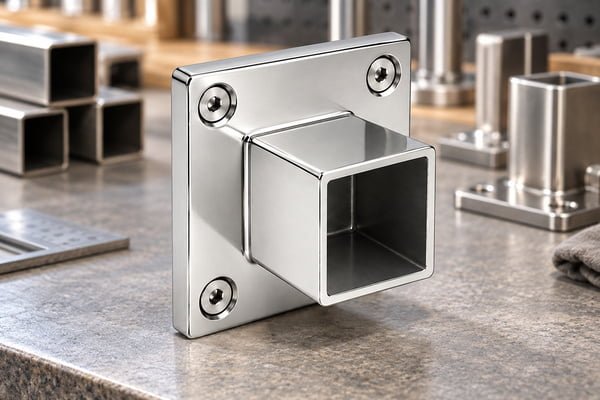
Consult the tube, flange and connector guide when checking the bill of materials. Components such as a square tube flange connector and an upright socket bracket should retain their own part references inside the location kit.
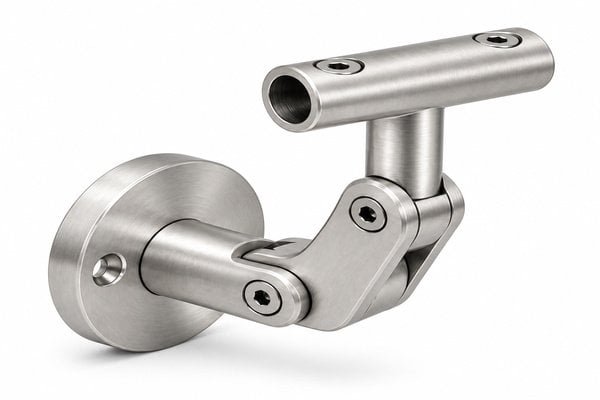
Product reference: Articulated Wall Handrail Sleeve Bracket — Satin silver appearance concept. Illustrative hardware reference; match the ordered configuration to its approved drawing.
Before production: freeze a three-level label system
| Label level | Example information | Person using it |
|---|---|---|
| Shipment | Purchase order, destination, shipment number | Freight and receiving teams |
| Location kit | Floor, zone, kit number, drawing revision | Site stores and installation crew |
| Component bag | Part number, quantity, finish, batch | Installer and quality inspector |
The examples describe a proposed system, not an existing Elim packaging standard. Agree the actual label artwork with the supplier. Keep readable text alongside machine-readable codes so a damaged scanner does not stop identification. GS1’s logistics-label guidance is a useful reference when designing a structured shipping label.
Do not put a full project drawing on a tiny bag label. Give the installer a short revision-controlled kit list and a clear route to the drawing. Distinguish quantities in pieces, pairs and sets; ambiguous units cause apparent shortages even when the carton count is correct.
Before packing: prove that the kit can be checked
Lay out one complete kit and photograph it. Check the component count against the list with a second person. Mark optional or separately supplied parts explicitly. If anchors are outside the supply scope, the kit list should say so rather than showing an unexplained empty position.
Use Elim’s manufacturing capabilities discussion to establish which packing and identification operations can be quoted. For material documentation, refer to grade-confirmation guidance. For protective packaging, use ISTA’s procedure overview to agree an appropriate test plan without claiming that ordinary packing is certified.
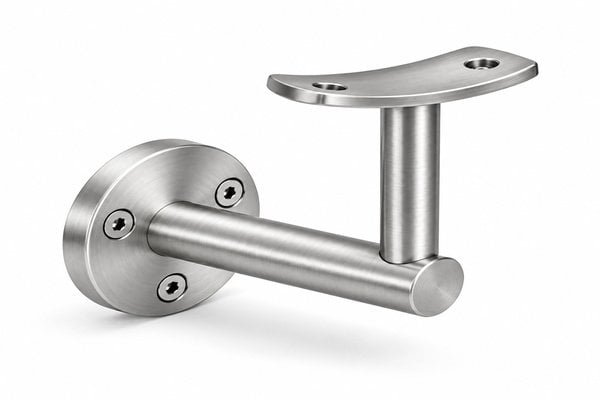
Product reference: Curved Saddle Wall Handrail Bracket — Fine-brushed silver appearance concept. Confirm the ordered configuration against its drawing.
Before dispatch: reconcile changes and partial releases
Create a release register with one line per kit. Record planned quantity, packed quantity, missing items, dispatch date and site acceptance. A partially complete floor should be marked as partial on both the register and its physical packaging.
Suppose a zone needs twelve brackets but only ten are released. Write “10 supplied; 2 outstanding under reference X,” not “one kit.” This makes the shortfall visible to the team scheduling installation. Ask whether a later replacement must match an existing finish batch; the finish-matching guide explains why that matters.
Align the packing list, commercial invoice and shipping descriptions with export-document guidance. These documents support shipment reconciliation; they do not establish product compliance. Keep project-specific fixing information separate, using the selected manufacturer’s documentation such as anchor technical guides.
At site: inspect without destroying the system
Check carton condition and location labels before opening. Record damaged packaging while the shipment is identifiable. Open a designated inspection kit, then reseal it with its parts list. Do not pool identical-looking fittings from several floors in one bin and lose the batch trail.
Store finished metalwork away from contaminants and adapt stainless cleaning advice to the supplied finish. Tea-staining guidance is relevant where components wait outdoors. The installed railing still needs project review, including applicable access requirements; Access Board stairway guidance is one jurisdiction-specific reference.

Product reference: Square Tube Wall Flange Connector — Reflective silver appearance concept. Confirm the ordered configuration against its drawing.
Handover questions
Should every floor receive the same spare allowance? Base it on the agreed parts and service plan, not an arbitrary percentage.
Can a revised part enter an old kit? Only with an approved substitution record and an updated list.
What should the supplier quote? Components, kit assembly, labels, protection, shipment splits and any storage charges as distinct scope items.
Send Elim the floor-by-floor release schedule, component list and label example. Ask for a packing proposal that your site team can check before the first shipment leaves.