Quick answer — stainless steel railing finishes: Match stainless steel railing finishes with an identified physical sample, grain direction and agreed measurable criteria. Grit describes an abrasive process; Ra describes surface roughness. For bulk orders, compare tubes and fittings together, keeping material grade and exposure requirements separate from colour and polish names.
For B2B buyers comparing stainless steel railing components, these checks turn the catalogue shortlist into a complete purchasing specification.
Stage 1: create the reference set
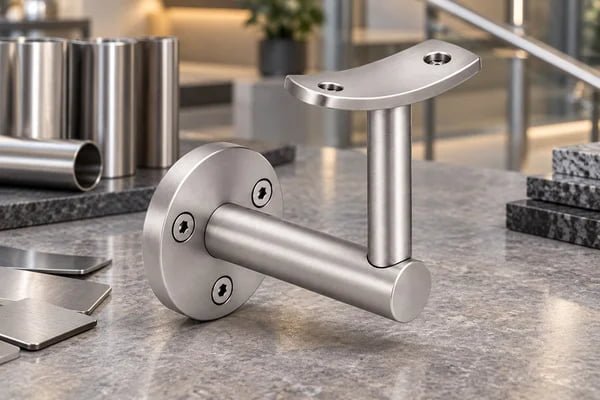
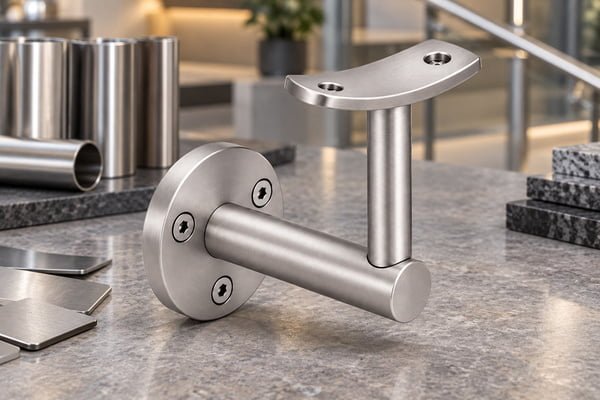
Elim catalogue comparison: Elim’s matte and fine-brushed curved-saddle entries use the same product-family wording with different appearance descriptions. That makes them useful for a finish discussion, but appearance-concept names are not measured roughness results or approved production samples. Catalogue references: matte curved-saddle bracket, fine-brushed curved-saddle bracket.
Buying decision: Use the same acceptance basis for the tube and each fitting. A supplier meeting a roughness requirement on a straight tube has not thereby demonstrated the finish of a curved saddle. Request measurements at agreed representative faces and retain the physical appearance reference.
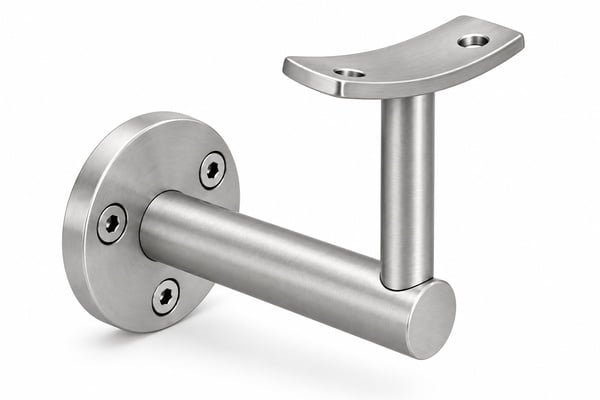
Catalogue reference: Curved Saddle Wall Handrail Bracket — Matte silver appearance concept.
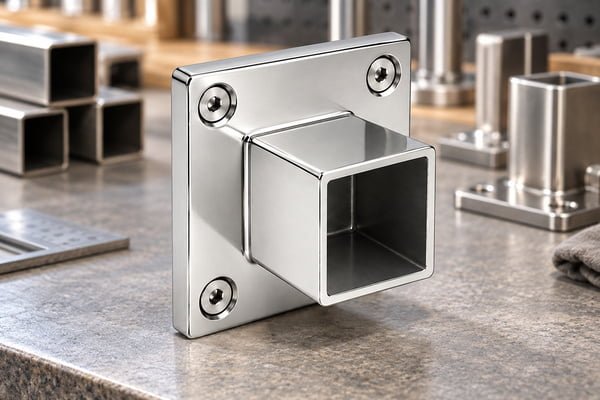
Add a mating accessory, such as the square-tube flange connector, when it belongs to the proposed installation. Approving one flat coupon alone may not reveal differences on curves, recesses, edges or separate manufacturing processes.
Stage 2: separate three questions
Is the material correct? Use the specified grade and traceable supply evidence. Thyssenkrupp’s grade comparison explains why 304 and 316 are separate material choices; it is not a method for identifying a bracket’s grade by appearance.
Is the appearance correct? Compare the agreed visible surfaces, texture and brushing direction under consistent conditions.
Has the part been damaged? Look separately for scratches, dents, embedded debris and packing marks. A damaged part may have started with the correct finish.
ASSDA’s tea-staining guidance and IMOA’s coastal-exposure discussion connect surface condition with service environment. They do not turn a visual sample approval into a corrosion guarantee.
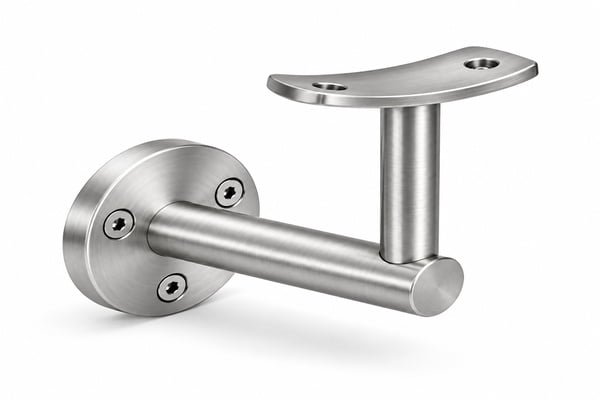
Catalogue reference: Curved Saddle Wall Handrail Bracket — Fine-brushed silver appearance concept.
Is a 320-grit finish the same as a measured Ra value?
No. Abrasive grit describes a processing input; Ra describes measured surface roughness. ASSDA’s coastal-corrosion guidance recommends abraded surfaces no rougher than 0.5 µm Ra. It does not certify an Elim finish or make roughness the only corrosion factor.
| Sample approval item | More useful than “satin silver” |
|---|---|
| Appearance | Identified master sample and grain direction |
| Roughness | Agreed Ra limit, measurement method and locations |
| Material | Grade recorded separately from the finish |
For a coastal quotation, discuss a measurable roughness requirement alongside drainage and maintenance. A 320-grit purchase description alone does not demonstrate that a supplier has achieved 0.5 µm Ra. Compare measurements from equivalent locations on the tube and fitting, since polishing access and geometry differ.
Source: ASSDA technical guidance on surface roughness. Reference checked 27 September 2026.
Request a matched quotation: Send the finish sample reference and exposure conditions for a quotation with measurable finish acceptance criteria..
Stage 3: write a usable inspection instruction
Use separate dispositions: accept, hold for review, or reject against a named criterion. Borderline appearance should be compared with the retained reference, not decided by whoever happens to unpack the carton first.
| Example record | Fictional entry |
|---|---|
| Reference | Finish board FB-02, revision A |
| Components | Bracket B1 and flange F1 |
| Visible faces | Front face and exposed curved arm |
| Observation | F1 brushing direction differs from reference |
| Disposition | Hold F1; supplier review required |
This is a record-format example, not an Elim inspection result. It shows how to isolate the issue without making an unsupported statement about the entire shipment.
Stage 4: preserve fit while reviewing appearance
Finish acceptance does not release dimensional or installation checks. Use the railing fitting compatibility guide to keep mating features under control. A polished surface cannot compensate for the wrong tube interface.
For the installed assembly, Hilti’s fastening guides and the US Access Board handrail guidance address separate fastening and accessibility considerations within their respective scopes. Keep those requirements in the project documents, rather than trying to solve them through a cosmetic inspection.
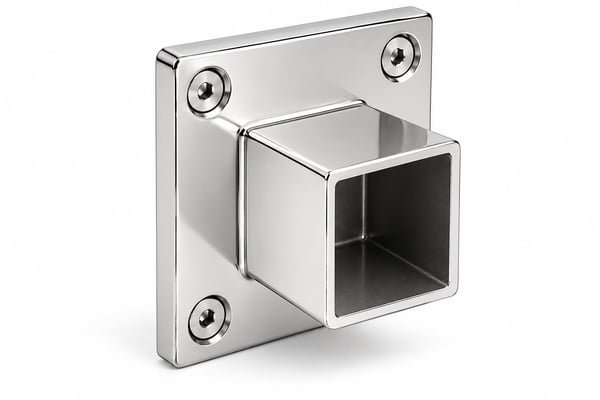
Catalogue reference: Square Tube Wall Flange Connector — Reflective silver appearance concept.
Stage 5: protect the reference appearance
Provide care instructions suitable for the actual material and treatment. ASSDA’s cleaning guidance is relevant background for stainless steel, but coated parts may require different instructions. Avoid copying one cleaning statement across every finish in the range.
Keep shipment descriptions consistent with the approved variant using export-document guidance. A carton marked only as railing accessories is harder to reconcile when several finishes arrive together.
Close the approval loop
Continue the same project: How to Specify Stainless Steel Handrail Brackets for Commercial Projects covers the next related purchasing decision in this system.
Must every component look identical? Define the intended visual relationship; different shapes and processes may need separately approved references.
Can photographs replace retained samples? They support identification, but should not silently replace an agreed physical comparison.
Send the component list, visible-face notes, finish references and inspection expectations through the quality-focused enquiry form. Request a written approval method before accepting the production quotation.