Quick answer — adjustable vs fixed handrail brackets: Choose fixed or adjustable handrail brackets by rail orientation, projection and saddle fit. Fixed geometry suits defined repeat installations; adjustment is useful only within the selected model’s declared range. Distributors should organize stock around customer installation needs, keeping profile, finish and included accessories separately identifiable.
For buyers developing a stainless steel railing range, the commercial question is not whether adjustability is generally better. It is which approved configurations customers repeatedly need, and which variants justify the additional stock and support effort.
Start with customer jobs
For relevant US projects, Access Board guidance provides handrail context. Substrate connections need their own documentation, such as the system-specific information organized in Hilti’s technical library. A bracket assortment should help customers identify requirements, not promise universal project compliance.
Give each family a clear sales role
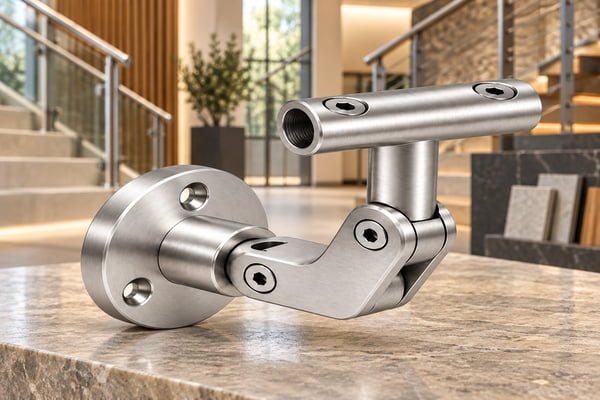
Elim catalogue comparison: Elim’s articulated sleeve, curved-saddle and flat-saddle references describe different interfaces. The articulated product’s name does not make either saddle product its direct fixed equivalent; catalogue shape and adjustment function must be compared separately. Catalogue references: articulated sleeve bracket.
Buying decision: Sort demand by rail interface first, then level or stair use, then finish. This avoids creating three finish variants of a bracket customers cannot fit. Stock the repeat interfaces and quote unusual adjustment needs against an identified job.
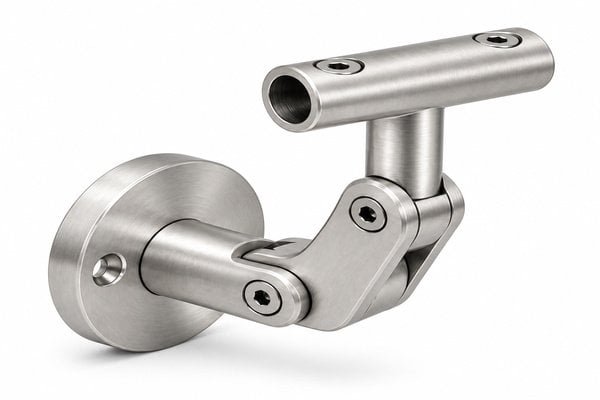
Catalogue reference: Articulated Wall Handrail Sleeve Bracket — Satin silver appearance concept.
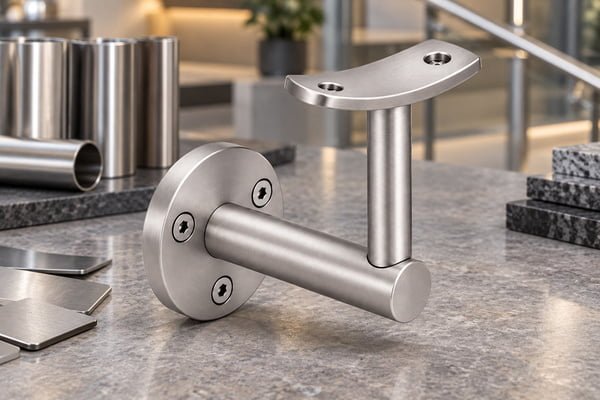
A curved-saddle bracket makes the rail-contact geometry central to selection. A flat-saddle bracket addresses a different interface. Neither should be described simply as the fixed equivalent of the articulated model without checking the complete drawing.
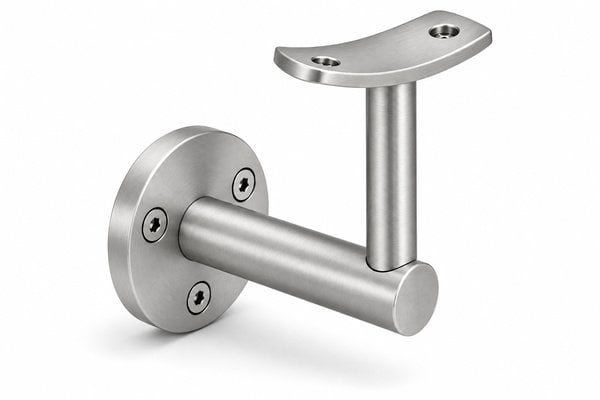
Catalogue reference: Curved Saddle Wall Handrail Bracket — Matte silver appearance concept.
When does an adjustable bracket solve a real fit problem?
Adjustment is useful when the project’s rail angle or finished-wall position varies within the bracket’s declared range. It does not compensate for an undersized fixing. On stairways covered by the U.S. ADA provisions, the Access Board illustrates 34–38 inches to the gripping surface and at least 1½ inches clearance.
| Stock enquiry | Information that distinguishes the SKU |
|---|---|
| Fixed bracket | Declared rail orientation and projection |
| Adjustable bracket | Actual angle or projection range |
| Both types | Saddle profile and wall attachment |
A request for a 30° stair rail is a project input, not proof that a bracket labelled adjustable reaches 30°. Ask the supplier to mark the available range on the drawing. Keep straight-run and stair-run demand separate when setting the distributor assortment.
Source: U.S. Access Board handrail dimensions. Reference checked 27 September 2026.
Request a matched quotation: Send the rail angles and wall-clearance targets for a fixed-versus-adjustable bracket shortlist..
Use a range matrix, not a photo wall
| Assortment field | Fixed configuration | Adjustable configuration |
|---|---|---|
| Geometry | Defined by the selected model | Defined position plus permitted adjustment |
| Documentation | Mating and fixing drawing | Drawing plus adjustment and locking instructions |
| Stock identity | Model, interface and finish | Model, interface, joint parts and finish |
| Support task | Confirm application fit | Confirm fit and explain approved adjustment |
The bracket specification guide can become the intake checklist behind this matrix. Keep the technical record available to counter sales rather than storing it only in the purchasing department.
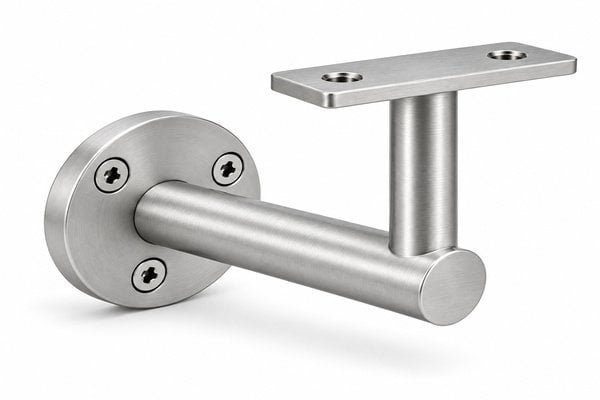
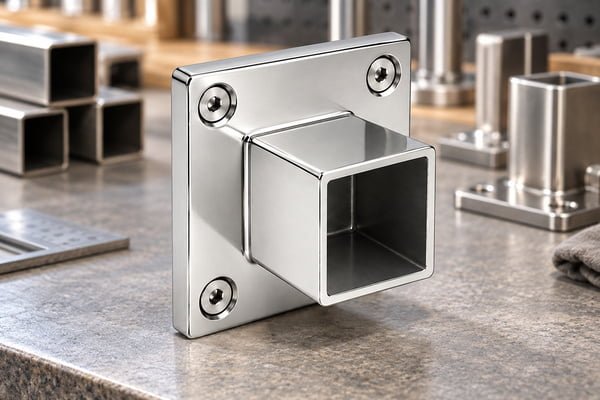
Catalogue reference: Rectangular Flat Saddle Handrail Bracket — Matte silver appearance concept.
Test a small assortment with a clear learning question
Consider a fictional distributor with 40 recorded enquiries: 24 concern level round rails, 10 concern sloping installations and six have incomplete drawings. These counts do not justify converting all 40 into confirmed demand. First separate suitable models from enquiries that still require technical clarification.
Control finish proliferation
Material grade and surface appearance need separate fields. Thyssenkrupp’s 304/316 comparison provides grade background; ASSDA’s tea-staining guidance and IMOA’s coastal discussion add exposure context. None identifies the material of an unverified stock item.
Avoid launching every finish across every model before establishing demand. Approve representative samples together and keep the finish references consistent across replenishment orders. Provide appropriate care information, drawing on ASSDA’s cleaning guidance for stainless surfaces.
Describe finish concepts as concepts until the production sample is accepted. A catalogue image can help customers discuss appearance, but a repeat order needs an identifiable supplied finish.
Make warehouse selection easy
Select packing evaluation with reference to ISTA’s procedures, and maintain consistent item descriptions across the purchase order and export documents. Replacement joint parts should have their own references if they are sold separately.
Continue the same project: Sourcing Stainless Steel Railing Fittings: How to Match Tubes, Flanges and Connectors covers the next related purchasing decision in this system.
Distributor questions
Should adjustable brackets replace fixed ones? Only where the approved configuration fits the customer’s requirements and support model.
What should be sent for a range quotation? Share customer applications, rail sections, target models, finish references and forecast quantities through the distributor enquiry form. Request a variant matrix that purchasing, sales and the warehouse can all use.