
Quick answer — stainless steel railing fittings: Match stainless steel railing fittings by tube shape, outside size, wall thickness and connector insertion geometry. Outside diameter alone does not define the bore. Keep flange fixing, end preparation and finish in the same assembly schedule so fabricators can quote a working connection rather than unrelated silver components.
This troubleshooting workshop is for fabricators sourcing stainless steel railing fittings. The examples are hypothetical purchasing situations, not reports of an Elim customer failure. Each situation ends with a document that should prevent the same ambiguity in the next order.
Situation 1: the tube will not enter the connector
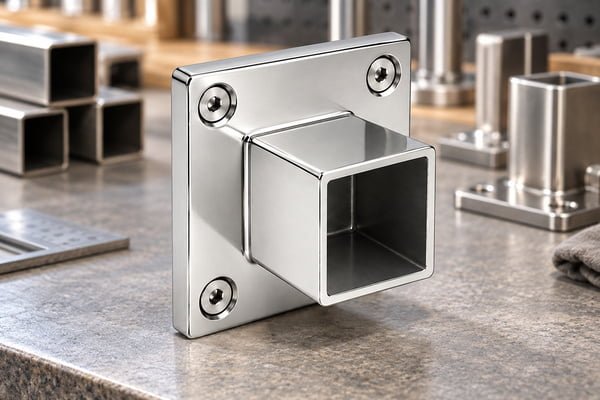
Elim catalogue comparison: Elim’s square-tube flange connector and upright-socket bracket describe different mating interfaces. The catalogue comparison identifies where dimensions must be checked; it is not a declaration that the two products form one approved assembly. Catalogue references: square-tube flange connector, upright socket bracket.
Buying decision: For every insert-type connection, compare the available tube bore with the insert drawing before ordering stock. Keep welding, adhesive or mechanical retention as a separate decision. Dimensional entry into a tube is necessary for fit but does not establish joint performance.
Record to produce: a joint drawing with the agreed dimensional limits, insertion requirement and assembly method. Use a fit sample representing the supplied tube, not a convenient offcut of unknown dimensions.
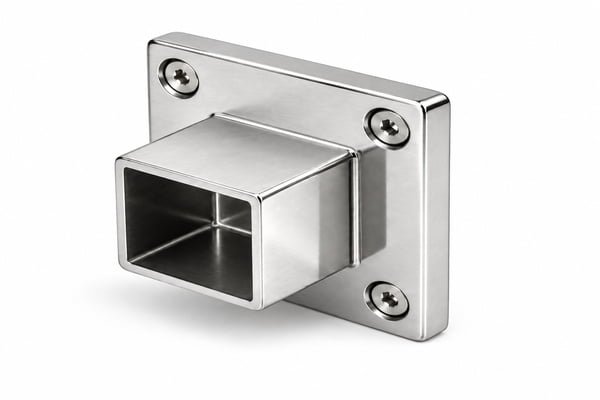
Catalogue reference: Square Tube Wall Flange Connector — Reflective silver appearance concept. Appearance does not establish dimensions or performance.
Situation 2: the assembly fits but the handrail position is wrong
Where US accessibility rules apply, consult the Access Board’s stairway guidance for handrail context. For the fastening interface, consult the relevant system documentation in Hilti’s technical guides. Neither source validates an improvised connector substitution.
Record to produce: an installation section showing the finished position and approved support arrangement. Ask the installer to sign off access for fastening and future maintenance before releasing the revised order.
Will a 42.4 mm connector fit every 42.4 mm tube?
No. Highco’s SL100242 example identifies a 42.4 × 1.5 mm slotted tube; outside diameter and wall thickness both belong in the order. This is a manufacturer-specific reference, not an Elim fit declaration.
| Illustrative round tube | Calculated inside diameter |
|---|---|
| 42.4 mm OD, 1.5 mm wall | 39.4 mm |
| 42.4 mm OD, 2.0 mm wall | 38.4 mm |
The calculation is OD minus twice the wall thickness. A 1 mm difference in the nominal bore can stop an insert from fitting. Weld seams, tolerances and the slot further affect the actual interface. For plug-in connectors, request both the tube section and connector insertion dimensions; a shared outside-diameter label is insufficient.
Source: Highco slotted-tube connector dimensions. Reference checked 27 September 2026.
Request a matched quotation: Send tube outside diameter, wall thickness and connector type to obtain a matched fitting schedule..
Situation 3: two silver components look different
Separate grade identification from visual matching. Thyssenkrupp’s stainless-grade comparison addresses material differences; it is not a finish-colour chart. Compare actual samples under consistent conditions and identify the faces that will be visible together.
State whether the order requires brushing direction, a specific sample match or another measurable finish description. Include handling controls so inspection compares clean, undamaged surfaces. ASSDA’s tea-staining guidance also explains why surface condition and service environment deserve attention.
Record to produce: a finish board containing the mating components and their references. A single photograph on a phone is an unreliable substitute for the agreed physical comparison.
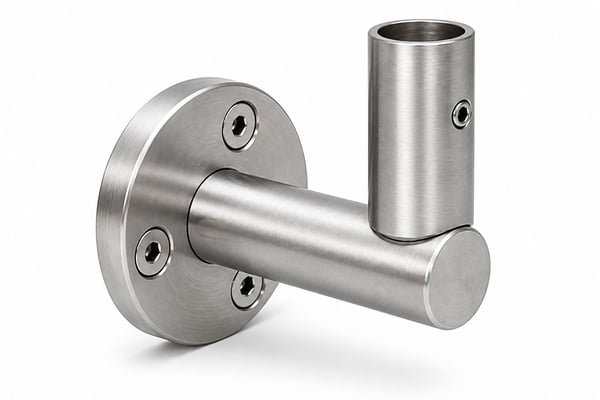
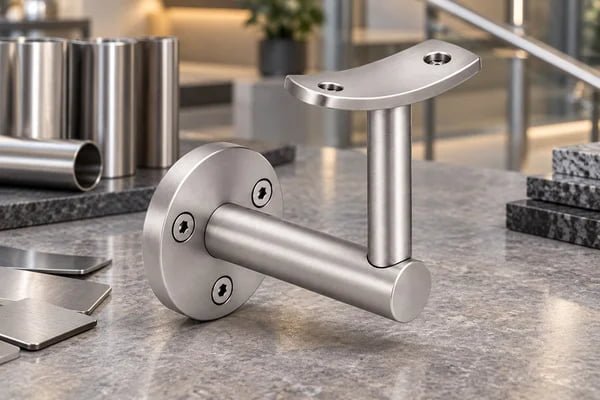
Catalogue reference: Upright Socket Wall Handrail Bracket — Reference silver appearance. Appearance does not establish dimensions or performance.
Situation 4: the quotation omits connection parts
| Joint requirement | Quotation evidence |
|---|---|
| Correct fit | Mating drawing and trial assembly |
| Correct appearance | Approved component finish references |
| Complete supply | Itemized assembly bill of materials |
| Repeatability | Revision and substitution controls |
Use the railing BOM guide to organize the list and Elim’s OEM process for custom interfaces. Ask the supplier to show where customization changes the standard part reference, so replacements remain identifiable.
Situation 5: the parts arrive marked or mixed
Agree separation, identification and receiving checks before shipment. Consult ISTA’s procedure overview for distribution-testing options and Trade.gov’s export-document guide for shipment documentation. Keep different interface revisions in distinguishable packs even when their finish is identical.
For maintenance planning, ASSDA’s cleaning guidance and IMOA’s coastal-exposure material offer useful background. Cleaning information should suit the supplied finish and environment; it does not resolve a dimensional mismatch.
Continue the same project: How to Specify Stainless Steel Handrail Brackets for Commercial Projects covers the next related purchasing decision in this system.
Quick workshop answers
Should the tightest possible tolerance be specified? Specify the fit the assembly actually needs. Excessively restrictive dimensions can add cost without solving an undefined interface.
Can a connector be substituted if it looks identical? Only after checking the controlled mating features, material, assembly method and relevant performance evidence.
What should the supplier receive first? Send the tube section, connector drawing, intended joint method, finish reference and quantities through the technical enquiry form. Include photographs of the intended assembly, but let the approved drawing govern production.
Comments (4)