Decision in brief: Compare exposed and concealed railing fixings by installation access, substrate coordination, drainage, inspection and future replacement. A concealed cover can improve appearance, but it does not establish the capacity of the base plate or anchors underneath. Price the complete connection and its installation work.
For commercial buyers sourcing stainless steel railing components, this is a design-coordination decision as much as a finish choice. Use the comparison below at the quotation stage, while the architect, installer and fixing designer can still resolve conflicts.
Two arrangements, several consequences
“Exposed” usually means the fixing heads remain accessible and visible. “Concealed” may mean a removable cover hides them, or that the connection is recessed into the construction. Those two concealed arrangements have very different service implications. Ask the supplier to draw the actual proposed detail.
| Buying criterion | Accessible exposed fixing | Covered or recessed fixing |
|---|---|---|
| Inspection | Heads can be viewed directly | Cover removal or an access method is needed |
| Installation | Tool clearance is visible | Cover and recess can restrict tools |
| Appearance | Fixings form part of the visual detail | Cover alignment and perimeter gaps matter |
| Maintenance | Usually easier to reach | Cleaning and drainage must be considered |
| Replacement | Access may be straightforward | Adjacent finishes may obstruct removal |
The table describes coordination questions, not a universal ranking. An exposed plate poorly positioned near an edge can be unsuitable; a concealed arrangement with documented access can work well.
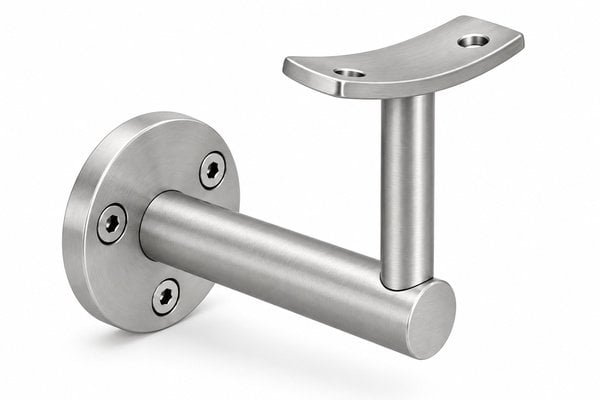
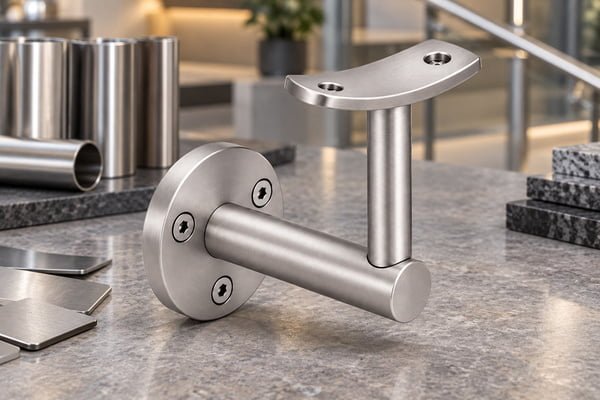
Product reference: Curved Saddle Wall Handrail Bracket — Matte silver appearance concept. Confirm the ordered configuration against its drawing.
Define the connection before comparing quotations
Start with the post section, base geometry, hole pattern, substrate and finished-floor build-up. Distinguish structural concrete from screed, tile or waterproofing layers. A decorative cover should not be mistaken for a load-bearing plate.
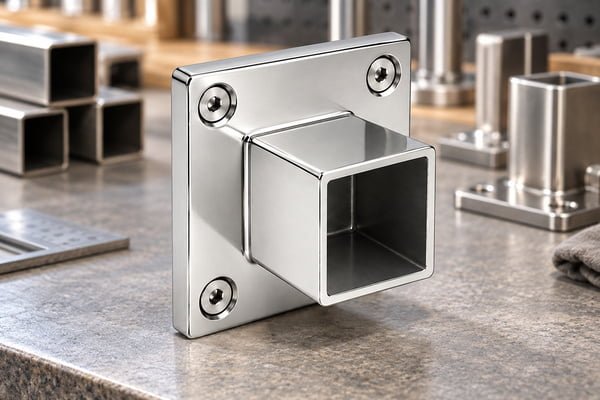
The tube and flange matching guide helps organize mating dimensions. Catalogue components such as a square tube flange connector and an upright socket bracket illustrate different interfaces; neither should be treated as an approved floor base merely because it has a flange.
Ask the fixing designer for the project-specific anchor arrangement. Hilti’s technical guides provide manufacturer information on anchor systems, while US Access Board stairway guidance addresses a separate accessibility context. Neither replaces the governing requirements and design review for the actual project.
Check the space around the hardware
Make a simple section through the base, floor finish and cover. Mark the tool envelope needed to install and inspect each fixing. Identify whether the cover must slide over the post before another part is attached. This sequencing detail can turn an inexpensive cover into an expensive site problem.
For illustration, a 10 mm finish layer changes the visible relationship between the plate and cover compared with a bare slab. That number is an example, not a permissible packing thickness. The designer must specify any approved packing, grout or recess arrangement rather than leaving the installer to improvise.
Request one complete assembly for a coordination mock-up. Photograph it with the actual tools and proposed finish build-up. Record who can approve appearance and who can approve the structural detail; those are not necessarily the same person.
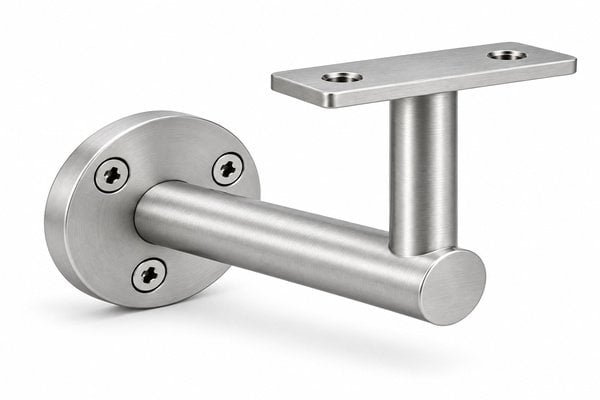
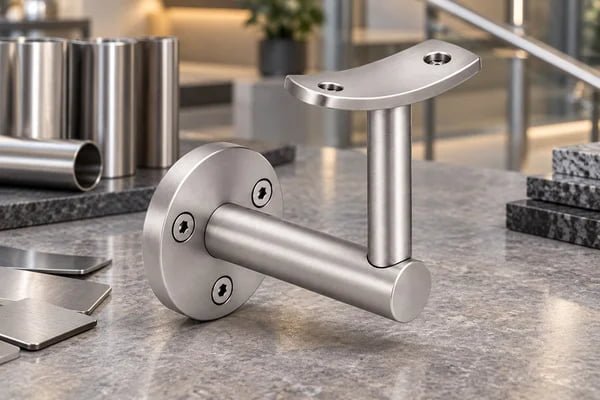
Product reference: Rectangular Flat Saddle Handrail Bracket — Matte silver appearance concept. Confirm the ordered configuration against its drawing.
Include exposure and cleaning in the purchase
Specify the material for the post, plate, cover and fasteners separately. A stainless grade comparison explains general alloy differences, and ASSDA’s grade-confirmation advice helps define verification. A cover with the requested appearance does not prove the grade of the hidden fastener.
For exterior work, review coastal salt exposure and tea-staining prevention. Ask how water and debris leave the proposed detail. Adapt stainless cleaning guidance to the supplied finish and the building’s maintenance access.
Discuss fabrication through Elim’s manufacturing capabilities, then reference the agreed drawing in the order. Avoid a purchase description such as “concealed base, standard size,” which leaves several interfaces undefined.
Compare installed cost, not cover price
Request separate prices for the plate assembly, cover, anchors if supplied, protective packing and any special machining. Ask the installer to price access, setting out and finish coordination separately. If one quote excludes anchors, make that exclusion visible before comparing totals.
Protect covers from rubbing against other metal parts during shipment. The ISTA procedure overview can guide packaging-test discussions. Keep finish references consistent with the bulk-order finish guide, especially when visible covers arrive in a later production batch.
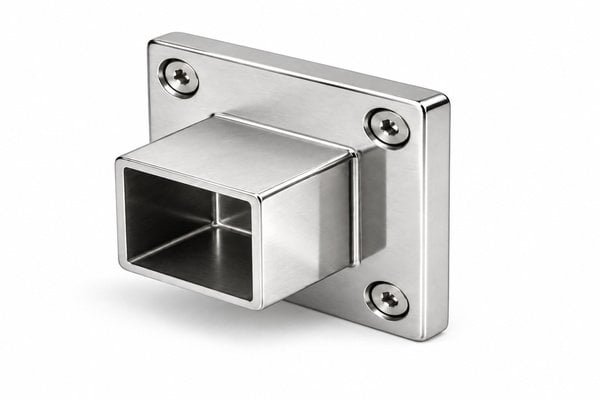
Product reference: Square Tube Wall Flange Connector — Reflective silver appearance concept. Confirm the ordered configuration against its drawing.
Before placing the order
Is concealed fixing always more expensive? Not necessarily; installation conditions and included scope determine the comparison.
Can a cover solve an incorrect hole layout? No. Resolve the underlying connection before production.
What should the RFQ contain? A section drawing, substrate information, floor build-up, material schedule, quantities and access requirements.
Send Elim the coordinated connection detail and request an itemized proposal. Approve both the visible finish and the accessible, maintainable assembly before release.