Buying decision: Choose a fixed-angle handrail connector when the surveyed geometry matches a defined fitting. Consider an adjustable connector when the layout needs an approved range of articulation. Compare the complete joint, including tube fit, locking method, appearance and installation access, rather than comparing angle alone.
Two projects, two different purchasing problems
Imagine a distributor supplying a repeatable rectangular platform and a contractor ordering for a surveyed stair. The platform may use repeated identical corners. The stair may require a different transition at each landing. Both belong within stainless steel railing systems, but their connector schedules should not be copied from one another.
For a fixed fitting, the question is whether its geometry matches the actual junction. For an adjustable fitting, the additional question is how the selected position is secured and inspected. Neither description alone proves that the completed handrail meets the project requirements.
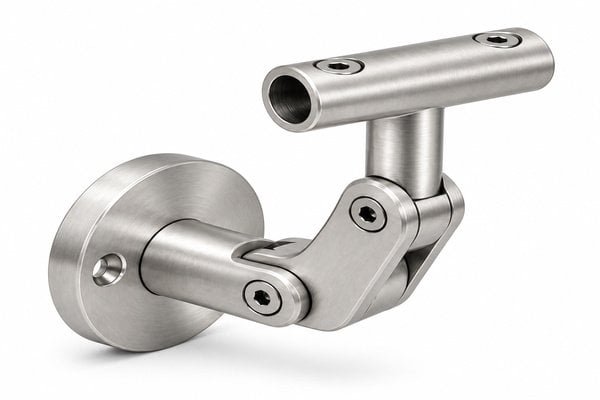
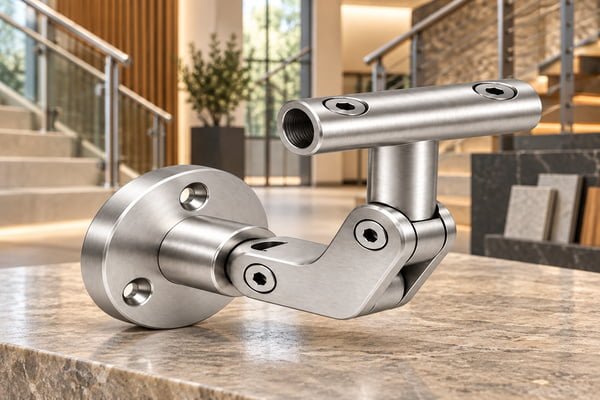
Catalogue illustration: Articulated Wall Handrail Sleeve Bracket — Satin silver appearance concept. Shown as a component reference, not an installation drawing or test result.
Compare the connections, not the labels
| Purchasing factor | Fixed-angle connector | Adjustable connector |
|---|---|---|
| Geometry | One defined angle or shape | Manufacturer-defined adjustment envelope |
| Survey dependence | Requires matching layout | Still requires an accurate layout |
| Assembly | Check insertion and joining method | Also check articulation and locking |
| Appearance | Predictable fixed transition | Inspect the visible joint at the chosen angle |
| Service | Identify removable connections | Confirm future access to locking parts |
The table is a procurement comparison, not a claim that every adjustable connector is suitable for every slope. A supplier should provide the drawing and installation information for the actual part being offered.
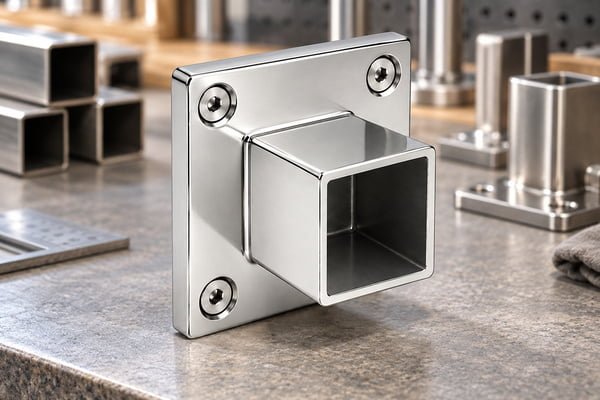
The tube and connector matching guide is a useful starting point for interface dimensions. “Fits a round handrail” is insufficient: the mating geometry, tube wall, connection type and finish all matter. Review the square-tube flange reference as an example of why connectors must match a particular tube interface, even though it is not an adjustable elbow.
Build a short junction schedule
Assign a junction number to each change in direction. For each junction, record the adjoining tube references, included angle, slope direction, finish and assembly access. Include a small sketch showing how the angle was measured.
An illustrative schedule might contain J01 at 90 degrees and J02 at 135 degrees. Those are communication examples, not approved stock specifications or installation limits. The supplier must confirm available configurations against the drawing. Use NIST’s traceability guidance when defining inspection evidence for critical measurements.
For applicable US accessible routes, the Access Board’s stairway guide provides handrail context. Applicability depends on the project and jurisdiction. Do not infer compliance from an elbow’s shape or from a catalogue description.
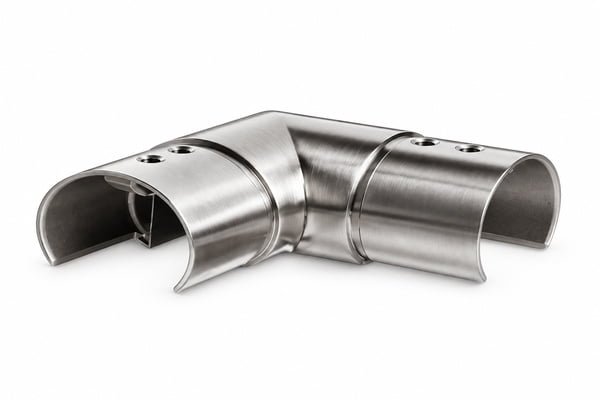
Catalogue illustration: Horizontal Corner Connector for Round Slotted Handrail. Shown as a component reference, not an installation drawing or test result.
Price the installed connection
Ask each supplier to price the same scope: connector, joining parts, any required preparation and instructions. The welded versus mechanical connection guide helps structure the comparison. An inexpensive connector can increase site work if it needs special tools, inaccessible tightening or additional finishing.
If a design uses stainless threaded components, review ASSDA’s galling guidance. For welded or fabricated interfaces, ASSDA’s pickling and passivation information provides relevant surface-treatment background. These references support assembly questions; they do not replace the fitting manufacturer’s procedure.
Discuss special junctions through OEM/ODM review. Ask which dimensions are standard, which require manufacture and whether the finish sample represents the final joined assembly. A single polished part cannot show the appearance of an entire installed corner.
Release a small, useful approval pack
Include an assembled sample photograph, marked junction drawing, component list and accepted finish reference. Separate material identification from appearance review: ASSDA’s grade-confirmation guide explains why simple observations do not fully identify stainless steel.
Specify the relevant exposure, using IMOA’s coastal guidance as environmental background. Consult the manufacturing capabilities page when discussing machining or finishing requirements. Plan protection for the approved appearance with reference to ISTA procedures, and include cleaning instructions informed by ASSDA’s maintenance guidance.
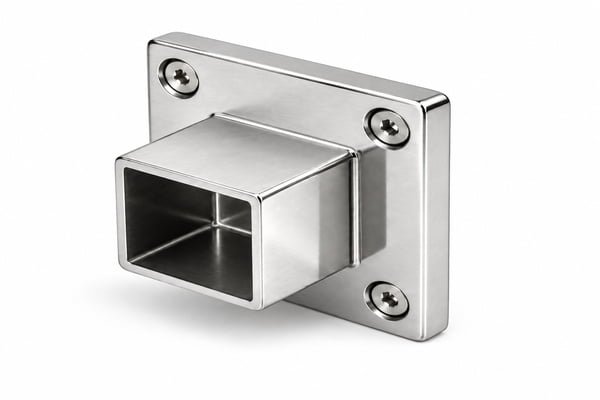
Catalogue illustration: Square Tube Wall Flange Connector — Reflective silver appearance concept. Shown as a component reference, not an installation drawing or test result.
Fast answers for buyers
Will an adjustable fitting remove the need for surveying? No. It still has an adjustment envelope and mating requirements.
Can a fixed elbow be altered on site? Do not assume this; obtain the manufacturer’s approved method or a correctly specified alternative.
What information speeds up a quote? A junction schedule, tube interfaces, finish and quantities. Send your connector schedule to Elim Hardware for a product and manufacturing review.