Match a railing bracket fastener by thread system, pitch, engagement, head geometry, material and the intended joint. A screw that starts turning is not necessarily the correct replacement. The screw-to-bracket connection and the bracket-to-building anchor are also different interfaces. This selection guide helps purchasing teams avoid incomplete fastener descriptions.
Which connection are you ordering?
Identify whether the fastener joins a rail to a bracket, locks an adjustable fitting or fixes the bracket to the building. Start with the model in the stainless railing system and its assembly drawing. Each connection may use a different fastener and installation procedure.
Our bracket load-rating guide explains why evidence belongs to the complete tested arrangement. Replacing a screw based only on its visible diameter can change that arrangement. Record the exact part number where the manufacturer provides one.
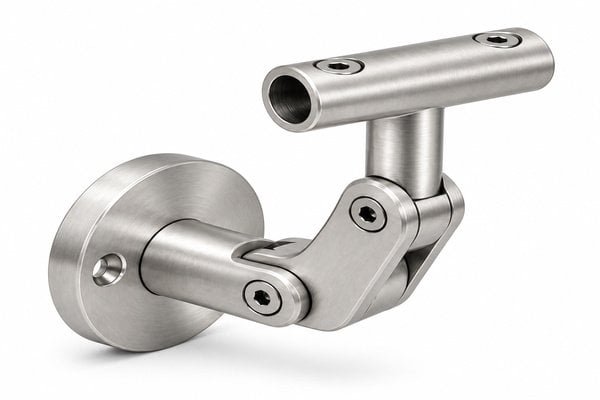
Catalogue illustration: Articulated Wall Handrail Sleeve Bracket — Satin silver appearance concept. Shown as a component reference, not an installation drawing or test result.
Read the thread designation completely
Specify the thread system and pitch, not just “M6” or “quarter inch” without the remaining information required by the drawing. Bossard’s metric thread resource provides reference context. A metric and an imperial component may appear close in size but must not be forced together.
Check whether the receiving hole is threaded, through-drilled or intended for another fastening method. Photographing a screw beside a ruler does not reliably identify pitch or tolerance. Use the appropriate gauge or documented specification and record the result.
Five checks before approving a substitute
| Check | Why it matters |
|---|---|
| Thread and pitch | Determines the mating thread compatibility |
| Effective engagement | Distinguishes engaged threads from overall length |
| Head and bearing face | Controls seating and access |
| Material and condition | Affects the specified joint behaviour |
| Installation instruction | Defines the approved assembly method |
Bossard’s engagement reference distinguishes effective thread engagement from a simple screw-length label. Do not treat a longer screw as automatically safer: it can bottom in a blind hole before seating. Include washers, covers and other intervening components when checking the actual stack.
Tightening is part of the specification
The relevant torque and preload resource shows why geometry and friction assumptions matter. Use the bracket supplier’s approved setting and procedure for the exact joint. A general fastener calculation cannot independently determine what the bracket or rail can accept.
ASSDA galling guidance is relevant when stainless threads bind. Our thread-galling prevention article offers purchasing context. Stop and identify a binding problem instead of applying more force or adding an unapproved lubricant to reach a nominal setting.
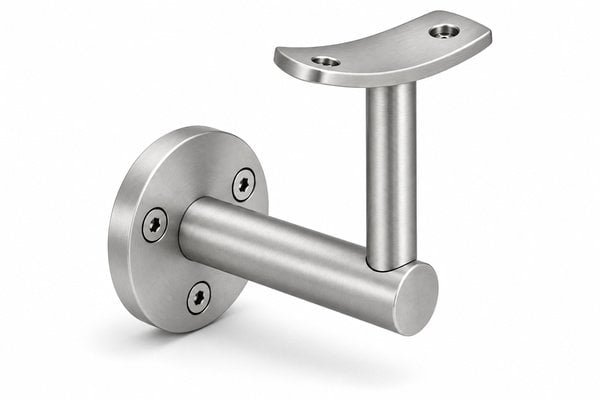
Catalogue illustration: Curved Saddle Wall Handrail Bracket — Matte silver appearance concept. Shown as a component reference, not an installation drawing or test result.
Check the surrounding parts
For rail connections, confirm the tube dimensions and receiving feature. Our tube ovality troubleshooting guide explains another cause of poor fit that should not be confused with a wrong screw. An assembly problem may involve both parts.
For the connection to the building, use the actual anchor technical documentation. A screw supplied with a bracket does not prove suitability for every wall or substrate. Separate the scope of the bracket package from the project’s anchorage design and installation responsibilities.
Make a first-article kit
For an illustrative order of 100 bracket sets, assemble one approved reference kit containing every required screw, washer and small part. Identify its revision and photograph the contents. The kit can support receiving checks, but the project’s inspection plan determines what else must be measured or tested.
Use suitable measurement traceability for controlled dimensions. Review material descriptions against appropriate stainless product information, while keeping the actual supplier’s component identity attached to the order. A broad alloy family name alone may not fully specify a fastener.
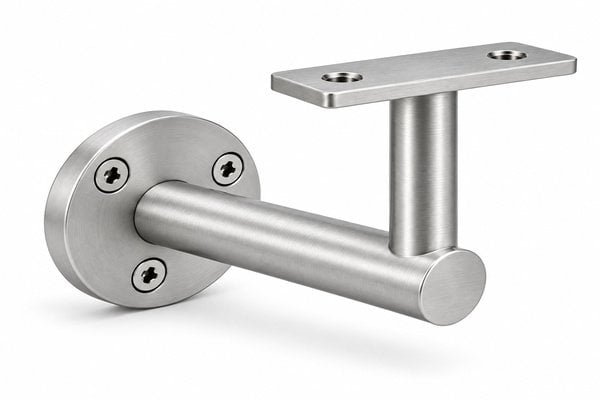
Catalogue illustration: Rectangular Flat Saddle Handrail Bracket — Matte silver appearance concept. Shown as a component reference, not an installation drawing or test result.
Questions from replacement buyers
Can we use a hardware-store screw with the same diameter? Only after confirming the complete specification and obtaining any required approval for the replacement. Diameter alone is insufficient.
Does full insertion prove correct engagement? No. A screw can bottom, bind or engage an incorrect thread without creating the intended joint.
What should be recorded after approval? The accepted part identity, drawing revision, installation instruction and inspection requirements. NIST conformity-assessment guidance helps distinguish dimensional inspection from performance evidence.
Discuss special kits through OEM development, review the manufacturing scope, and request a fastener-matched quotation. Include the complete bracket assembly drawing so the supplier can quote a usable kit rather than a bag of approximately matching screws.