A railing bracket load rating is useful only when its force direction, fixing arrangement and acceptance basis are known. A single number cannot establish the suitability of every bracket installation. This report-reading guide is for engineers, procurement managers and distributors comparing supplier claims.
Ask what the number represents
A result may describe a test load, a failure load, an allowable value or another defined quantity. These are not interchangeable. Ask the supplier to identify the term used, units and underlying method. Do not convert a reported failure value into a working value by choosing an arbitrary safety factor.
Start with the exact model in our stainless railing range. The NIST conformity-assessment overview helps distinguish inspection, testing and certification. A catalogue statement is not the same document as a signed test report for an identified assembly.
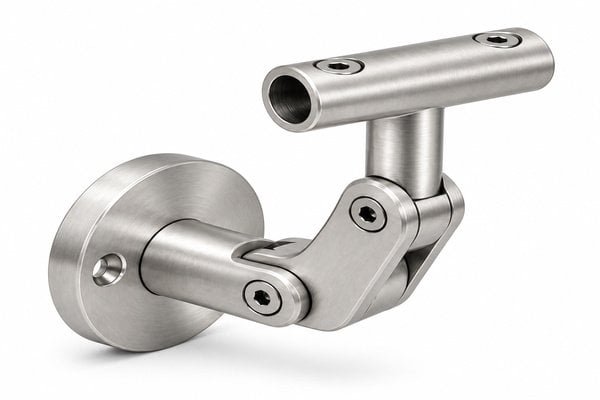
Catalogue illustration: Articulated Wall Handrail Sleeve Bracket — Satin silver appearance concept. Shown as a component reference, not an installation drawing or test result.
Read the configuration before the result
| Report field | What to verify |
|---|---|
| Specimen | Model, revision, material and relevant dimensions |
| Support | Substrate, backing arrangement and fixings |
| Loading | Direction, point of application and procedure |
| Measurement | Displacement locations and measurement method |
| Acceptance | Defined criterion and the stated result |
| Scope | Limits on applying the result to other arrangements |
Our bracket projection guide explains why the distance from the support matters. A test on one projection cannot automatically support a longer arm merely because the screw pattern is unchanged.
Use units to expose missing information
For illustration, a perpendicular force of 1 kN applied 0.1 metres from a fixing plane produces a nominal moment of 0.1 kN·m about that plane. The same force at 0.2 metres produces 0.2 kN·m. This is simple mechanics, not a load rating for a particular bracket.
The example does not calculate anchor demand, stress distribution or allowable loading. It shows why a claim stated only as “supports 100 kg” leaves important questions unresolved. Ask for the force units, geometry and defined test or design basis.
The substrate is part of the assembly
A bracket tested on a rigid fixture is not automatically qualified for every wall. Identify whether the report includes the actual screws, anchors, backing and substrate. Hilti’s technical guides provide useful context for anchor-specific evidence.
Our base-plate guide similarly separates the visible fitting from its support detail. If the project uses a different substrate or fastening arrangement, obtain the responsible designer’s applicability review before accepting the original number as a project value.
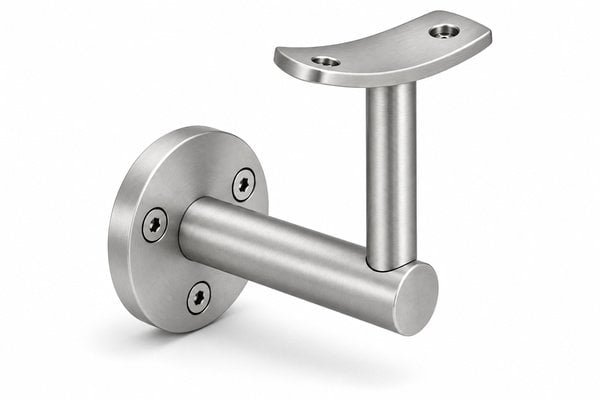
Catalogue illustration: Curved Saddle Wall Handrail Bracket — Matte silver appearance concept. Shown as a component reference, not an installation drawing or test result.
Understand which requirement is being addressed
ASTM E2353 provides a test-method reference for relevant railing assemblies, while the Access Board stairway guide addresses accessibility matters under its framework. Neither establishes a universal bracket load figure for every jurisdiction and application.
Our railing report checklist helps compare the tested arrangement with the proposed order. Keep dimensional, structural and accessibility requirements distinct, then coordinate them in the project specification. Passing one type of check does not imply that every other requirement has been addressed.
Make measurements and materials traceable
NIST’s measurement traceability guidance explains the role of documented measurement references. Ask which instruments and procedures support the reported results. Outokumpu’s product resources are material background, not certification for an Elim finished bracket.
Where fasteners are stainless, the ASSDA galling guide informs the assembly discussion. Installation instructions should come from the selected system documentation; a general corrosion or fastening article cannot supply a missing tightening specification.
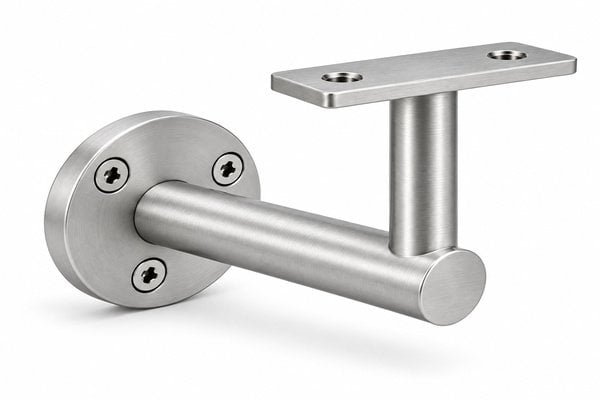
Catalogue illustration: Rectangular Flat Saddle Handrail Bracket — Matte silver appearance concept. Shown as a component reference, not an installation drawing or test result.
Convert the review into a purchasing decision
State the accepted model and revision, supplied fixing scope and required documentation on the purchase order. Use OEM development for a modified arm or plate rather than treating the modification as covered by an unrelated report. Review the manufacturing scope for the ordered configuration.
Preserve the connection between shipment identity and evidence; the GS1 traceability framework provides general background for that recordkeeping.
Can two suppliers be compared by the highest published number? Only after the test or design bases and configurations are genuinely comparable. Otherwise the apparent ranking may be meaningless.
To request a documented bracket quotation, provide the required geometry, loading basis, substrate, fixing scope and report requirements. Ask suppliers to flag differences explicitly so the technical review happens before the commercial award.