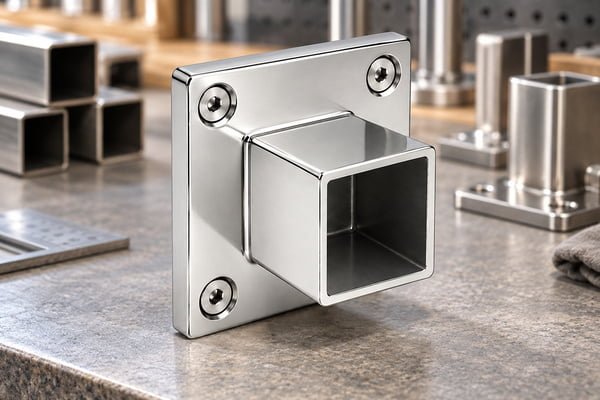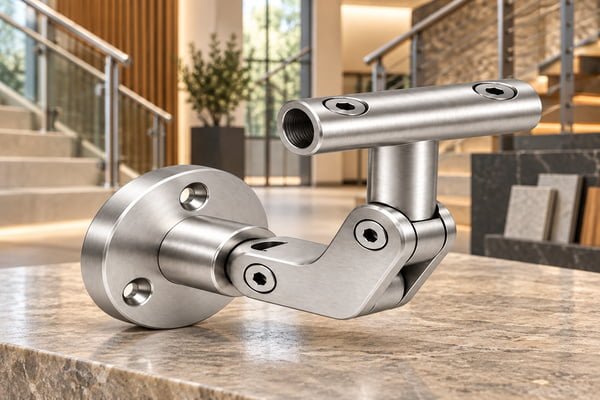
Compare cast and machined railing fittings by the finished component’s requirements, not by the process label alone. Casting can form complex bodies; machining can control selected interfaces. Many fittings use both processes. The economical route depends on geometry, quantity, material and inspection. This commercial comparison is for importers building repeatable product ranges.
What are you actually comparing?
A cast body may have machined bores, threads and mounting faces. A part machined from bar or billet starts from a different stock form, but still needs a specified alloy, finish and acceptance plan. Browse the stainless railing system by function first: bracket, connector or base component. Then ask suppliers to identify the proposed manufacturing route.
The Steel Founders’ Society resources offer casting context. Outokumpu’s product information describes stainless product forms. Neither establishes that a particular route is automatically stronger or more accurate for your fitting. Compare the delivered drawing and evidence.
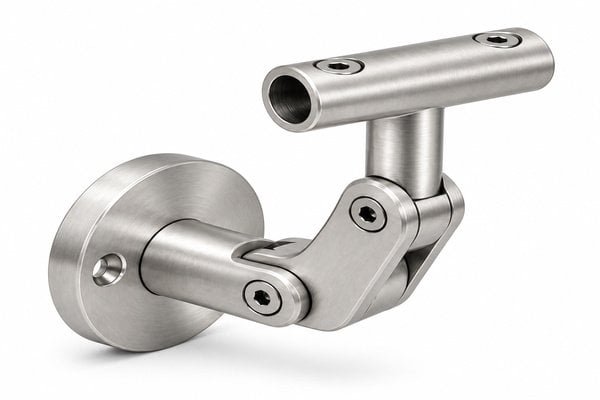
Catalogue illustration: Articulated Wall Handrail Sleeve Bracket — Satin silver appearance concept. Shown as a component reference, not an installation drawing or test result.
Compare the cost structure
| Cost item | Cast body with finishing operations | Machined stock route |
|---|---|---|
| Initial preparation | Pattern or tooling and sample development | Programming, workholding and stock selection |
| Recurring operations | Casting, cleaning and required machining | Material removal and tool time |
| Complex external shape | Review casting feasibility | Review access and machining time |
| Critical mating feature | Specify the finishing operation | Specify the controlled dimension |
| Design changes | Assess tooling consequences | Assess programming and stock consequences |
Obtain quotations against the same drawing revision and batch quantity. A supplier offering a rough casting is not quoting the same scope as a finished, inspected fitting. Include polishing, threads, packaging and inspection in both comparisons. Our casting surface inspection guide covers one quality risk that belongs in that scope.
Run a simple break-even exercise
Use a spreadsheet with tooling cost, unit price, inspection cost and expected quantity. For illustration only, Route A might carry 1,200 currency units of tooling and a unit price of 8, while Route B has no separate tooling charge and costs 11 per unit. Ignoring other costs, the difference reaches break-even at 400 pieces. These are hypothetical numbers, not Elim prices.
Now add rejection handling, revision risk, minimum batch size and replenishment time. A low unit price is less useful if a drawing changes before the tooling is recovered. Conversely, a stable high-volume fitting may justify dedicated tooling. Request ownership and maintenance terms for project-specific tools.
Control the interfaces that matter
Identify the bore, thread, mounting face and angular relationship that control assembly. Do not apply an unnecessarily tight tolerance to every visible surface. Our material-certificate checklist helps separate alloy identity from dimensional acceptance. ASSDA’s grade-confirmation guidance explains relevant identification methods without treating a surface appearance as a material certificate.
Use NIST traceability principles when specifying dimensional records. State the datum and measurement method for a critical feature. A number without a location or method is difficult to compare between supplier and receiving inspector.
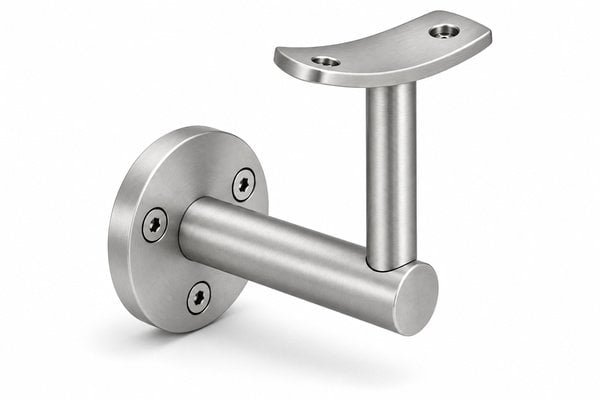
Catalogue illustration: Curved Saddle Wall Handrail Bracket — Matte silver appearance concept. Shown as a component reference, not an installation drawing or test result.
Finish is a separate acceptance decision
A polished sample can hide differences in edge definition, local waviness and transition areas. Approve viewing conditions and reference areas rather than relying on the word “mirror.” Our finish sample-approval guide provides a practical starting point, supported by ASSDA finish information. Where pickling or passivation is part of the route, identify the process scope using relevant surface-treatment guidance.
Do not infer treatment completion from a bright surface. Record the finishing sequence and protect approved surfaces during packing. Where parts mate with another supplier’s component, evaluate the assembled appearance as well as each item separately.
Release the first batch deliberately
Agree which dimensions receive first-article inspection and which characteristics are checked during production. NIST’s acceptance-sampling overview helps explain the distinction between inspecting a sample and guaranteeing every item. The plan should reflect product risk and contractual requirements, not an arbitrary inspection percentage.
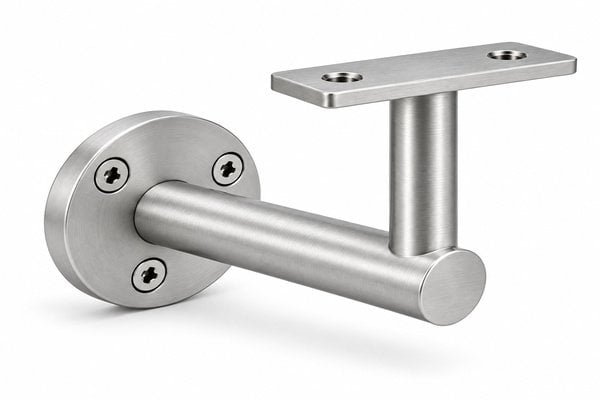
Catalogue illustration: Rectangular Flat Saddle Handrail Bracket — Matte silver appearance concept. Shown as a component reference, not an installation drawing or test result.
Is a machined fitting always better? No. A suitable casting with controlled critical features may meet the same purchasing requirements.
Can the supplier change route later? Treat a route change as a controlled change where it can affect material, geometry, finish or evidence. Maintain batch identity using appropriate traceability principles.
Discuss the drawing through OEM development, review the available manufacturing processes, and request comparable quotations. Ask for the same finished specification, delivery scope and inspection evidence from each route. That creates a useful business decision instead of a contest between manufacturing labels.