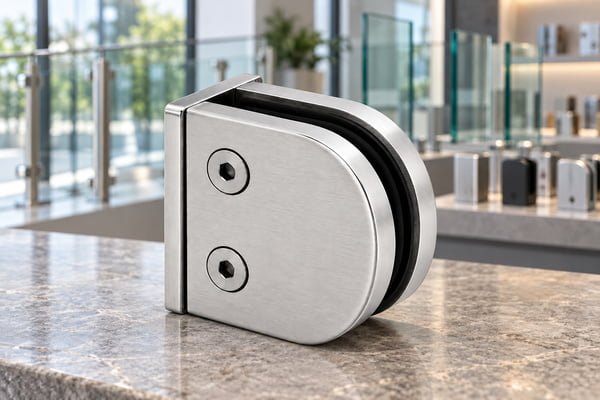
A clamp’s published thickness range does not automatically permit two unequal panels in one connection. For mixed-thickness glass, verify each contact interface, gasket arrangement and alignment datum using the exact manufacturer’s instructions. Do not assume a thicker gasket can turn any clamp into a transition fitting.
This question-and-answer guide is for buyers comparing glass clamp hardware where adjacent panels have different constructions or nominal thicknesses.
Does a thickness range cover unequal panels?
Not necessarily. A range may describe several supported configurations rather than every possible combination within it. The CRL architectural catalogue illustrates model-specific clamp and gasket information. Read the drawing for the actual connection, including which parts change between configurations.
A CRL gasket instruction sheet is another example of product-specific guidance. Its details must not be transferred to an unrelated fitting. Ask the supplier to identify the approved arrangement for both sides of the proposed connection in writing.
What information belongs on the glass schedule?
List the construction of each panel separately. For laminated glass, record the plies and interlayer rather than only an approximate total. Our laminated glass clamp guide explains the purchasing fields. Kuraray’s interlayer information provides background on that material category.
| Panel information | Record for each side |
|---|---|
| Glass construction | Monolithic or complete laminated build-up |
| Thickness | Specified value and applicable tolerance |
| Preparation | Holes, cutouts and edge details |
| Reference face | Face to align with the adjoining panel |
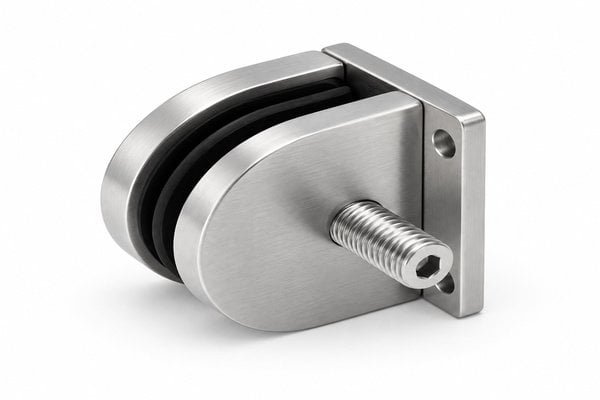
Catalogue illustration: Flanged D-shaped Glass Clamp. Shown as a component reference, not an installation drawing or test result.
The CPSC glass safety alert is useful safety context. It does not authorize a particular clamp configuration. Keep glass design responsibility with the qualified project team.
Which face should line up?
State whether the installation aligns one exposed face or another defined datum. If two panels have different thicknesses, their centre planes and outer faces cannot all coincide. An elevation alone may hide this issue; provide a section through the joint.
For a hypothetical illustration, compare 10 mm and 12 mm nominal panels. The 2 mm difference is a geometric observation, not approval to combine them in any particular clamp. The selected fitting must accommodate the intended arrangement within its documented scope.
Use NIST measurement traceability guidance to frame how the sample will be measured. Record the actual method and agreed tolerance rather than merely stating that dimensions were checked.
Can a different gasket solve the mismatch?
Only when the exact gasket arrangement is specified for that assembly. Gasket material, shape and thickness interact with the clamp design. Our EPDM versus silicone gasket guide helps organize the material questions, but material names alone do not establish compatibility.
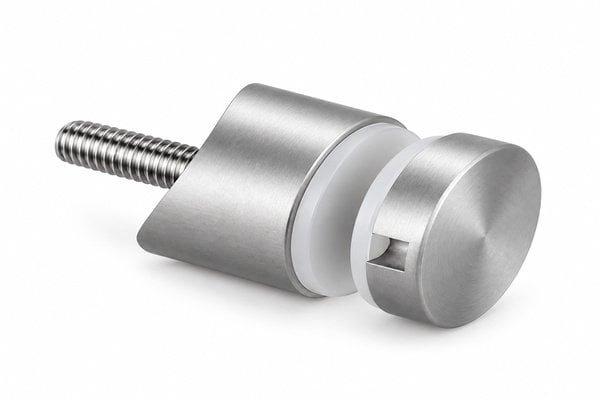
Catalogue illustration: Matte Silver Stepped-cap Cylindrical Glass Standoff. Shown as a component reference, not an installation drawing or test result.
Do not stack improvised layers or alter contact parts to make the glass appear aligned. Ask for a documented configuration or an alternative connector. If a custom design is proposed, use OEM/ODM development with the two panel specifications and the required face alignment.
What evidence should accompany a sample?
Separate fit evidence from performance evidence. ASTM E2353 provides a glass-railing test-method reference; compare any submitted report with the actual mixed-panel configuration. A test of a different assembly should not be described as verification of this one.
Our glass clamp torque guide addresses another important distinction: tightening values must come from the applicable instructions. The CRL installation reference is an external example, not a universal torque schedule.
For repeated mixed-panel joints, label the two sides on the drawing and packing list. A correct gasket kit can still be installed in the wrong orientation if both sides are described only as glass. Ask the sample review to check the identified arrangement and retain that reference with the order. Replacement instructions should use the same side labels and component codes.
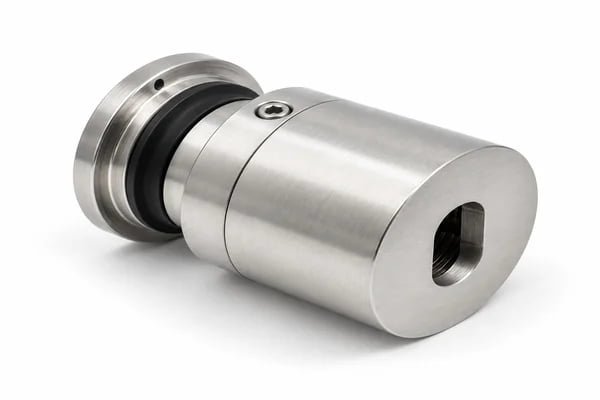
Catalogue illustration: Set-Screw Glass Pool Fence Standoff. Shown as a component reference, not an installation drawing or test result.
Ask for the identified components, drawing revision and inspection record. Review the relevant manufacturing capabilities. The NIST conformity assessment overview helps buyers describe the evidence accurately instead of labelling every inspection a certification.
How do we make quotations comparable?
Send the same two-panel schedule and connection section to every bidder. Require a clear response on compatible parts, included gaskets, glass preparation and exclusions. Keep each side identifiable in the bill of materials so a replacement order cannot reverse the intended arrangement.
The useful purchasing decision is not whether a clamp looks adjustable. It is whether the complete arrangement is documented for the intended glass connection. Request a configuration review with panel details, quantities and the alignment requirement before placing the bulk order.