Plan plant removal before a green wall cable system is ordered: identify which sections can be accessed, how vegetation will be supported during work and which fittings can be released under the approved procedure. Cutting tensioned cables or removing anchors without a controlled plan is not a maintenance strategy.
This lifecycle guide is written for facilities managers joining a project before handover. Our green wall hardware range provides component families; the maintainable arrangement must still be coordinated with the structure, plants and site-access method.
Imagine the first replacement visit
A plant fails beside healthy mature growth. The maintenance team needs to remove it without damaging adjacent stems, the facade or reusable hardware. Which area can be isolated? Where can workers reach the connectors? How will they identify the correct release points once foliage covers the original labels?
Our repairable cable-section guide addresses sectional planning. Jakob’s greening applications and GreenSolutions technical catalogue show examples of cable and mesh approaches; they are design references, not evidence that every catalogue fitting can be released safely while carrying load.
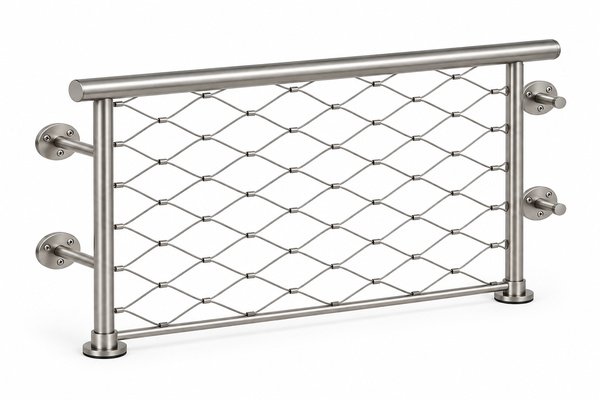
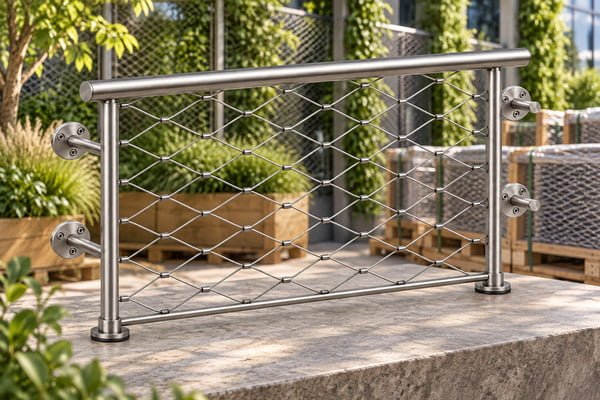
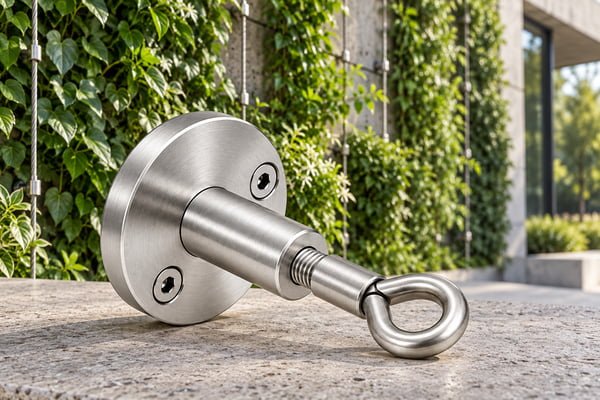
Catalogue illustration: Tubular Rail Cable Mesh Panel — Matte silver appearance. Shown as a component reference, not an installation drawing or test result.
Divide the maintenance problem into manageable zones
| Planning item | Handover information |
|---|---|
| Zone identity | Elevation drawing and location code |
| Plant access | Agreed route and working method |
| Cable or mesh section | Boundaries and connected supports |
| Release procedure | Responsible competent party and approved sequence |
| Replacement parts | Exact models, revisions and permitted substitutions |
| Return to service | Inspection and sign-off requirements |
Zone boundaries should reflect the actual system, not merely equal areas on a spreadsheet. Our plant and access planning article helps connect the cable layout with maintenance needs. A small section is useful only if its connections and load path permit the intended work.
Preserve the building interface
Routine plant removal should not automatically require disturbing facade penetrations. Identify which connections are intended for service and which form permanent parts of the support. Where anchor work is necessary, obtain a project-specific procedure rather than treating a mounting screw as an ordinary gardening fastener.
The Hilti technical-guide library is relevant to the chosen fixing system. If access is near openings, review our cables-around-windows guide so maintenance does not obstruct required access or damage surrounding details. Photographs of the completed facade are useful, but retain drawings showing concealed interfaces too.
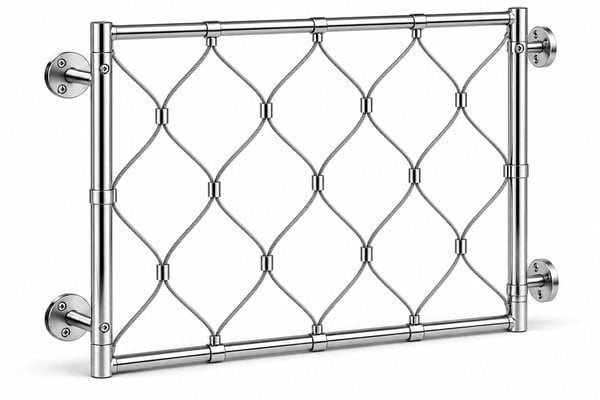
Catalogue illustration: Ferruled Cable Mesh Frame — Polished silver appearance. Shown as a component reference, not an installation drawing or test result.
Inspect what becomes visible after removal
Once vegetation is cleared under the approved plan, inspect the accessible hardware for damage, deposits and changed geometry. Record findings by zone. Do not assume cleaning will resolve every surface condition or that a silver appearance establishes the material grade.
Use ASSDA’s cleaning resource and IMOA’s exposure guidance as maintenance references for the relevant material. The product’s actual care instructions remain important, especially where coatings, adjacent finishes or plant treatments limit permitted cleaning products.
Keep cable and fitting identity together
Replacement planning requires more than a diameter. Record cable construction, terminal codes, connector orientation and the relevant drawing revision. Bergen Cable’s construction overview provides background on why apparently similar cables need not behave identically.
Preserve a labelled spare-parts list and define which components are reusable after disassembly. Do not improvise replacements from visually similar stock. If the original component is discontinued, obtain a documented technical review before changing the fitting arrangement or the maintenance procedure.
Include a handover photograph that shows each zone before vegetation obscures the fittings. Pair it with the drawing rather than treat it as a replacement for dimensional records. Future maintainers can then locate the approved service points without interpreting the entire system from mature foliage.
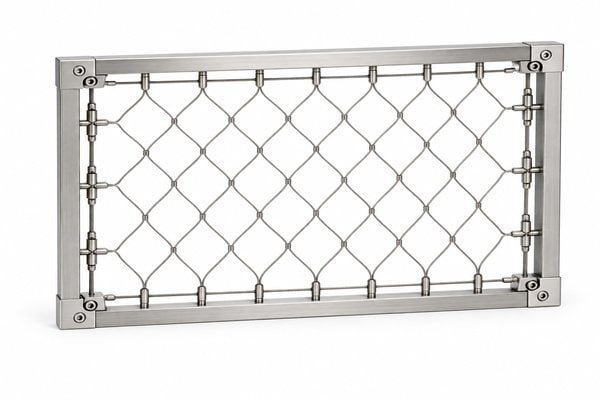
Catalogue illustration: Perimeter Tensioned Cable Net Panel — Fine brushed silver appearance. Shown as a component reference, not an installation drawing or test result.
Buy the service package with the hardware
Ask for readable installation and maintenance instructions, component identification, agreed spare quantities and a route for technical questions. Protect spare parts in storage and during shipment. ISTA’s procedure library can inform packaging discussions; GS1 traceability principles can help link replacement kits to their intended system.
For a hypothetical twelve-zone facade, a useful register has twelve zone entries with their own component references. That is an organisational example, not a recommendation for zone size or loading. The key is to avoid a single undifferentiated list that leaves the maintainer guessing where each part belongs.
Does sectional construction guarantee easy plant removal? No; access and the approved release procedure are equally important. Can any tensioner be loosened first? No; follow the competent designer’s coordinated procedure for the particular system.
Include the maintenance brief in OEM review, discuss manufacturing and assembly options, and send the zone schedule with the enquiry. A maintainable green wall is specified as a lifecycle system, not only as an attractive opening-day elevation.