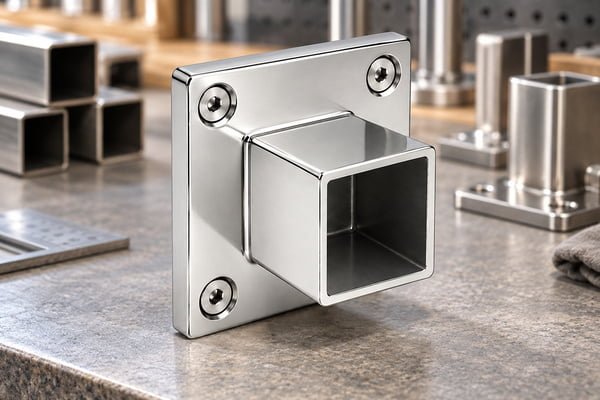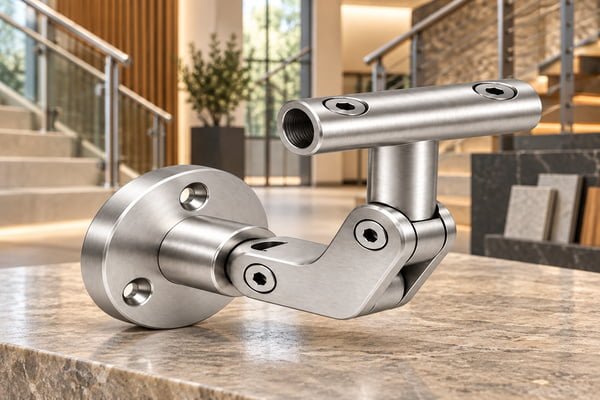
Choose a handrail wall return as part of the complete handrail. The return must coordinate grip clearance, the finished wall, the connection and the installation sequence. A neat-looking bend is not enough if users cannot pass their hand comfortably or installers cannot reach the fixing.
For buyers of stainless steel railing components, wall returns deserve their own schedule. They are often ordered late as decorative accessories even though they determine how a handrail terminates and how the last connection is assembled.
What problem does the return solve?
A return brings the handrail end back toward a wall or another permitted termination. Requirements depend on the applicable accessibility and building provisions. The US Access Board ADA standards provide a specific US reference; they are not a universal specification for every destination market.
As one clearly scoped example, ADA handrail provisions use a minimum 1½-inch clearance between a handrail and an adjacent surface. The applicable arrangement must be checked as a whole. The Board’s stairway guide illustrates termination and extension concepts. It should be read alongside the local project requirements.
Compare the purchasing routes
| Route | Useful when | Check before ordering |
|---|---|---|
| Fabricated return | Geometry is project-specific | Drawing, weld treatment and finish sample |
| Modular elbow and connector | Repeatable site assembly matters | Tube interface and locking method |
| Integrated end fitting | A defined product system is used | Exact series and connection instructions |
Our handrail bracket projection guide helps establish the finished-wall datum. Measure from the completed surface, including cladding, rather than from the unfinished structure. A later wall build-up can consume the intended clearance.
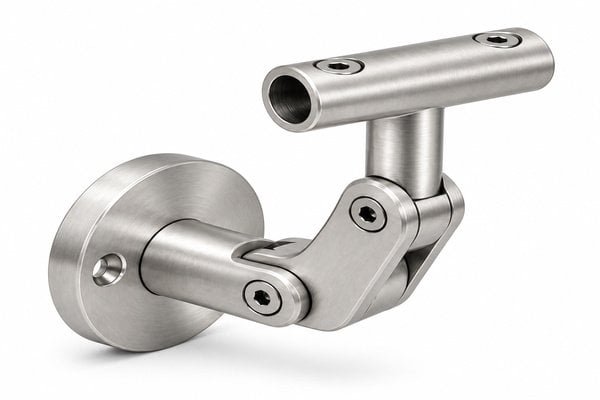
Catalogue illustration: Articulated Wall Handrail Sleeve Bracket — Satin silver appearance concept. Shown as a component reference, not an installation drawing or test result.
Specify the interface in plain dimensions
Write down the tube outside diameter or section, wall thickness, insertion depth where specified and finish. Nominal tube labels alone may not identify the internal fit. ASTM A554 is a reference for welded stainless mechanical tubing; the purchase order still needs the relevant dimensional requirements.
For a bonded connector, follow the selected adhesive’s documented materials, preparation and curing requirements. Henkel retaining compound information explains this joining category. It does not approve a particular railing assembly. The adhesive versus set-screw guide helps frame the comparison without assuming either method is universally stronger.
For threaded retention, confirm engagement, screw access and the manufacturer’s assembly instructions. Bossard’s thread engagement resource supports technical review, but is not a substitute for the fitting’s validated design.
Think through installation in reverse
Imagine the rail already against the finished wall. Can the installer reach every screw? Can the return be inserted without bending the rail? If the final fitting must be installed first, will the adjacent bracket prevent the rail from sliding into position?
These questions are easy to answer with a dry assembly and hard to solve after finishing. Compare the termination with our end-cap selection guide, while remembering that an end cap and a wall return serve different purposes.
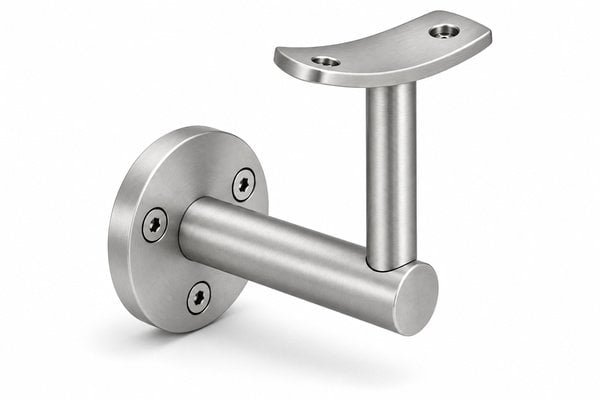
Catalogue illustration: Curved Saddle Wall Handrail Bracket — Matte silver appearance concept. Shown as a component reference, not an installation drawing or test result.
Submit unusual geometry through Elim OEM/ODM with a section view and assembly sequence. Ask the quote to identify which parts arrive assembled and which are loose. Include left- and right-hand quantities if the layout is mirrored.
Approve appearance and inspection together
A fabricated curve may reveal polishing differences under directional lighting. ASSDA surface finish resources help buyers describe a finish beyond “silver.” Review the relevant manufacturing capabilities, then approve a representative junction with the intended cleaning and finishing process.
Record the measurement method for clearance and alignment. NIST traceability guidance explains the basis of traceable measurements, while its conformity assessment overview distinguishes inspection from certification. Neither resource is evidence of a test performed on the supplied return.
For multi-floor orders, identify each return by landing and side. Mirrored layouts can use different parts even when the overall rail length is identical. Ask the packing list to repeat those location codes, and agree an identified service stock where the owner needs replacement components after handover.
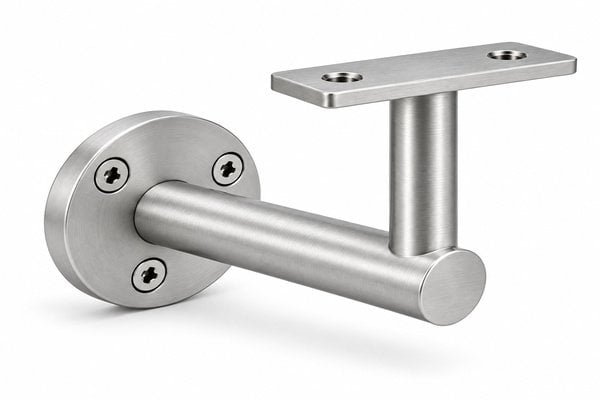
Catalogue illustration: Rectangular Flat Saddle Handrail Bracket — Matte silver appearance concept. Shown as a component reference, not an installation drawing or test result.
Three questions before the purchase order
Does the fitting maintain the required clearance? Check the completed assembly against the project standard, including the wall finish.
Can the connection be serviced? Define access and replacement steps before enclosing or permanently bonding parts.
What should the RFQ contain? Tube dimensions, return geometry, quantities, finish and installation sequence. Send those details for quotation so that the proposal covers the connection as well as the visible component.