Choose adhesive retention or set screws for a stainless handrail connector only within an approved joint design. Adhesive performance depends on the specified product and preparation; mechanical retention depends on geometry, fasteners and assembly conditions. Neither method is automatically suitable because the connector fits inside the tube.
Compare two complete joints
Identify the connector, tube, engagement and intended function from the stainless railing range. The tube-and-fitting matching guide helps establish the basic interface. Do not compare an adhesive-only sketch with a fully specified mechanical connection and treat the price difference as a fair result.
Henkel’s retaining-compound overview describes products for cylindrical assemblies. Its cylindrical assembly design resource provides further context. These are not blanket approvals for structural railing joints or for every stainless connector.
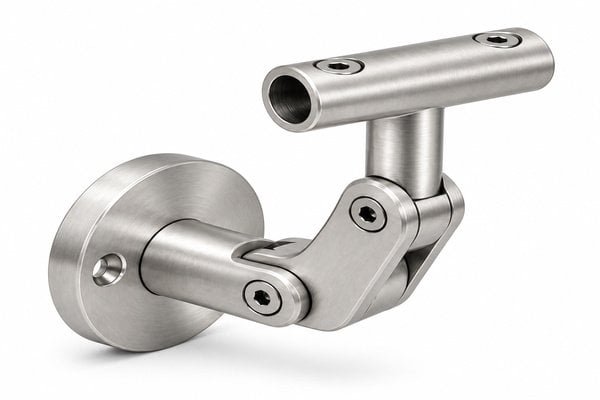
Catalogue illustration: Articulated Wall Handrail Sleeve Bracket — Satin silver appearance concept. Shown as a component reference, not an installation drawing or test result.
What changes between the methods?
| Purchasing issue | Adhesive retention | Set-screw retention |
|---|---|---|
| Interface | Defined bond geometry and surfaces | Defined screw, thread and contact arrangement |
| Assembly | Product-specific preparation and cure | Product-specific positioning and tightening |
| Inspection | Process records and approved checks | Fit, fastener and approved assembly checks |
| Service | Disassembly may be restricted | Access to the fastener must remain available |
The table identifies decisions to resolve, not comparative load ratings. Request applicable evidence for the actual joint and intended service. NIST conformity assessment guidance helps explain the role of testing, declarations and certification.
Adhesive instructions must be specific
Record the adhesive identity, shelf-life controls, preparation procedure and release condition. Obtain the manufacturer’s technical and safety instructions for the selected product. Do not publish a generic curing time: the relevant conditions and product must be known.
Check whether the specified material and surface condition are covered. Outokumpu product information offers material context. An adhesive selected for another alloy or joint should not be transferred to a railing application without assessment.
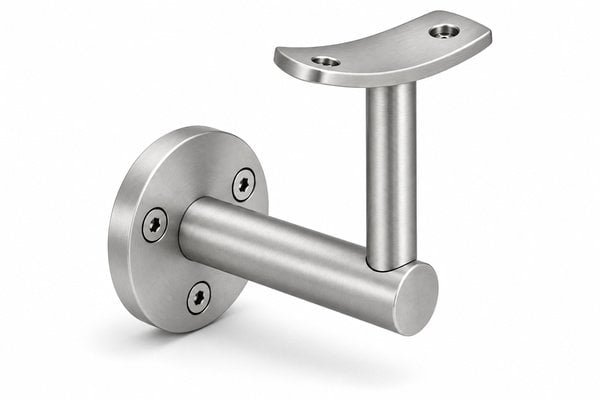
Catalogue illustration: Curved Saddle Wall Handrail Bracket — Matte silver appearance concept. Shown as a component reference, not an installation drawing or test result.
Set screws need more than a nominal diameter
Specify thread, screw form, position and approved assembly requirements. The railing fastener guide helps organize these details. Bossard’s thread-engagement resource shows why engagement is a design question rather than a universal number.
ASSDA’s galling guidance is relevant to stainless-thread handling. Follow the approved instructions for the complete joint. A change in lubrication, screw point or tube wall can affect the arrangement and should be reviewed.
Preserve fit and service access
Use the tube ovality checklist before assuming the nominally round components will mate consistently. Define the accepted interface dimensions and inspection locations. NIST calibration guidance supports a reproducible measurement plan.
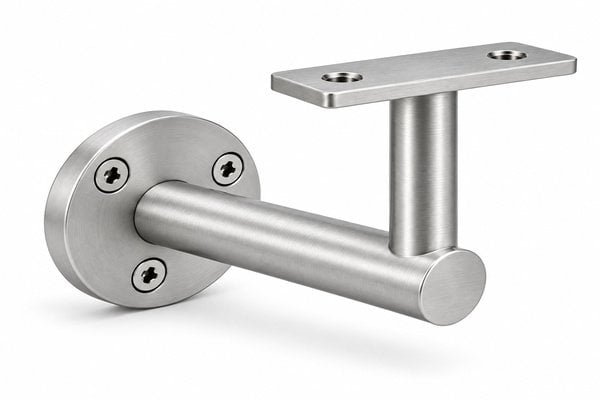
Catalogue illustration: Rectangular Flat Saddle Handrail Bracket — Matte silver appearance concept. Shown as a component reference, not an installation drawing or test result.
Ask each bidder to identify the exact scope of responsibility for joint selection, assembly instructions and performance evidence. If the connector supplier does not select the adhesive, make that interface explicit. Similarly, identify who sets the approved screw assembly requirements. An order should not leave the installer to reconcile two incompatible instruction sets after delivery. Close these questions before a sample becomes the basis for the production release.
Test the planned installation sequence with representative components. If set screws become hidden behind a wall or finishing element, serviceability may be compromised. If adhesive disassembly is restricted, identify which replacement assembly will be supplied and how maintenance is intended to proceed.
Separate process approval from batch inspection
A successful trial assembly does not establish every performance claim. Agree what design evidence is required and what production checks will control repeatability. Link parts, adhesives or fastener batches and inspection records using a scheme informed by GS1 traceability guidance.
For example, a hypothetical change from one adhesive code to another should trigger the agreed change-review process, even if the supplier describes both as “metal adhesive.” The same applies to a different screw point or connector engagement. Retain the approved configuration so purchasing can recognize a change rather than accepting a familiar-looking part.
Can adhesive hide a loose fit? Do not use it as an improvised correction outside the approved joint design.
Are set screws always removable? Only if access and the specified service procedure permit it.
Which is faster to install? Compare the complete sequence, including preparation, cure or tightening and inspection.
For an OEM connector review, submit the joint section and service requirements. Review manufacturing capabilities and request a quotation against one controlled configuration with explicit assembly and evidence requirements.