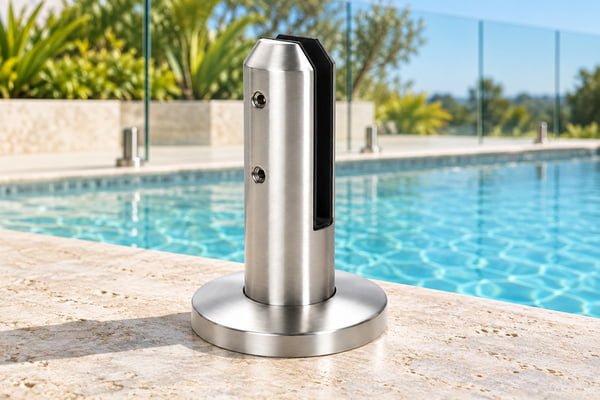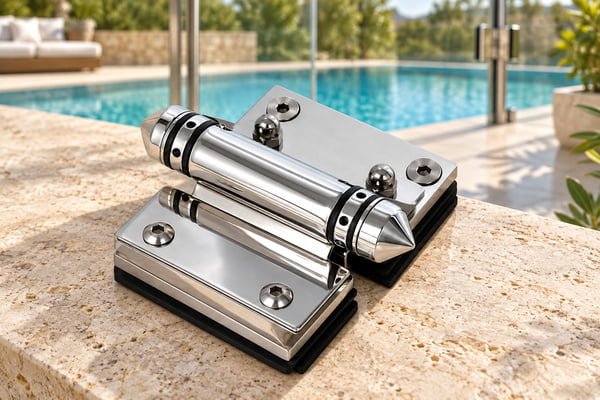
Maintenance answer: Movement at a pool gate can come from hinge wear, loose fixings, glass movement or the supporting structure. Identify where the movement occurs before replacing parts. A gate that no longer closes or latches reliably needs prompt attention under the applicable safety requirements.
This field-record guide supports maintenance teams responsible for pool gate hardware. It explains how to describe a problem accurately; it does not provide a universal permissible hinge clearance or authorize dismantling a loaded gate.
Begin with the complete gate
Record the gate identification, hinge model, latch model and installation date if known. Photograph both hinges, the latch and the supporting surfaces. Use the closing-test checklist to keep operational observations separate from dimensional measurements.
D&D’s technical drawings and manufacturer FAQ illustrate the type of model-specific information needed. A hinge with a spring, bearing or hydraulic mechanism may require a different service procedure from a simple pin joint.
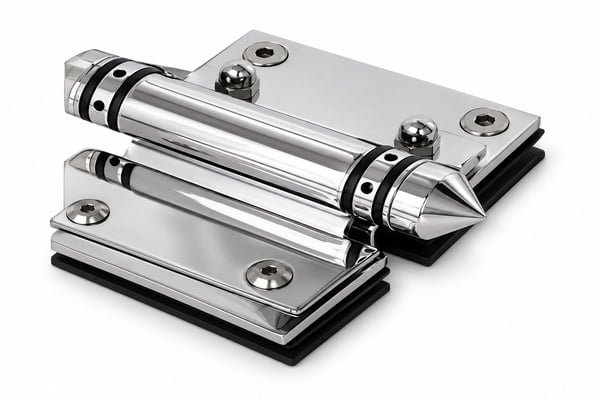
Catalogue illustration: Bolt-Plate Glass-to-Glass Pool Gate Hinge. Shown as a component reference, not an installation drawing or test result.
Locate the movement
| Where movement is seen | Possible source to investigate | Useful evidence |
|---|---|---|
| Between hinge leaves | Pin or bearing interface | Close video and model code |
| Between hinge and mounting face | Fixing or mounting interface | Joint photographs |
| At the supporting post | Support movement | Wider view during operation |
| At the latch | Alignment or gate movement | Closing sequence |
These are diagnostic possibilities, not conclusions. More than one issue may be present. A technician should assess the assembly using the manufacturer’s instructions and suitable support arrangements.
Do not compensate for wear with another adjustment
Increasing closing force to overcome misalignment may hide the symptom without correcting the cause. Compare spring and hydraulic hinge systems to understand the mechanism involved. The SureClose product documentation is specific to that product family and must not be transferred to an unrelated hinge.
Similarly, moving a striker until the latch catches can conceal a gate that has changed position. D&D’s latch adjustment guidance concerns its specified hardware; first establish why adjustment is needed.
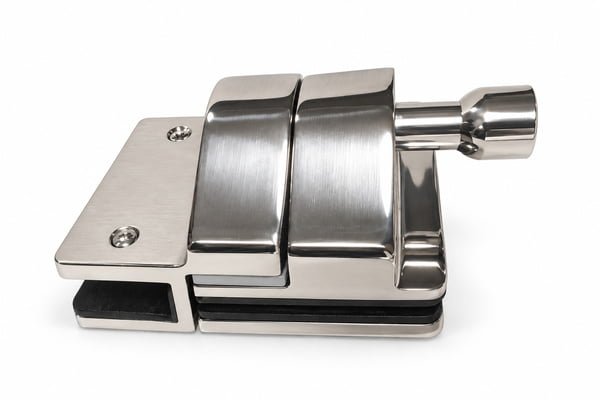
Catalogue illustration: Inline Glass Pool Gate Latch with Metal Housing. Shown as a component reference, not an installation drawing or test result.
Make the inspection repeatable
Use the same observation position and record the gate state during each measurement. Include whether the gate was open, closed or supported. A loose verbal description such as “slightly more play” is difficult to compare over time.
If a manufacturer provides a wear limit and measurement procedure, record both with the result. If no limit is available, request an assessment instead of inventing a millimetre allowance. A value suitable for one hinge geometry may be inappropriate for another.
Public guidance such as the CPSC pool barrier guide emphasizes the complete barrier. NSW owner obligations are a jurisdiction-specific example of ongoing maintenance responsibilities; use the rules for the actual project location.
Repair or replace?
The retrofit guide helps structure this decision. Confirm whether the pin, bushing or complete hinge is an approved replacement item. Check glass cutouts, fixing positions and clearances before ordering a different model.
A catalogue photograph cannot prove interchangeability. Use dimensions and instructions from the actual supplier. The CRL pool hardware catalogue is useful for product terminology, not for approving a mixed-brand repair.
Where several gates share the same model, use a location register and record the condition of each gate separately. One successful gate does not prove that the others are operating correctly. Keep photographs from before and after the repair, together with the replacement part numbers. If a repeated issue appears across one delivery lot, send the combined record to the supplier rather than treating every occurrence as an unrelated callout. This improves both maintenance planning and the quality of the investigation.
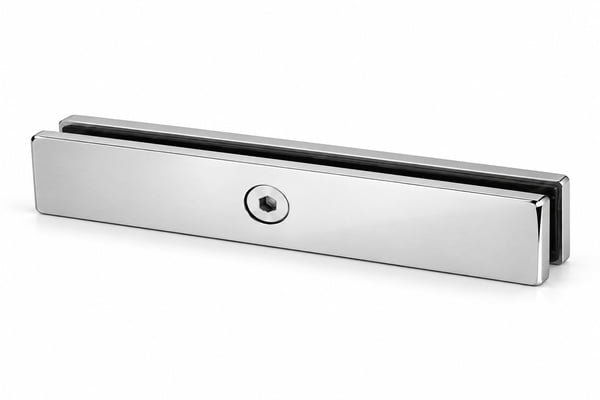
Catalogue illustration: Long Flat Glass Pool Fence Joiner — Polished silver appearance concept. Shown as a component reference, not an installation drawing or test result.
A practical service enquiry
Send the original order reference, labelled photographs, inspection findings and the required completion date. Link the replacement to the original lot where possible; GS1 traceability guidance provides a general recordkeeping framework.
Include whether the site requires a complete hinge set, matching latch components or spare fasteners. The quotation should identify what is included, not simply state “replacement hinge.” This reduces the chance of a second visit for a missing accessory.
Can the existing pin be machined to remove wear? Only under an approved repair procedure. An improvised change can alter clearances and the original design.
Can one hinge be changed independently? Ask the supplier to assess the complete gate and the compatibility of the remaining components.
Use the OEM enquiry route for a reviewed replacement proposal, consult manufacturing capabilities, and send the inspection record. Retain the completed repair and operational check in the site’s maintenance file.