Compare pool gate closing systems by their complete closing and latching performance on the intended gate, not by the words “spring” or “hydraulic” alone. Hydraulic damping controls movement; the mechanism that returns the gate and the latch that secures it must also be identified. This comparison is for distributors evaluating product families and contractors coordinating gate hardware.
What is actually being compared?
A spring provides restoring force. A hydraulic mechanism can regulate closing movement, and some products combine both functions within a hinge-closer. Therefore, “spring versus hydraulic” is useful shorthand for shopping, but it is not a complete engineering description.
Our pool fencing hardware range includes gate-related components. Do not infer an internal mechanism from a photograph. For an external example, D&D’s SureClose product page describes a hydraulic hinge-closer and differentiates models. That example is not a claim that an Elim hinge has the same mechanism, capacity or approval.
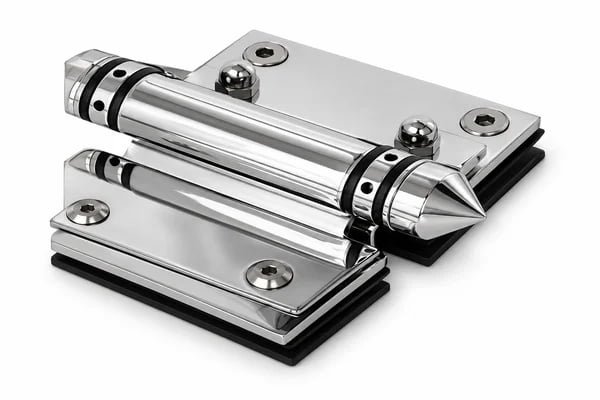
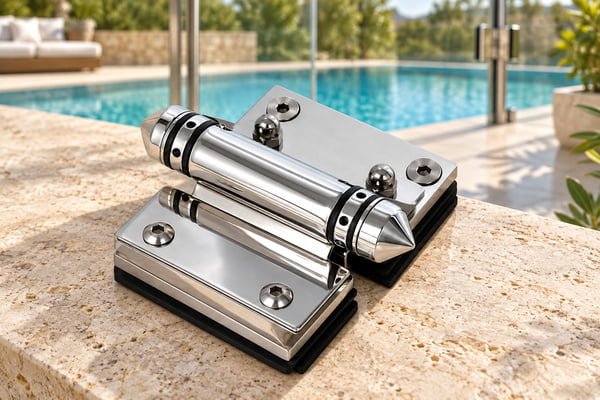
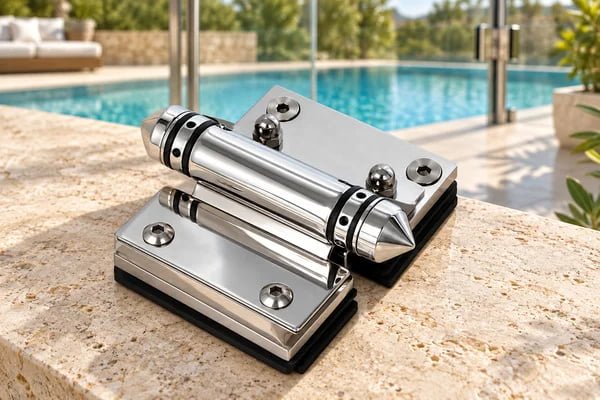
Catalogue illustration: Bolt-Plate Glass-to-Glass Pool Gate Hinge. Shown as a component reference, not an installation drawing or test result.
Compare the complete gate arrangement
| Buying question | What to establish |
|---|---|
| Return action | How the selected model moves the gate toward closure |
| Speed control | Whether adjustment exists and its documented limits |
| Latching | Compatibility with the installed latch and closing geometry |
| Gate identity | Width, mass, material and mounting arrangement |
| Exposure | Intended environment and maintenance requirements |
| Service | Replacement parts, instructions and access |
Use our gate hinge width and weight guide to organise the configuration. A product advertised for a steel gate is not automatically suitable for a frameless glass gate. Interface geometry and the approved fixing arrangement must match as well as the stated application.
What matters at a pool barrier?
Closing movement is only one part of barrier performance. Review the applicable local requirements for the gate, latch and surrounding barrier with the responsible professional. The CPSC pool-barrier guide, NSW pool-owner guidance and Pool Safely resource provide public safety context for their respective audiences; none is a universal approval checklist for every market.
For procurement, request the exact installation instructions and the evidence supporting the proposed model and configuration. Avoid selecting a hold-open feature for convenience without resolving its suitability for the required pool-barrier function. A generic “self-closing” label is insufficient documentation.
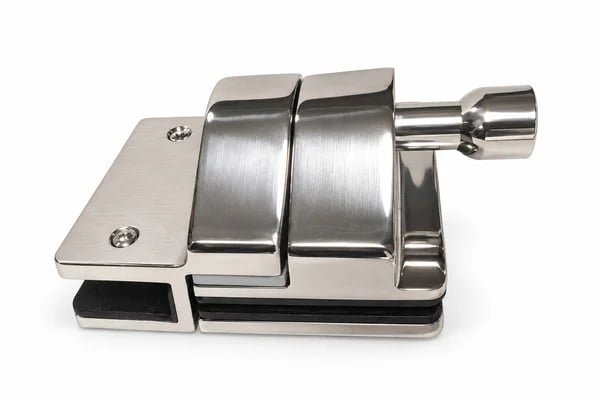
Catalogue illustration: Inline Glass Pool Gate Latch with Metal Housing. Shown as a component reference, not an installation drawing or test result.
A demonstration should answer a specific question
Ask the supplier to demonstrate the proposed assembly using the documented procedure and relevant opening conditions. Record gate details, settings, latch identity and results. Do not accept a short video of an unidentified gate as proof that another model will behave the same way.
Our pool gate closing-test checklist helps structure the record. If a trial reveals inconsistent latching, investigate alignment, mounting, hardware compatibility and settings. Increasing closing force without diagnosing the problem can hide another defect and should not replace the approved adjustment procedure.
Compare ownership cost, not only hinge cost
List installation labour, commissioning, service access, replacement availability and expected inspection tasks separately. A mechanism with additional adjustment may be useful, but only if the installer and maintainer receive clear instructions. Ask how settings are identified and protected against unintended change.
For glass components, the CPSC tempered-glass alert supplies safety context. For outdoor stainless parts, consult IMOA’s exposure guidance and ASSDA’s cleaning resource. These do not establish the material or performance of a particular hinge; the purchase schedule must name the actual supplied specification.
For a distributor comparison sheet, keep gate material and mounting arrangement beside the mechanism description. A hydraulic closer for a metal gate and a hinge for frameless glass are not directly interchangeable stock items. Ask which additional brackets, fasteners and installation steps each complete option requires.
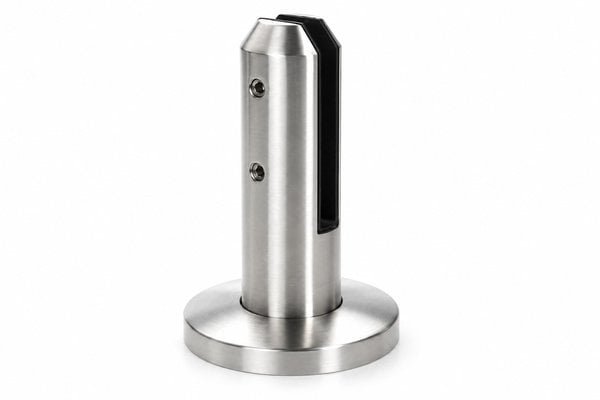
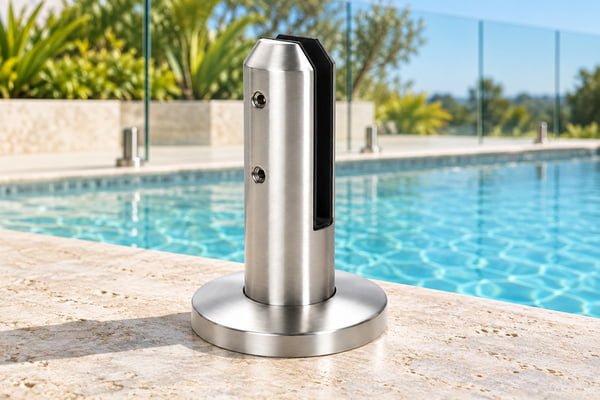
Catalogue illustration: Round Base-Plate Glass Pool Fence Spigot. Shown as a component reference, not an installation drawing or test result.
Questions to ask before approving a range
Is hydraulic always better? No. Compare the documented performance, intended gate and service requirements of the exact products. Does a hinge-closer remove the need for a latch? Do not assume so; evaluate the whole barrier arrangement.
Can an existing latch remain? Check its compatibility with the new closing system. Our latch-positioning guide highlights the glass preparation and clearance information that may need coordination. Maintain model and batch records using a defined system; GS1 traceability principles provide a general framework.
Request OEM compatibility review for a proposed change, discuss the relevant manufacturing capabilities, and send the gate configuration for a model-specific response. Catalogue illustrations in this article identify component families; they do not expose or verify an internal hydraulic mechanism.