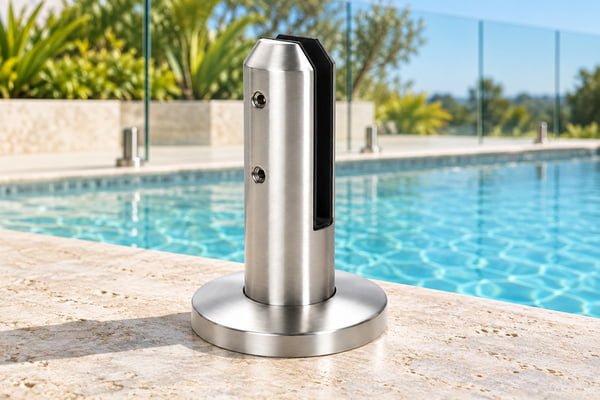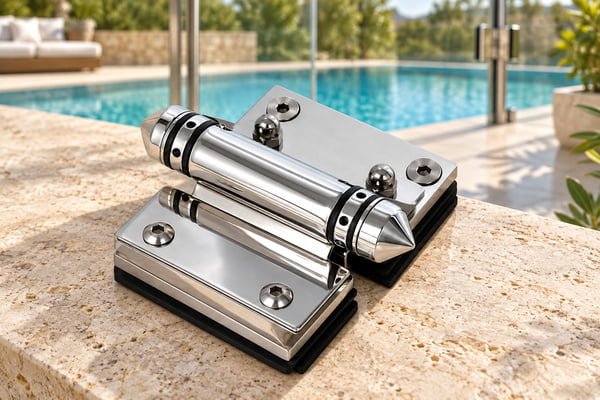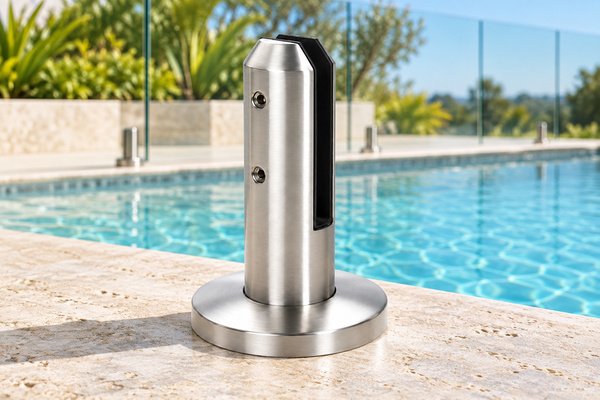
A pool fence spigot cover should fit the exact spigot and base geometry while preserving the approved drainage, fixing access and finished-deck detail. Its decorative role does not make it a structural anchor or a waterproofing system. This detail-review guide is for contractors and buyers trying to avoid last-minute cover modifications at site.
Start below the visible cover
Choose the base arrangement first. Our pool fencing hardware range includes different mounting configurations, and the base-plate versus core-drill comparison explains why their interfaces should not be mixed. A cover that slides over one shaft may not clear another shaft’s shoulder or adjustment hardware.
Record the finished deck level, the structural substrate and any intermediate layers. Use the Hilti technical-guide library when reviewing the selected anchor system. A neat cover cannot correct an unsuitable substrate or an unapproved fixing arrangement.
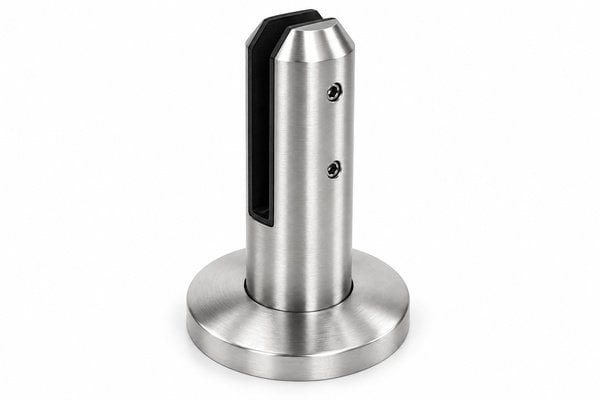
Catalogue illustration: Round Base-Plate Glass Pool Fence Spigot. Shown as a component reference, not an installation drawing or test result.
Five dimensions belong on the drawing
| Dimension or feature | Coordination question |
|---|---|
| Centre opening | Does it clear the actual spigot profile and tolerances? |
| Internal envelope | Does it clear the base, fastener heads and washers? |
| Cover height | Does it sit correctly above the finished surface? |
| Outer footprint | Does it overlap joints, edges or adjacent fittings? |
| Removal path | Can it be lifted or opened after the glass is installed? |
Do not specify only the outside diameter or width. A cover can have the expected visible size and still foul a bolt head internally. Ask for a section view showing the complete base assembly, not an isolated top-view outline.
Test the assembly sequence on paper
For a one-piece cover, determine when it must be placed over the spigot. If later removal would require disturbing glass or structural hardware, record that constraint before approval. Where a split cover is proposed, check how the pieces connect, how the joint appears and how the fastening method is serviced.
This is a maintenance-access decision as well as an appearance decision. The CPSC pool-barrier guide provides safety context for keeping the completed barrier effective; it does not specify an Elim cover design. Any maintenance affecting barrier integrity needs an appropriate controlled procedure.
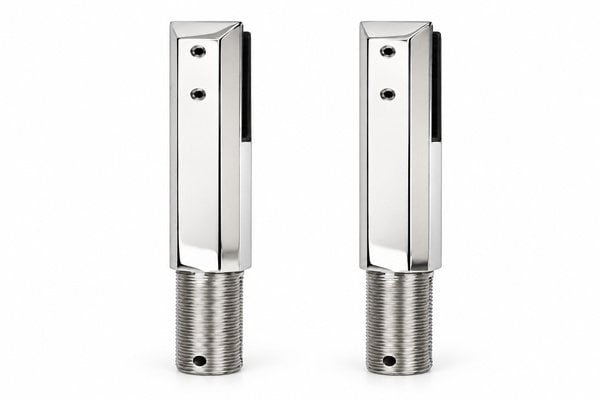
Catalogue illustration: Threaded-Shank Core-Drill Pool Fence Spigot — Polished silver appearance concept. Shown as a component reference, not an installation drawing or test result.
Keep drainage and waterproofing distinct
Water may enter a decorative cover unless the particular detail is designed otherwise. Review where it can leave and whether the assembly traps dirt or obstructs existing drainage. Our spigot drainage article identifies interfaces that deserve attention; do not improvise holes or sealants on site without approval.
For a tiled installation, coordinate the deck-layer ordering checklist with the tile contractor and waterproofing designer. A cover conceals part of the interface; it does not demonstrate that the underlying waterproofing connection is complete.
Outdoor stainless selection and care can be discussed using IMOA’s coastal guidance, ASSDA’s tea-staining resource and ASSDA’s cleaning guide. Avoid an unsupported “maintenance-free” claim simply because the cover is described as stainless steel.
Approve appearance under repeatable conditions
Agree the visible finish, grain direction if relevant, edge condition and comparison sample. Inspect the cover alongside the spigot rather than compare separate photographs taken under different lighting. A surface that looks similar on a screen may appear different once assembled.
Measure fit using appropriate instruments and record the drawing revision. NIST’s traceability policy supplies the general measurement framework. Do not force an undersized opening over the spigot or modify an edge to compensate for an unrecorded dimensional mismatch.
Use a sample to rehearse the agreed installation sequence before final packing. Check whether the cover must be positioned before another part is fitted and whether its protective film remains accessible for removal. Small sequencing details can create unnecessary rework even when every nominal dimension is correct.
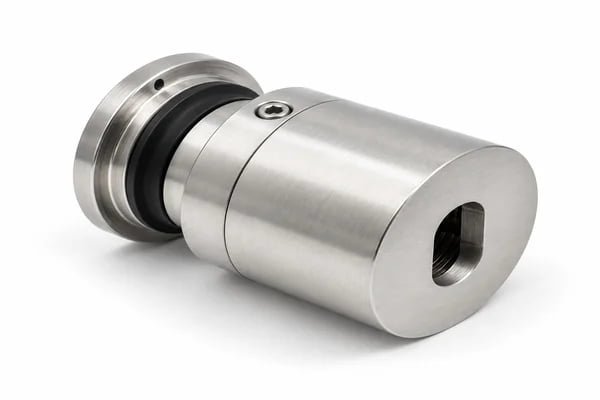
Catalogue illustration: Set-Screw Glass Pool Fence Standoff. Shown as a component reference, not an installation drawing or test result.
Include the small delivery details
Specify whether covers are packed with individual spigots or supplied as separately labelled items. Protect visible surfaces from contact with loose fasteners. ISTA’s procedure library can inform transport-validation discussions, while GS1 traceability guidance helps frame the connection between part codes and packing records.
Can the cover conceal any base plate? Only if the internal fit and approved assembly permit it. Does a close-fitting cover make a waterproof seal? Not unless the approved system explicitly provides that function. Should it be removable? Define the required service route before choosing the design.
For a custom cover, send the entire base section for OEM review. Discuss the intended manufacturing route, and request a coordinated quotation with model codes, quantities and deck details. The goal is a cover that remains practical after installation, not merely attractive before assembly.