A pool gate stop limits movement at an intended contact point; it does not replace the gate’s closing and latching functions. Specify it together with hinge travel, glass clearance and the opening path so the gate cannot reach an unintended hard contact. This troubleshooting guide is aimed at contractors coordinating the complete gate assembly.
Start with the collision, not the accessory
On the plan, mark the gate at its closed position and throughout its permitted opening arc. Identify nearby walls, posts, handles and fixed glass. Then locate the intended stopping surface. A catalogue stop is not suitable merely because it fits in the remaining floor space.
Review the candidate pool fencing hardware as one assembly. The D&D product-drawing library is an external example of model-specific geometry. Its documents apply to its identified products, not to an unverified substitute from another supplier.
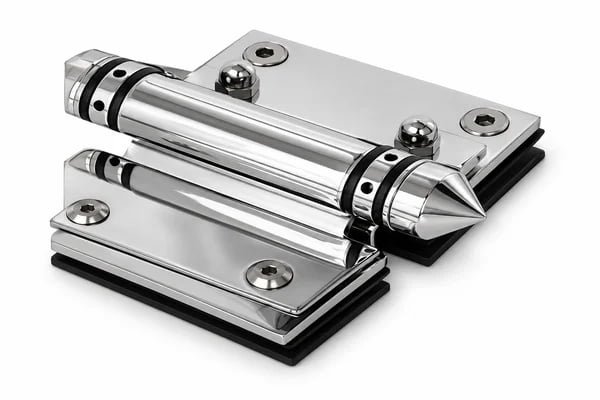
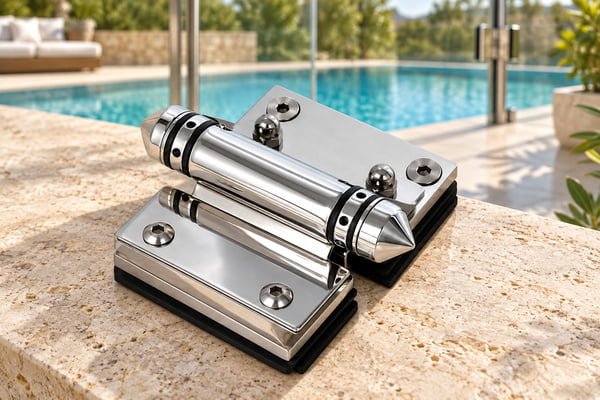
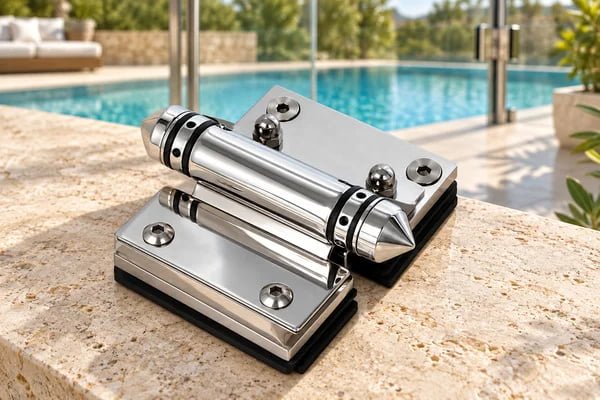
Catalogue illustration: Bolt-Plate Glass-to-Glass Pool Gate Hinge. Shown as a component reference, not an installation drawing or test result.
Three failure scenarios to review
1. The glass reaches the wall first
A stop positioned too late in the opening arc may allow a handle or glass edge to hit an obstruction. Check the complete moving envelope, including the handle projection. Do not resolve a clash by assuming the user will always open the gate gently.
2. The hinge becomes the unintended stop
Some hinges have specific travel limitations or integrated features. Read the exact manufacturer’s instructions rather than assuming all hinges can absorb an impact at full opening. Our pool gate hinge selection guide helps define the gate geometry and load information needed for that review.
3. The added stop interferes with closing
A poorly coordinated part can obstruct movement, catch another component or create an unwanted hold-open effect. Pool-barrier requirements must govern the complete gate. The CPSC barrier guide, NSW owner guidance and Pool Safely resources provide jurisdiction-specific or general safety context; confirm the requirements applicable at the project location.
Specify a complete interface
| Detail | Record before purchasing |
|---|---|
| Movement | Hinge-side plan and intended opening direction |
| Contact | Approved contact location and receiving surface |
| Clearance | Gate, handle, fixed glass and wall envelopes |
| Fixing | Substrate, fastener arrangement and access |
| Maintenance | Replaceable parts and inspection access |
The CPSC glass safety alert is relevant when a proposed change affects glass fabrication. Do not introduce a new hole into finished tempered glass to fit an accessory. Any glass preparation must be coordinated with the glass manufacturer and approved assembly detail.
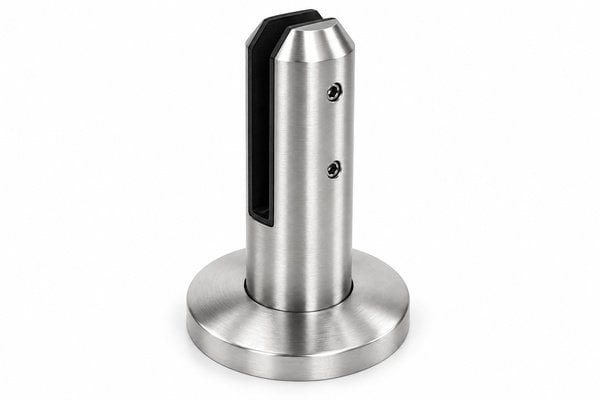
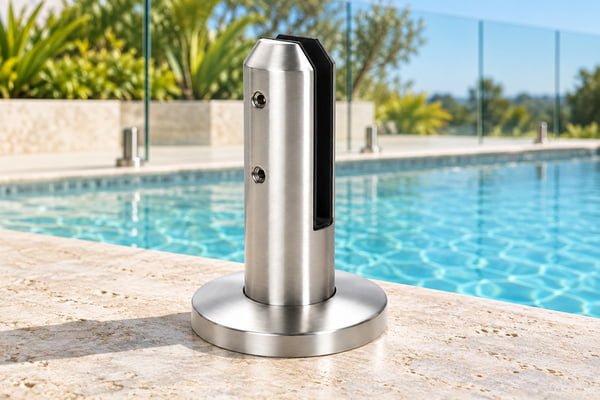
Catalogue illustration: Round Base-Plate Glass Pool Fence Spigot. Shown as a component reference, not an installation drawing or test result.
Separate closing control from stopping
The D&D hydraulic-closing product information illustrates a particular closing mechanism. Our spring versus hydraulic comparison discusses the procurement questions behind different mechanisms. Neither establishes that a chosen closer also provides an approved impact-stop function.
Ask the supplier to state which component performs each function: hinge support, controlled closing, latching and limiting opening. If one component provides several functions, request its documentation. The quote should identify the exact configuration, not just say “complete gate kit.”
Check the mounting substrate
A stop fixing may encounter a tiled deck, waterproofing layer or thin structural section. Coordinate the detail before selecting the fixing. Hilti’s technical guides provide anchor-design context, not approval of an unspecified stop installation.
For modified mounting parts, use our drawing-based development process. The capabilities overview identifies manufacturing activities; the project designer still needs to approve the intended connection. Avoid converting an attractive accessory photograph into a structural fixing specification.
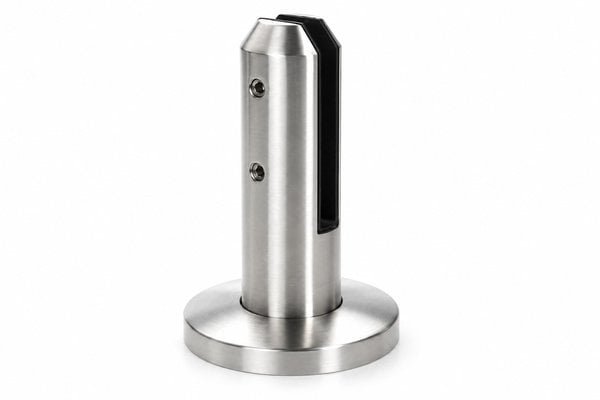
Catalogue illustration: Round Base-Plate Glass Pool Fence Spigot. Shown as a component reference, not an installation drawing or test result.
Handover: inspect the complete gate
Use the closing-test checklist to record the approved gate checks after installation. Include clearance observations and the identity of any stop. Follow the applicable procedure and manufacturer instructions; do not invent an impact test using uncontrolled force.
Keep the installation configuration with the handover record. NIST’s conformity-assessment explanation helps distinguish a functional inspection from independent certification. A successful closing observation on one occasion is not a certificate for every possible installation.
Does every pool gate need an additional stop? The answer depends on the approved gate system, travel arrangement and applicable requirements. Specify the function first, then identify the permitted component.
To request coordinated gate hardware, provide the gate drawing, adjacent obstructions, hinge model, intended movement, mounting substrate and quantities. This gives the supplier enough context to review a complete arrangement instead of quoting an isolated accessory.