
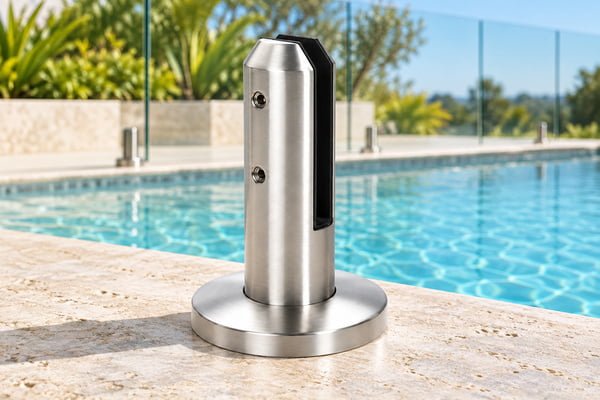
Quick answer — pool fence spigots: Choose base-plate or core-drill pool fence spigots around the supporting slab, fixing detail and finished surface. A base plate needs its specified anchor layout; a core-mounted unit needs its specified embedment arrangement. Quote the selected pool-fence assembly separately from any guard required at a raised edge.
This decision memo helps contractors compare pool fencing hardware before placing a project order. It is a purchasing framework, not a structural design or a declaration that a particular component meets every pool-barrier rule.
Decision owner: who approves the barrier?
Identify the project location and the person responsible for barrier compliance. The CPSC residential-pool guidance and NSW pool-owner requirements address different jurisdictions. Do not combine their details into one assumed international standard.
Coordinate the glass specification with the applicable project requirements. The AGWA notice on AS 1288 provides Australian glass-standard context; obtain the current requirements relevant to the actual installation. The hardware quotation should reference the approved design rather than replace it.
Route A: surface mounting with a base plate
Elim catalogue comparison: Elim’s round base-plate spigot and threaded-shank core-drill reference show two mounting families. The named mounting style is useful for the shortlist; the polished appearance concept does not identify an approved core-hole or embedment detail. Catalogue references: round base-plate spigot.
Buying decision: Compare both systems before finishing the slab edge. Include drilling, anchors or fixing medium, cover parts and replacement access in the price comparison. The mounting option that is cheapest to buy may require more site work or costly repair access.
Ask whether the substrate and edge conditions support the proposed fastening system. Hilti’s technical guides illustrate that anchors require system-specific design and installation information. Do not select them solely because their diameter fits the spigot plate.
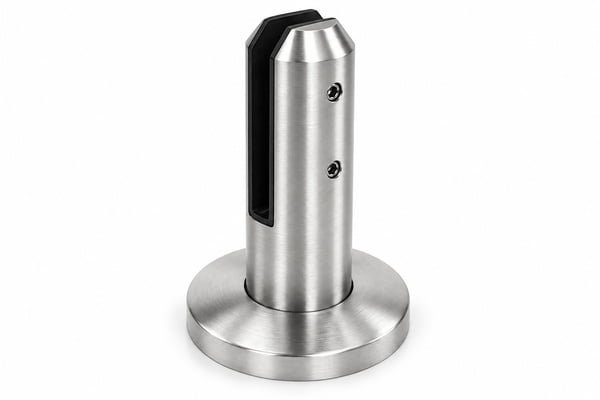
Catalogue reference: Round Base-Plate Glass Pool Fence Spigot. Appearance does not establish dimensions or performance.
What does a concrete core-mount spigot specification actually include?
CRL’s FWCR12PS example is a core-mounted, friction-fit component for 12 mm tempered glass made from duplex 2205. The manufacturer excludes guard-rail use. Do not transfer its material or glass specification to an Elim model.
| Purchase choice | Drawing information that changes the order |
|---|---|
| Base plate | Plate footprint and anchor-hole pattern |
| Core mount | Embedded shank and specified core detail |
| Cover ring | Outside diameter and finished surface level |
A shank diameter is not the required core-hole diameter. The installation detail also needs embedment and the specified fixing medium. For a pool-boundary screen, quote the selected system against the pool layout; for a raised edge, resolve the separate guard requirement before comparing component prices.
Source: CRL core-mount spigot specification. Reference checked 27 September 2026.
Request a matched quotation: Send the slab section and preferred base-plate or core-mount arrangement for a quotation with installation exclusions listed..
Route B: a core-drill fixing arrangement
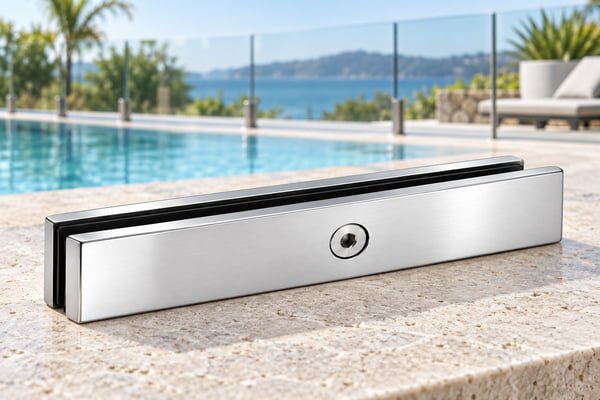
A threaded-shank core-drill spigot changes the lower connection geometry. Request the complete installation detail, including the substrate preparation and specified fixing materials. The product photograph cannot establish embedment or drilling dimensions.
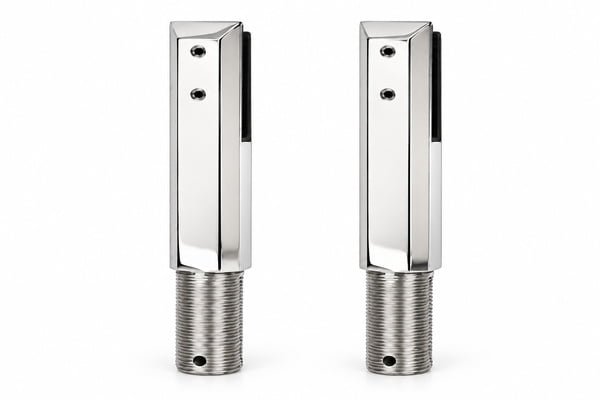
Catalogue reference: Threaded-Shank Core-Drill Pool Fence Spigot — Polished silver appearance concept. Appearance does not establish dimensions or performance.
Compare both routes on one decision sheet
| Decision item | Evidence required before ordering |
|---|---|
| Substrate | Site description and approved fixing design |
| Glass | Panel specification and interface drawing |
| Waterproofing | Coordinated detail and responsible trade |
| Installation | Access and sequence review |
| Maintenance | Inspection and replacement approach |
For a hypothetical quotation comparison, ask both suppliers to price the same panel layout and scope. Separate drilling, anchors, covers, protective packing and site labour. Do not infer a required spigot quantity from this example; the design establishes the support arrangement.
Review the environment independently
Use the coastal pool material discussion to prepare questions about grade and exposure. IMOA’s coastal-salt guidance and ASSDA’s tea-staining advice support that conversation. They do not certify an individual spigot or remove the need for maintenance.
Treat colour, material and corrosion performance as separate fields. If a catalogue image describes an appearance concept, request confirmation of the production finish through Elim’s OEM review before making a commitment to the project client.
Close the commercial gaps
Continue the same project: Sourcing Glass Pool Gate Hinges and Latches: A Compatibility Checklist covers the next related purchasing decision in this system.
Consult ISTA’s procedure overview for appropriate packing evaluation and Trade.gov’s document guide for shipment paperwork. Keep each variant identifiable at unloading so a similar finish does not conceal a different fixing arrangement.
Contractor questions
Is a core-drill spigot always stronger? No universal conclusion follows from the mounting name. The complete assembly, substrate and design evidence govern selection.
Can the contractor switch mounting style after glass is ordered? Review the change with the responsible design team first. Interfaces, levels and support assumptions may change.
What should accompany the RFQ? Send the location, panel layout, glass details, substrate section, waterproofing information and quantities through the project quotation form. Ask the supplier to identify every assumption in the proposed fixing arrangement.
Comments (3)