
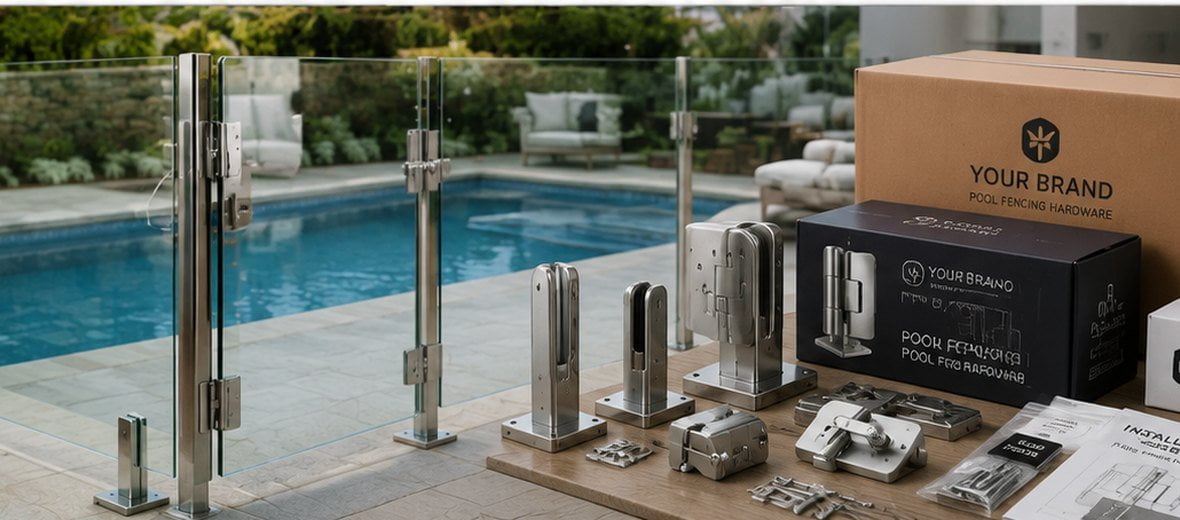
Private label pool fencing hardware can look simple at first, but one wrong hole position, hinge match, or finish choice can create costly installation problems after import. Distributors often start with logos and packaging. I prefer to start with fit, environment, and risk control before any branding decision is made.
Private label pool fencing hardware can be customized in logos, labels, barcodes, manuals, packaging, kit combinations, spare-part packs, materials, finishes, and some dimensions. However, distributors should confirm fence system size, installation method, usage environment, local regulations, and sample fit before changing load-related structures, holes, hinges, latches, or clamps.

In distributor inquiries, I have seen many buyers treat customization as a decoration step. That approach is risky for poolside hardware. A better approach is to separate easy branding changes from technical changes that affect installation, corrosion resistance, safety expectations, and after-sales support.
Why Should Private Label Pool Fencing Hardware Customization Start With System Fit?
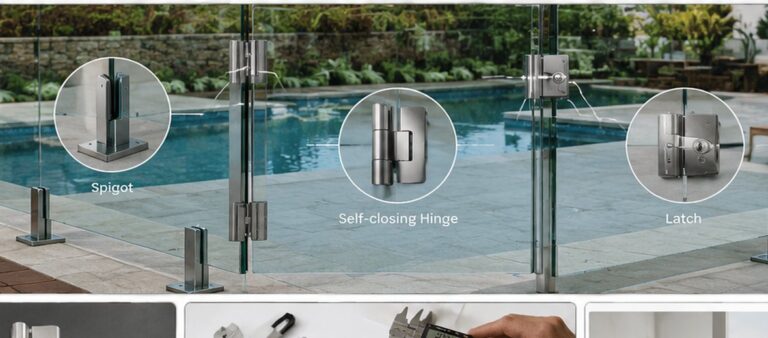
Private label pool fencing hardware creates problems when the customized part does not match the actual fence system. A distributor may approve a logo quickly, but installers still need the hinge, latch, clamp, spigot, screw, and glass size to work together on site.
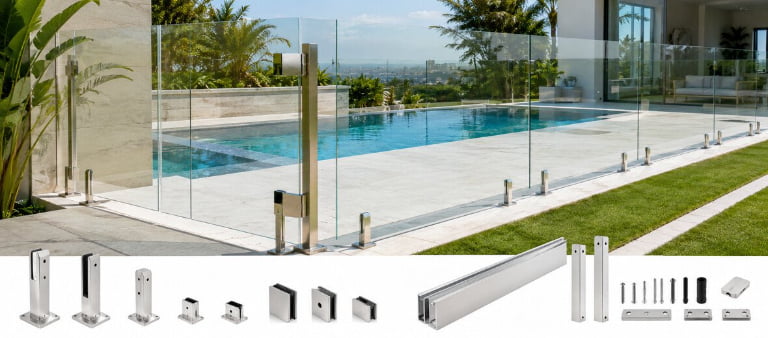
Private label pool fencing hardware customization should start with system fit because the hardware is part of an installed barrier system, not a loose accessory. Before importing, distributors should confirm glass thickness, post or frameless design, installation surface, hole positions, accessory combinations, and target-market requirements.
Dive deeper
I often see one misunderstanding during sampling discussions: the buyer asks, “Can we put our brand on it?” before asking, “Will this fit our system?” The logo question is valid. However, it should come after the fit question.
Pool fencing hardware works under real installation conditions. The part may be installed near water, outdoors, on concrete, timber decking, tile, or stone. The fence may use glass panels, posts, clamps, spigots, hinges, gates, latches, or mixed accessories. Each condition changes the customization conversation.
A distributor should first define the system. This step does not require a long engineering report, but it does require clear communication.
Start with these system details
Before discussing private label packaging or color, I recommend that distributors prepare:
- Fence type: frameless glass, semi-frameless glass, post-supported, tubular, or mixed system
- Glass thickness: common examples include 10 mm, 12 mm, or other local specifications
- Panel dimensions: width, height, and edge treatment expectations
- Gate weight and size: especially important for hinges and latches
- Installation surface: concrete, tile, timber, composite deck, or metal frame
- Fixing method: core-drilled, base-plated, side-mounted, or clamp-mounted
- Local market: country, region, sales channel, and applicable buyer requirements
- Usage environment: poolside, coastal, humid, high-salt, public, or residential
I treat customization as a risk-control process. A branded box is useful, but a well-matched system protects the distributor from returns, installation delays, and reputation damage.
Why the sales channel matters
A distributor selling to contractors may need bulk cartons, installation packs, and replacement parts. An e-commerce seller may need retail packaging, barcodes, manuals, clear product images, and labeled components. A pool contractor may care more about screw quality, template accuracy, and fast identification on site.
| Sales Channel | Customization Priority | Risk If Ignored |
|---|---|---|
| Wholesale distributor | Carton labels, item codes, spare parts | Warehouse confusion and wrong shipments |
| Contractor supply | Installation packs, screw sets, diagrams | Delays and incomplete installation |
| E-commerce seller | Retail packaging, barcode, manual | Returns and negative reviews |
| Private-label brand | Logo, finish consistency, product family | Weak brand recognition |
| Project supplier | Samples, test documents, batch traceability | Approval delays |
Distributors should also verify local pool barrier rules and safety requirements in the target market. A supplier can support samples, technical drawings, material information, and third-party testing processes where available. However, buyers should not treat a supplier conversation as a legal compliance opinion or engineering certification.
For complementary guidance, see Coastal Pool Projects: When Is 316 Stainless Steel Worth the Extra Cost?.
Which Private Label Pool Fencing Hardware Items Are Low-Risk to Customize?
Private label pool fencing hardware customization feels easier when buyers separate branding items from structural items. The problem appears when a low-risk request and a high-risk request are treated equally. That creates confusion during quoting, sampling, production, and inspection.
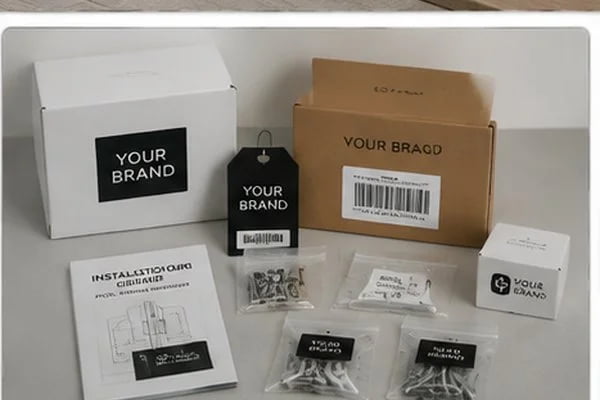
Low-risk customization for private label pool fencing hardware usually includes logos, product labels, carton marks, barcodes, manuals, installation diagrams, retail packaging, kit combinations, and spare-part bags. These items still need proofing, but they rarely change how the hardware carries load or fits the fence system.
Dive deeper
Low-risk does not mean “no control needed.” It means the change is less likely to affect installation performance. These items are usually easier to approve before import because they sit around the product rather than inside the mechanical function of the product.
In my experience with export communication, distributors often underestimate how much value these “simple” details create. A contractor may not notice a beautiful logo during installation. But that contractor will notice if the screw pack is missing, the diagram is unclear, or the replacement part code cannot be identified three months later.
Common low-risk customization options
Distributors can usually plan these items early:
Logo marking
- Laser marking
- Stamping
- Printed logo on packaging
- Sticker or label branding
Packaging
- Neutral carton
- Private-label color box
- Contractor bulk pack
- E-commerce mailer carton
- Pallet label system
Documentation
- Installation manual
- Exploded diagram
- Maintenance note
- Warning label
- QR code for video support
Identification
- SKU labels
- Barcodes
- Batch codes
- Component numbers
- Spare-part codes
Kit combinations
- Hinge pair plus latch
- Clamp set plus screws
- Spigot set plus cover plates
- Gate hardware set
- Installer starter pack
Low-risk customization comparison
| Customization Item | Typical Risk Level | What to Confirm Before Import |
|---|---|---|
| Logo on carton | Low | Artwork, size, color, placement |
| Barcode label | Low | Code type, scan test, country format |
| Installation manual | Low to medium | Language, diagrams, local terminology |
| Screw pack label | Low | Screw size, quantity, part code |
| Retail box | Low to medium | Drop protection, carton strength, shelf design |
| Kit combination | Medium | All parts match the intended system |
The “kit combination” line is important. A kit is not just a marketing bundle. It becomes a promise that the parts work together. If a kit includes hinges, latches, screws, caps, and templates, the distributor should check whether the set matches the glass thickness, gate size, opening direction, and installation surface.
How private-label kits reduce after-sales pressure
A good private-label system can make after-sales easier. For example, a distributor can label each small bag with the item code and installation step. That simple choice helps installers avoid mixing screws or using the wrong component.
I like this structure for hardware kits:
- Bag A: main hardware
- Bag B: screws and anchors
- Bag C: gaskets or spacers
- Bag D: covers and caps
- Bag E: spare small parts
- Manual: QR code plus printed diagram
This kind of packaging does not guarantee installation success. However, it reduces avoidable mistakes. It also helps the distributor handle replacement requests because the customer can say, “I need Bag C, item code XX,” instead of sending unclear photos.
For complementary guidance, see Spigots, Hinges and Latches: Where Pool Fence Hardware Compatibility Goes Wrong.
Which Pool Fencing Hardware Changes Need Samples and Fit Checks?
Pool fencing hardware customization becomes risky when the change affects dimensions, movement, load, hole positions, or compatibility. The problem is that these changes may look small on a drawing but create major site issues when installers try to fit the parts.
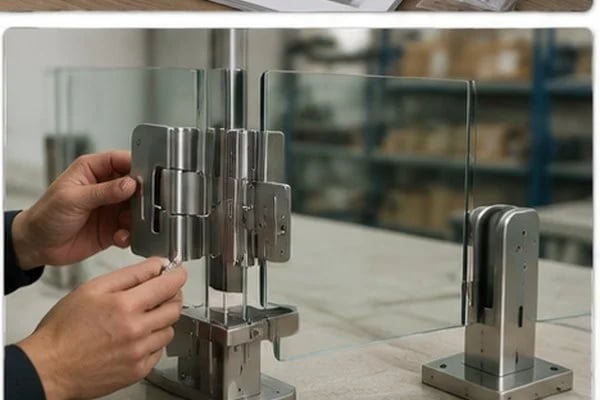
Changes to dimensions, hinge geometry, latch position, clamp shape, glass hole position, base plate size, screw specification, or load-related structure should go through samples and fit checks. Distributors should avoid approving these changes by photo only, especially for glass pool fencing systems.
Dive deeper
A few millimeters can matter. That sentence may sound dramatic, but it is practical. If a glass hole position does not match the hinge plate, the installer cannot “adjust it” on site without risk. If a latch does not align with the gate frame or glass panel, the gate may not close properly. If a screw type is changed without checking the installation surface, the fixing may not meet expectations.
I do not present this as engineering advice. Final decisions for structural safety, regulatory compliance, and field performance should involve qualified professionals and target-market verification. However, from a sourcing and sampling point of view, these are the changes that deserve more control.
High-risk customization examples
The following changes should not be treated like logo artwork:
- Hole position changes
- Glass clamp inner shape changes
- Hinge body or spring mechanism changes
- Latch height, catch position, or magnetic force changes
- Base plate thickness or anchor pattern changes
- Spigot depth or glass slot width changes
- Gasket thickness or material changes
- Screw grade, anchor type, or thread changes
- Load-bearing profile changes
- Welding, casting, or machining changes
Why samples matter
A sample lets the distributor confirm more than appearance. During sampling, buyers can check:
- Fit with the actual glass or post
- Gate swing and closing behavior
- Hole alignment
- Screw and anchor compatibility
- Surface finish consistency
- Packaging protection
- Installer understanding
- Carton labeling and SKU matching
A distributor should also consider a pre-production sample after artwork and structural details are locked. The first sample may confirm fit. The pre-production sample confirms the final version that will be mass produced.
Suggested sample approval record
| Check Item | Buyer Action | Supplier Support |
|---|---|---|
| Dimension check | Measure key points | Provide drawing and tolerance notes |
| Fit check | Install with sample glass or post | Provide matching accessories |
| Finish check | Compare color and surface | Provide finish sample or reference |
| Manual check | Test with installer feedback | Revise diagrams and part names |
| Packing check | Simulate handling | Adjust inner protection |
| Document check | Verify certificates and reports | Provide available documents for review |
During distributor inquiries, I sometimes hear, “We already sell similar hardware, so the size should be fine.” That may be true, but “similar” is not a specification. A private-label import order needs drawings, tolerances, samples, photos, and clear acceptance criteria.
What should be written before production?
The buyer and supplier should agree on a simple but specific confirmation file. It can include:
- Product drawing or key dimensions
- Material description
- Surface finish description
- Logo artwork proof
- Packaging layout
- Kit list and quantity per set
- Screw and accessory list
- Manual version
- Inspection points
- Agreed sample photos
This documentation does not replace professional engineering review. It does, however, reduce avoidable sourcing mistakes and keeps both sides aligned before production starts.
For complementary guidance, see What Makes a Complete Glass Pool Fencing Hardware System?.
How Should Material and Finish Choices Guide Private Label Pool Fencing Hardware?
Private label pool fencing hardware is often compared by unit price, but poolside material and finish choices should be driven by the use scene. A cheaper finish may look acceptable in a showroom and still perform poorly in humid, outdoor, or coastal conditions.
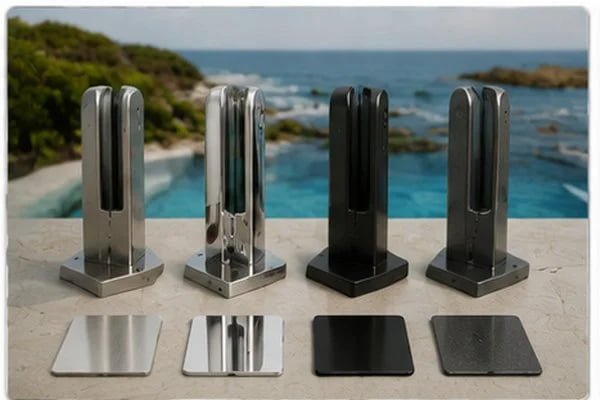
Material and surface treatment should match the target environment, installation location, and buyer expectation. For poolside or coastal markets, distributors should discuss stainless steel grade, aluminum finish, powder coating, polishing, passivation, coating thickness, maintenance guidance, and corrosion-resistance test documents before importing.
Dive deeper
Pool fencing hardware lives in a difficult environment. Water, cleaning chemicals, sunlight, humidity, salt air, and temperature changes can all affect appearance and durability. A product that performs acceptably in a dry inland backyard may not meet expectations near a coastal pool.
This is why material and finish should not be treated as simple price options. They are scene-driven decisions.
Common environment questions
Before selecting material and finish, distributors should ask:
- Will the hardware be used indoors or outdoors?
- Will the project be near a saltwater pool?
- Is the market mostly coastal or inland?
- Will the hardware face chlorine exposure?
- Will the product be sold for residential or commercial use?
- What maintenance instructions will buyers receive?
- What finish appearance does the brand promise?
- Are there local expectations for material marking or test reports?
Material and finish discussion table
| Option | Common Use | Key Discussion Point |
|---|---|---|
| Stainless steel | Outdoor pool fencing hardware | Grade, polishing, passivation, maintenance |
| Aluminum | Lightweight components or profiles | Anodizing or powder coating quality |
| Zinc alloy | Some fittings or decorative parts | Corrosion expectations and coating |
| Powder coating | Color customization | Thickness, adhesion, UV exposure |
| Polished finish | Premium appearance | Scratch visibility and cleaning |
| Brushed finish | Modern appearance | Direction consistency and batch control |
I avoid making broad promises such as “this grade is always suitable.” That statement ignores the environment and maintenance conditions. A better supplier discussion would be: “This product is intended for outdoor poolside use in a coastal market. What material, finish, available test documents, and maintenance guidance can support this application?”
What documents can buyers request?
Distributors can ask suppliers for available documents, then verify whether those documents match the target market and product batch. Examples include:
- Material declaration
- Stainless steel grade reference
- Surface treatment description
- Salt spray test report, if available
- Coating thickness report, if available
- Product drawing
- Inspection report
- Packing list and batch information
- Third-party testing documents, where applicable
These documents should be treated as documents to verify, not as automatic proof of local compliance. Local pool fencing regulations, building codes, and safety requirements vary by country and region. Buyers should consult qualified testing bodies, engineers, or compliance professionals when the application requires it.
Finish consistency and branding
Private-label buyers often focus on the logo, but finish consistency may matter more for brand trust. If hinges, latches, clamps, and cover plates have visibly different shades, the final system looks unprofessional even when every part is technically usable.
For private-label programs, I recommend that distributors define:
- Finish name and reference sample
- Acceptable color variation
- Gloss level, if relevant
- Visible surface requirements
- Protective film or bagging method
- Cleaning and maintenance note
- Inspection method for scratches, stains, or coating defects
A small maintenance card can also protect the brand. It can remind users to rinse and clean poolside hardware regularly, especially in high-salt or chemical exposure environments. That card should be practical and should not replace local safety or maintenance guidance.
Importing Glass Pool Fencing Hardware: A Checklist for Wholesalers and Distributors?
Importing glass pool fencing hardware becomes stressful when distributors rush from quotation to production without a system checklist. The problem often appears after import, when the carton looks correct but the installer finds missing screws, unclear diagrams, or incompatible accessories.
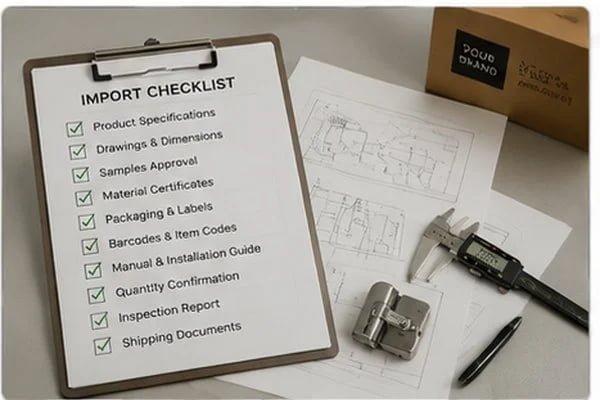
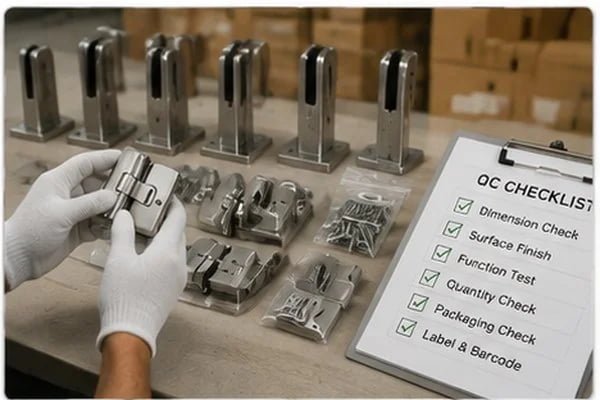
When importing glass pool fencing hardware, wholesalers and distributors should check system dimensions, glass thickness, gate size, installation method, material, finish, samples, documents, packaging, kit lists, spare parts, labels, and target-market regulations before placing bulk orders.
Dive deeper
A good checklist protects both the buyer and the supplier. It gives the buyer a clear procurement process. It also gives the supplier fewer chances to misunderstand the request.
In export communication, I have noticed that the strongest buyers usually prepare more information before asking for price. They do not only ask, “What is your MOQ?” They ask, “Can this hinge fit our gate panel size, this glass thickness, this installation method, and this sales channel?”
That question creates a better quotation because the supplier can quote the correct product, packaging, and accessory set.
Procurement checklist before quotation
Use this checklist before asking for final price:
| Category | Questions to Confirm |
|---|---|
| Fence system | Frameless, semi-frameless, post-supported, or mixed? |
| Glass | Thickness, height, width, hole positions, edge type? |
| Gate | Weight, size, swing direction, closing requirement? |
| Hardware | Hinges, latches, clamps, spigots, screws, caps, gaskets? |
| Installation | Surface type, fixing method, anchor expectation? |
| Environment | Poolside, coastal, humid, indoor, outdoor, high-salt? |
| Compliance | What local rules or standards must the buyer verify? |
| Branding | Logo, carton marks, labels, barcode, manual? |
| Packaging | Bulk, retail, contractor kit, e-commerce carton? |
| Documents | Drawings, reports, declarations, inspection records? |
| Sampling | Prototype, fit sample, pre-production sample? |
| After-sales | Spare parts, replacement labels, batch traceability? |
What should be checked during sampling?
A sample should answer practical questions:
- Does the product match the drawing?
- Does the hardware fit the glass or post?
- Does the gate operate as expected in a basic fit check?
- Are the screws and anchors the expected type?
- Does the finish match the brand requirement?
- Is the logo position acceptable?
- Is the packaging strong enough?
- Are all small parts easy to identify?
- Does the manual match the actual parts?
- Are warning labels and instructions clear?
What should be checked before shipment?
Before shipment, distributors can request inspection photos or a third-party inspection, depending on order value and risk level. Key checks may include:
- Quantity per carton
- SKU and barcode accuracy
- Logo and label position
- Surface finish defects
- Key dimensions
- Accessory pack completeness
- Manual version
- Carton strength and marks
- Pallet condition
- Batch or production record
Why spare parts matter
Private-label distributors are not only importing products. They are building a system that must be sold, installed, supported, and reordered. Spare parts make that system more reliable.
Useful spare-part planning may include:
- Extra screws and anchors
- Replacement gaskets
- Cover caps
- Latch components
- Hinge accessories
- Printed manuals
- QR code support labels
- Item-code stickers
This planning helps after-sales service. It also helps distributors avoid sending a full replacement set for a small missing or damaged part.
A practical rule for customization risk
I use this simple rule:
If the change affects branding or identification, it is usually low risk. If the change affects fit, movement, load, corrosion resistance, or installation, it needs samples and professional validation.
This rule keeps the conversation clear. It also helps distributors protect schedule, cost, and customer satisfaction before importing.
Frequently Asked Questions
Can I customize the logo on pool fencing hardware before importing?
Yes, distributors can usually customize logos on cartons, labels, manuals, and sometimes on the hardware itself through laser marking, stamping, or printing. Buyers should confirm the marking position, size, finish impact, and sample appearance before mass production.
Can hole positions or hinge dimensions be changed for private-label orders?
Hole positions, hinge dimensions, latch geometry, and clamp structures should not be changed casually. These changes can affect fit and installation. Buyers should use drawings, samples, fit checks, and qualified professional evaluation before approving any structural or compatibility-related modification.
What documents should distributors request before importing pool fencing hardware?
Distributors can request drawings, material information, finish descriptions, inspection records, packing details, and available test reports. Buyers should verify whether documents match the product, batch, and target market. Local pool safety compliance should be reviewed by qualified professionals.
Is stainless steel always the best choice for pool fencing hardware?
Stainless steel is common for outdoor pool fencing hardware, but the best choice depends on environment, finish, maintenance, and local expectations. Coastal or high-salt locations may require stricter corrosion-resistance discussion. Buyers should review material grade, surface treatment, and available test documents.
What is the safest way to build a private-label pool fencing hardware kit?
The safest way is to confirm the complete system first. The kit should match glass thickness, gate size, installation surface, screws, gaskets, hinges, latches, and spare parts. Each component should be labeled clearly, and the final kit should be checked through sampling.
Private-label pool hardware: a practical decision record
Use this proposed worksheet to record a purchasing decision. It is an editorial checklist, not a completed project inspection or test result.
| Review step | What to record |
|---|---|
| Define the requirement | Separate branding changes from changes to hinge geometry, latch engagement or load-carrying components. |
| Resolve the interface | Record the destination market, drawing revision and gate assembly configuration before approving modified samples. |
Worked example: Private-label scope
Illustrative assumptions only — not an actual order, measured result, price offer or engineering approval.
Four hardware models in 2 finishes with 2 packaging artworks create 4 × 2 × 2 = 16 controlled combinations.
Decision: Link each combination to the correct artwork and product revision before approving labels.
Reference and applicability
CPSC residential pool barrier guidance: US residential guidance discusses gates and barriers. Check the rules in the actual project jurisdiction. Project-specific technical or regulatory requirements should be checked by the responsible qualified professional.
Editorial update: 25 September 2026. This update checks article structure, topic scope and the references identified above. It does not claim independent engineering certification.
Related guides and product references
For the next stage of pool fencing hardware selection, use these guides alongside the product catalogue. Catalogue references do not replace project-specific drawings or engineering approval.
- Importing Glass Pool Fencing Hardware: A Checklist for Wholesalers and Distributors
- Glass Pool Fencing Hardware: The Complete Buyer's Guide
- Pool fencing hardware product range
- Bolt-Plate Glass-to-Glass Pool Gate Hinge — catalogue reference
Conclusion
Private label pool fencing hardware is more than a branding project. It is a procurement and risk-control process that starts with system fit, installation conditions, target market, and usage environment. Logos, labels, packaging, and manuals are easier to customize, while dimensions, hinges, latches, holes, and load-related parts need samples and professional validation. If you are preparing a private-label import program, start with a clear checklist and confirm every critical detail before production.


Comments (4)