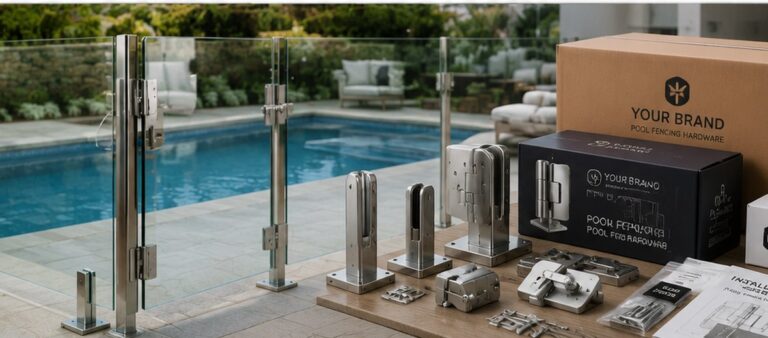
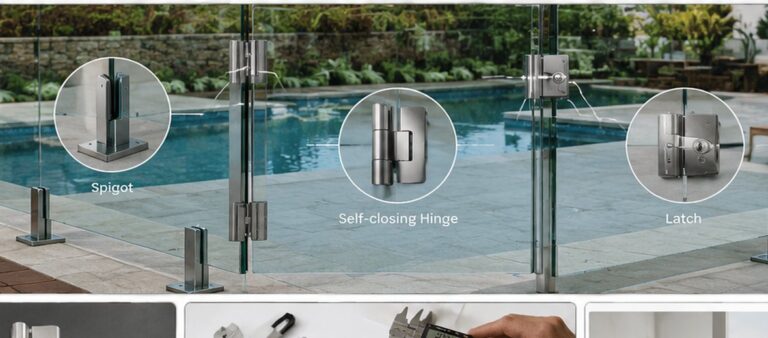
Importing glass pool fencing hardware can look simple when the quote shows a good price and “stainless steel” in the material column. But small mismatches in glass thickness, hole position, accessories, or packaging can turn a bulk order into slow-moving stock. I use a checklist approach to reduce that risk before production starts.
Importing glass pool fencing hardware should be treated as a compatibility and risk-control process. Wholesalers and distributors should confirm glass thickness, fitting dimensions, installation scenario, accessory completeness, SKU planning, sample approval, pre-production details, inspection standards, packaging, and replacement support before placing a bulk order.
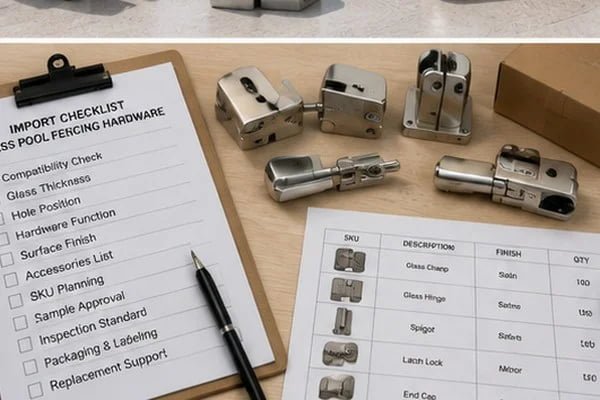
In many inquiries, buyers first ask me about price, stainless-steel grade, or surface finish. Those points matter, but they are not enough. A better question is: Will this full hardware set arrive as a compatible, saleable, and inspectable product line?
How Should Importing Glass Pool Fencing Hardware Start With Compatibility Checks?
Many bulk-order problems begin before production. The buyer and supplier may both think they are discussing the same glass clamp, hinge, post, or latch, but the actual installation conditions may be different. That gap can create costly stock and replacement issues.
The first step in importing glass pool fencing hardware is to confirm compatibility. Buyers should check glass thickness, hole positions, edge distance, fixing method, post or frameless design, gate direction, hinge type, latch type, and local installation requirements before approving samples or bulk production.
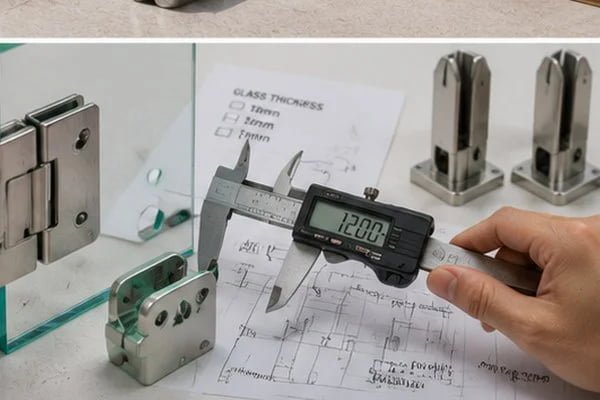
Key compatibility points to confirm
I usually ask buyers to confirm these details before I treat a quote as final:
- Glass thickness: Common options may include 10 mm, 12 mm, or other specifications, depending on the system.
- Glass hole position: Hinges and spigots may require exact hole sizes and spacing.
- Installation type: Frameless, semi-frameless, post-mounted, wall-mounted, or gate hardware.
- Hardware function: Clamp, spigot, hinge, latch, lock, post, handrail bracket, or end cap.
- Surface finish: Mirror polish, satin finish, brushed finish, or powder-coated finish.
- Environment: Coastal, indoor, outdoor, high-humidity, or standard residential use.
- Buyer-side compliance: Pool safety rules and installation codes must be checked with local professionals.
Glass pool fencing accessories are often not universally interchangeable. A hinge from one system may not match a latch from another system. A clamp may fit one glass thickness but not another. A post may look similar in photos but use different wall thickness, base plate size, or hole layout.
| Check Item | Why It Matters | Buyer Action |
|---|---|---|
| Glass thickness | Affects fit and safety | Confirm exact glass spec |
| Hole position | Affects hinge and latch alignment | Share drawing or sample |
| Gate direction | Affects hinge and lock selection | Confirm left/right opening |
| Surface finish | Affects resale consistency | Approve physical sample |
| Local rules | Affects project suitability | Ask qualified local installer |
I am not an installation engineer or local code authority. So I avoid telling buyers that one hardware set is “approved” for every market. Instead, I help them define the product clearly enough so their local installer, engineer, or compliance team can review it properly.
What Makes Importing Glass Pool Fencing Hardware a Complete Sellable System?
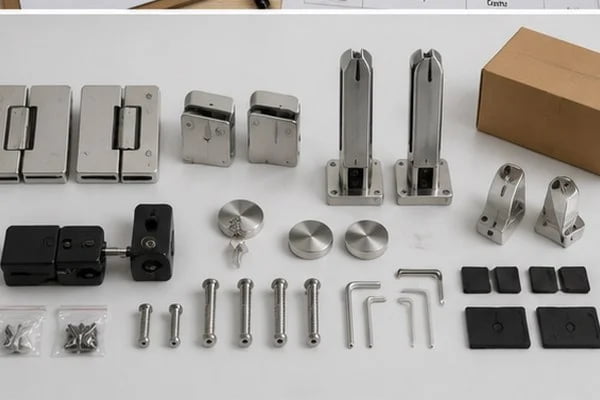
A distributor does not sell one isolated screw. A distributor sells a usable product set. If the order lacks gaskets, screws, caps, keys, Allen tools, or spare parts, the warehouse team may only discover the issue after customers start complaining.
A complete glass pool fencing hardware order should include a confirmed accessory list, SKU combinations, spare parts ratio, labeling method, inner box design, carton marks, installation sheets if needed, and replacement support plan. This protects resale value and reduces after-sales pressure.
Treat each item as part of a resale SKU
When I review glass pool fencing hardware orders, I like to separate production items from sellable SKUs. They are not always the same thing.
For example, one gate kit may need:
- Two hinges
- One latch or lock
- Glass gaskets
- Screws and anchors
- Cover caps
- Keys, if applicable
- Installation guide or warning sheet
- Branded inner box
- Barcode or SKU label
- Spare parts policy
If only the hinge price is confirmed, the order is not fully controlled. The distributor still needs to know whether each kit is complete, easy to pick in the warehouse, and easy for the end buyer to understand.
Practical SKU planning questions
Before bulk production, wholesalers should ask:
- Will I sell this as single hardware pieces or as a full gate kit?
- Do I need different SKUs for 10 mm and 12 mm glass?
- Will satin and mirror finish share the same packaging design?
- Do I need private-label boxes or neutral export cartons?
- What spare parts should I stock for after-sales service?
A small spare parts plan can reduce many complaints. For example, extra rubber gaskets, screws, keys, and cover caps may be low-cost items, but they are important when one carton is damaged or one customer loses a part.
Packaging is also part of quality control. Heavy stainless-steel hardware can scratch during transport if the inner protection is weak. I usually check foam, polybags, dividers, carton strength, label accuracy, and carton marks before shipment.
Which Inspection Steps Matter Most Before Shipment?
A good-looking sample does not guarantee a good bulk shipment. Changes can happen during mass production if specifications are unclear. That is why sample approval, pre-production confirmation, and pre-shipment inspection should be treated as the backbone of the import checklist.
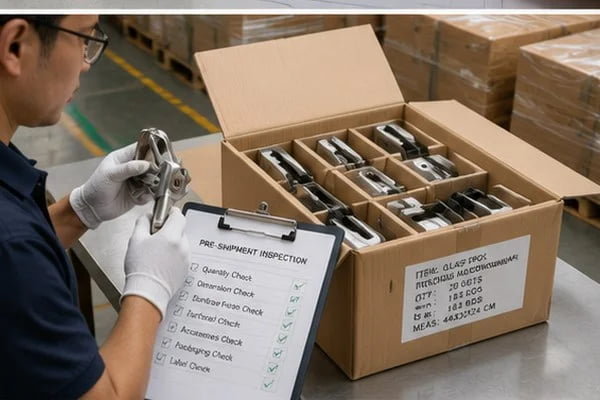
The most important inspection steps are sample confirmation, drawing confirmation, material and finish confirmation, pre-production sample review, in-line checking when needed, appearance inspection, quantity check, accessory check, packaging check, and final pre-shipment review.
My practical QC flow
I prefer a simple three-stage process:
| Stage | What to Check | Main Purpose |
|---|---|---|
| Sample approval | Fit, finish, dimensions, accessories | Confirm the buying standard |
| Pre-production check | Drawings, packaging, labels, materials | Prevent wrong mass production |
| Pre-shipment review | Quantity, appearance, cartons, SKU list | Catch issues before export |
During appearance checks, I pay attention to scratches, polishing marks, sharp edges, color differences, welding quality, thread condition, logo position, and packaging damage. For functional parts like hinges and locks, buyers should also confirm movement, alignment, and basic assembly before shipment.
For technical use, wholesalers should not rely only on photos. Clear drawings, approved samples, and written specifications are much safer. If the product is used in a regulated pool fencing system, the buyer should verify local requirements with qualified professionals.
Frequently Asked Questions
Is stainless steel grade enough to judge glass pool fencing hardware quality?
No. Stainless-steel grade is important, but buyers should also check dimensions, compatibility, finish, accessories, packaging, batch consistency, and local use requirements. A good material can still become a bad order if the parts do not fit the system.
Should I order samples before bulk purchasing?
Yes. Samples help confirm fit, finish, packaging direction, and accessory completeness. I always prefer sample confirmation before mass production because many problems come from unclear expectations, not from the product category itself.
Are glass clamps, hinges, and locks interchangeable?
Not always. Similar-looking parts may have different glass thickness ranges, hole positions, fixing methods, and dimensions. Buyers should confirm drawings and installation scenarios before treating different hardware as interchangeable.
What should distributors check in packaging?
Distributors should check inner protection, labels, barcodes, carton marks, carton strength, accessory packing, and SKU separation. Good packaging reduces scratches, warehouse confusion, and after-sales claims.
<!-- elim-blog-links-20260925 -->
Related guides and product references
For the next stage of pool fencing hardware selection, use these guides alongside the product catalogue. Catalogue references do not replace project-specific drawings or engineering approval.
- Private Label Pool Fencing Hardware: What Distributors Can Customize Before Importing
- Coastal Pool Projects: When Is 316 Stainless Steel Worth the Extra Cost?
- Spigots, Hinges and Latches: Where Pool Fence Hardware Compatibility Goes Wrong
- What Makes a Complete Glass Pool Fencing Hardware System?
- Glass Pool Fencing Hardware: The Complete Buyer's Guide
- Pool fencing hardware product range
- Bolt-Plate Glass-to-Glass Pool Gate Hinge — catalogue reference
<!-- /elim-blog-links-20260925 -->
Conclusion
Importing glass pool fencing hardware is not only about price comparison. It is a structured buying process that protects compatibility, accessory completeness, SKU planning, and batch consistency. Before placing a bulk order, I recommend confirming samples, drawings, packaging, spare parts, and inspection standards in writing. If you are building a wholesale or private-label hardware line, contact my team to review your product list and sample requirements before production.