
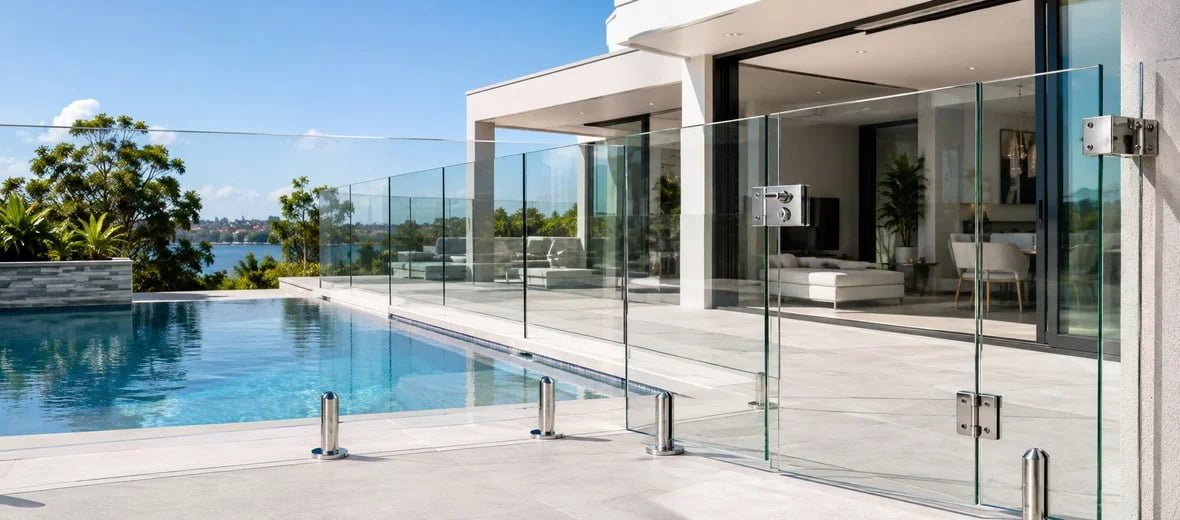
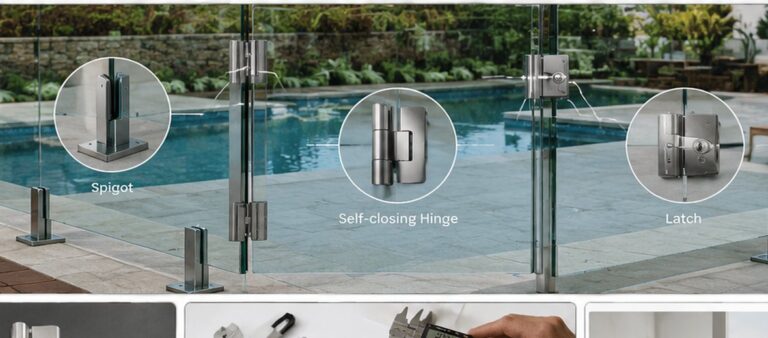
When purchasing glass pool fencing hardware, the biggest challenge is not choosing an individual component. It is making sure the entire system works together. If the glass, hardware—including posts, clamps, spigots, hinges, and latches—and the mounting surface are not coordinated with Australian safety requirements in mind, costly rework can easily occur on site. In several Australian projects I have worked on, the cost of rework was higher than the cost of the hardware itself, and it also caused serious delays during inspection and approval.
Quick answer: Buy glass pool fencing hardware as a complete system. Start with the gate and select hinges and a latch that support self-closing and self-latching performance in line with AS 1926. Then choose the anchoring method according to the substrate, select 304 or 316 stainless steel based on the exposure environment, and finally confirm the glass thickness, hole positions, panel weight, and hardware ratings. Always verify the final details against local regulations and the requirements of the local inspector.

Want to improve the chance of passing inspection the first time? Focus on four areas: the gate, the substrate, the environment, and system compatibility. The following checklist is based on common problems I have seen during installation, after-sales support, and repair work.
The Gate Is the Starting Point for Compliance: How Can It Self-Close and Self-Latch?
Many pool fencing projects fail inspection because of the gate. Common problems include weak hinge return force, a latch that does not engage fully, incorrect clearances, or hardware that creates a climbable point.
On site, I usually ask installers to test the gate repeatedly from different opening positions. The goal is to confirm that the gate closes and latches reliably without manual assistance. The general design should follow the self-closing, self-latching, and non-climbable principles associated with AS 1926, while the exact requirements should always be confirmed locally.
Key point: Choose a combination of self-closing hinges and a dependable self-latching latch. Control the gaps around and below the gate, and avoid handles or fittings that may create footholds or handholds. Perform repeated opening, closing, and rebound tests before booking an inspection.
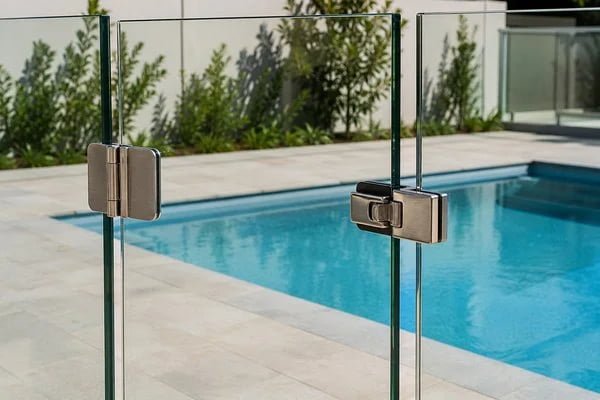
- First confirm the gate opening direction, expected usage frequency, and exposure to pool water.
- Select hinges according to the gate weight and the available spring-tension adjustment range.
- Choose a latch that engages consistently and resists accidental or incomplete closing.
- Avoid gate hardware shapes that may create climbable points.
- Use AS 1926 as a design reference, but follow the final requirements of the local authority and inspector.
For complementary guidance, see Private Label Pool Fencing Hardware: What Distributors Can Customize Before Importing.
The Substrate Determines the Anchoring Method: Which Fixing System Is More Reliable?
The same hardware can perform very differently on different substrates. Some of the most common after-sales problems I have seen include cracked tiles, loose fixings, and movement in timber decking. In many cases, the root cause was the use of an expansion anchor in an unsuitable base material.
Key point: When the concrete is solid, undamaged, and thick enough, mechanical expansion anchors can be an efficient option. For timber decking, composite decking, tiled surfaces, thin slabs, or locations close to an edge, a chemical anchor or base-plate solution may provide better load distribution and reduce the risk of cracking.
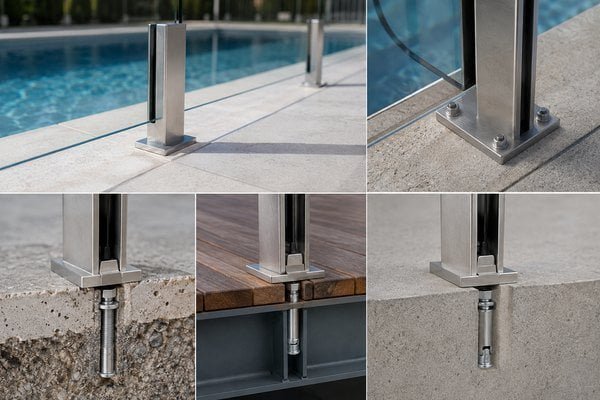
- For sound concrete, mechanical expansion anchors are often fast and practical.
- For timber, composite decking, tiles, or thin slabs, consider chemical anchors with sleeves or a surface-mounted base plate.
- Near slab edges, use a larger base plate where appropriate to distribute the load and reduce edge breakout.
- One repair case involved expansion anchors installed directly through a tiled layer. After three months, the fittings became loose and the tiles cracked. The system was later stabilized using chemical anchors, sleeves, and proper load-distribution pads.
- Always follow the anchor manufacturer’s data for embedment depth, edge distance, hole cleaning, and curing time.
For complementary guidance, see Coastal Pool Projects: When Is 316 Stainless Steel Worth the Extra Cost?.
304 or 316 Stainless Steel: Let the Environment Decide
When stainless steel develops visible tea staining within a short period, the material grade and the exposure environment are often not properly matched. Coastal air, salt spray, chlorinated water, and poor cleaning conditions can all accelerate surface corrosion.
In coastal and poolside environments, I have seen 304 stainless steel lose its appearance quickly, even when the hardware was cleaned regularly. Material grade alone is not the only factor, but it has a major influence on long-term performance.
Key point: For coastal areas, salt-laden wind, and zones exposed to pool splash, 316 stainless steel is generally the safer choice. In mild inland environments, 304 stainless steel may be suitable when supported by regular cleaning and maintenance. Surface finish, polishing quality, sealing, drainage, and the prevention of crevices also affect corrosion resistance.
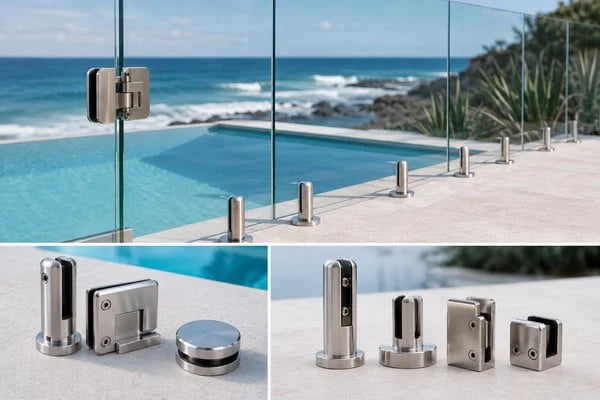
- For coastal and pool splash zones, 316 stainless steel offers better corrosion resistance and normally requires less intensive maintenance.
- 304 stainless steel may be suitable for low-corrosion inland environments, but regular cleaning is still important.
- Check the workmanship as well as the material grade. Consistent polishing, sealed edges, suitable gaskets, and good drainage can extend service life.
- A practical purchasing method is to define the exposure category first and then choose the material grade and finish.
- For more information about tea staining in coastal environments, refer to the Australian Stainless Steel Development Association guidance.
For complementary guidance, see Spigots, Hinges and Latches: Where Pool Fence Hardware Compatibility Goes Wrong.
Glass and Hardware Must Be Compatible: How Can You Prevent Sagging or Stress Breakage?
One of the most serious mistakes is failing to match the glass thickness, hole positions, panel weight, and hardware ratings. I have seen gate panels sag because the hinges were undersized, and I have also seen glass damaged by uneven point pressure from clamps or fittings.
Most of these problems can be traced back to incomplete checks before ordering.
Key point: Order the glass according to the hardware manufacturer’s approved thickness range, hole diameter, hole spacing, and edge-distance requirements. Confirm the gate weight against the rated capacity of the hinges and spigots. Whenever possible, use components from one verified system or from combinations that have already been tested together.
Before placing an order, confirm these four items:
- What is the glass thickness?
- What are the required hole diameter and hole positions?
- What is the total gate or panel weight?
- What are the support spacing and fixing conditions?
The rated ranges of the posts, clamps, spigots, hinges, and latches must be compatible with one another. Glass selection should also consider the application principles in AS 1288, while the applicable local edition and project requirements should be confirmed before fabrication.
Manufacturing tolerances also matter. A difference of only one millimetre may create installation problems when the holes, gaskets, pins, and glass thickness are not coordinated.
A Practical Purchasing Checklist for Glass Pool Fencing Hardware
Before requesting a quotation, prepare the following information for the supplier:
- Pool fence layout and total length
- Number and size of glass panels
- Glass thickness and glass type
- Gate dimensions and estimated weight
- Mounting substrate
- Distance from the coast or other corrosive environments
- Preferred stainless steel grade
- Preferred surface finish
- Spigot or post mounting method
- Required hinges, latches, clamps, gaskets, covers, and anchors
- Applicable local standards or project specifications
- Installation drawings or site photographs
A complete enquiry allows the supplier to check the system instead of quoting isolated parts. It also reduces the risk of receiving incompatible hinges, latches, spigots, or glass-processing drawings.
Common Questions
Is a Frameless Pool Fence Cheaper?
Not always. A frameless system has a clean and open appearance, but it usually requires better substrate preparation, more accurate alignment, reliable anchoring, and tighter installation tolerances.
The hardware may look simpler, but the total installed cost can be higher when the site is uneven or when additional structural work is required. Compare the complete project cost rather than the price of the hardware alone.
How Do I Choose Between Chemical Anchors and Expansion Anchors?
The decision depends on the substrate, slab thickness, edge distance, and design load.
Mechanical expansion anchors are often suitable for strong, dense concrete with sufficient thickness and edge distance. Chemical anchors or base-plate systems may be more appropriate for tiled surfaces, thin slabs, edge locations, and some timber or composite structures.
Follow the anchor manufacturer’s installation data and confirm the final solution with the project engineer or local inspector where required.
What Should I Do If the Gate Fails Inspection?
Check the gate systematically:
- Confirm that it closes from all required opening positions.
- Adjust the hinge spring tension.
- Check whether the latch engages completely.
- Confirm the gate gaps and ground clearance.
- Remove or reposition any climbable hardware.
- Check whether the gate has dropped out of alignment.
- Repeat the opening and closing test several times.
After completing the adjustments, verify the gate again before arranging a reinspection.
Should All Hardware Come from the Same Supplier?
Using one complete, verified system can reduce compatibility risks. It makes it easier to coordinate glass thickness, holes, gaskets, pins, fasteners, load ratings, and finishes.
Mixing products from different suppliers is possible, but every interface should be checked carefully. Do not assume that similar-looking components have the same dimensions or load capacity.
How Often Should Stainless Steel Pool Fence Hardware Be Maintained?
Maintenance frequency depends on the environment. Hardware near the coast or exposed to chlorinated water normally requires more frequent fresh-water cleaning than hardware in a dry inland location.
Remove salt, dirt, and chemical deposits before they remain on the surface for long periods. Do not use steel wool or tools that may contaminate the stainless steel surface with carbon steel particles.
Pool barrier review: a practical decision record
Use this proposed worksheet to record a purchasing decision. It is an editorial checklist, not a completed project inspection or test result.
| Review step | What to record |
|---|---|
| Define the requirement | Identify the governing jurisdiction and the complete gate/barrier configuration. |
| Resolve the interface | Ask the responsible local professional to verify the installation; a hinge or latch catalogue entry alone is not whole-barrier compliance. |
Worked example: Pool gate documentation
Illustrative assumptions only — not an actual order, measured result, price offer or engineering approval.
For 6 gates, create 6 individually identified gate records. Five completed records leave one gate requiring review even if the hardware models are identical.
Decision: Site conditions and local requirements must be checked for each installation.
Reference and applicability
CPSC residential pool barrier guidance: US residential guidance discusses gates and barriers. Check the rules in the actual project jurisdiction. Project-specific technical or regulatory requirements should be checked by the responsible qualified professional.
Editorial update: 25 September 2026. This update checks article structure, topic scope and the references identified above. It does not claim independent engineering certification.
Related guides and product references
For the next stage of pool fencing hardware selection, use these guides alongside the product catalogue. Catalogue references do not replace project-specific drawings or engineering approval.
- What Makes a Complete Glass Pool Fencing Hardware System?
- Importing Glass Pool Fencing Hardware: A Checklist for Wholesalers and Distributors
- Pool fencing hardware product range
- Bolt-Plate Glass-to-Glass Pool Gate Hinge — catalogue reference
Conclusion
To purchase the right glass pool fencing hardware, treat the project as a complete system.
Start with gate compliance. Match the anchoring method to the substrate. Select the stainless steel grade according to the exposure environment. Confirm that the glass, spigots, posts, clamps, hinges, latches, gaskets, and anchors are compatible before production begins.
The best time to solve these problems is before the purchase order is placed—not during installation.
Need help reviewing a glass pool fencing hardware list or coordinating supply from China? Send us your drawings, glass specifications, installation surface details, and project requirements. Our team can help identify compatibility risks before production and support your installer with a more complete hardware solution.


Comments (1)