

Quick answer
Consider a 316 upgrade by exposure, maintenance and replacement difficulty rather than applying it to every pool component. Coastal handrails and high, unwashed indoor-pool structural supports are different applications; the latter require a separate specialist materials assessment.
316 stainless steel often becomes a serious question when a coastal pool project starts moving from design to purchasing. The problem is simple: salt air, chlorinated water, and splash zones can punish metal parts. The agitation comes later, when stains, complaints, and replacements cost more than expected. The solution is not blind upgrading, but smarter risk-based material selection.
316 stainless steel is usually worth the extra cost for coastal pool parts that face high salt exposure, chlorinated splash, constant moisture, heavy touch, high visibility, or difficult replacement. It is not automatically necessary for every component. Buyers should compare exposure level, maintenance ability, appearance risk, replacement cost, and complaint sensitivity before deciding.
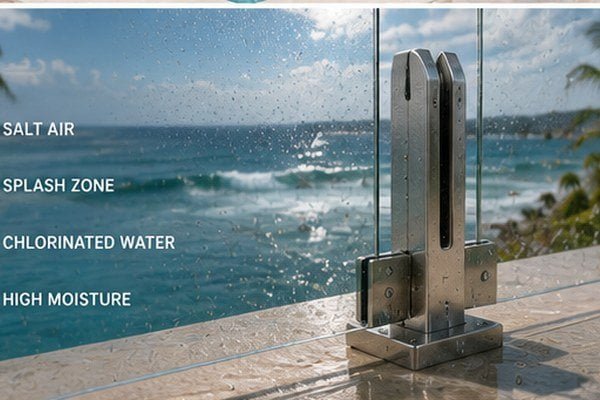
Instead of asking which grade is universally better, identify the exposure, cleaning access, replacement difficulty and component function. Use those conditions to frame the material assessment and compare actual quotations.
Why Is 316 Stainless Steel Often Considered for Coastal Pool Projects?
Coastal pool projects create a harsh environment for visible metal hardware. Buyers want clean finishes, long service expectations, and fewer complaints. The problem is that budget pressure often pushes teams toward lower initial cost. The risk is that early staining can make a new project look poorly specified.
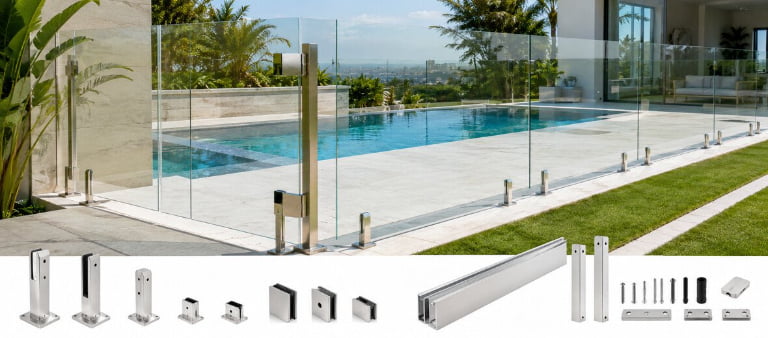
316 stainless steel is often considered because it generally offers better corrosion resistance than 304 in salt, moisture, chlorine, and splash-prone environments. In coastal pool projects, that advantage can matter most for exposed, visible, touched, or hard-to-replace components such as handrails, ladders, railings, clamps, and glass pool fencing hardware.

The practical difference buyers actually feel
Many buyers know that 316 contains molybdenum, while 304 usually does not. That chemical difference matters, but procurement teams rarely buy chemistry for its own sake. They buy lower risk.
In real project discussions, the questions I hear are usually practical:
- Will this part touch pool water?
- Will it sit near the waterline?
- Will guests touch it every day?
- Will sea wind carry salt onto the surface?
- Will cleaning teams maintain the metal properly?
- Will stains create complaints or refund pressure?
- Will replacement require draining, drilling, or closing part of the pool area?
These questions matter more than a simple “304 versus 316” chart.
Where coastal exposure becomes more aggressive
A coastal pool does not expose every component equally. A screw inside a dry service area is not in the same condition as a pool ladder step near chlorinated splash. A railing facing sea wind is not the same as a bracket protected indoors.
In many coastal projects, the most aggressive zones include:
- Splash zones near pool edges.
- Waterline areas where moisture stays longer.
- Outdoor railings exposed to sea breeze and salt fog.
- Damp shaded areas where surfaces dry slowly.
- High-touch metal parts where oils, sweat, sunscreen, and cleaning chemicals contact the surface.
- Glass pool fencing hardware close to the deck or drainage path.
316 stainless steel does not make these risks disappear. It improves resistance compared with common 304 grades in many chloride-rich settings. Buyers should still confirm the grade, finish, fabrication quality, and maintenance plan.
A simple evaluation table
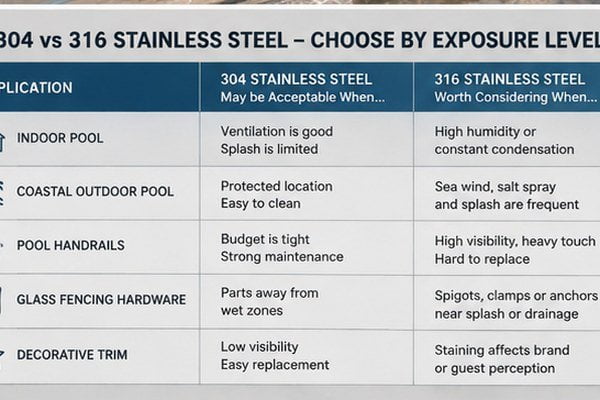
| Project condition | 304 may be acceptable when... | 316 is often worth considering when... |
|---|---|---|
| Indoor pool | Ventilation is good and splash is limited | Chlorine level is high or condensation is constant |
| Coastal outdoor pool | Metal is protected and easy to clean | Sea wind, salt fog, and splash exposure are frequent |
| Pool handrails | Budget is tight and maintenance is strong | Handrails are visible, touched often, and hard to replace |
| Glass fencing hardware | Parts are away from wet zones | Clamps, spigots, or anchors sit near splash or drainage |
| Decorative trim | Low visibility or easy replacement | Staining would affect brand image or guest perception |
I usually advise buyers to spend more where risk concentrates, not everywhere by default. That approach protects the project budget while still reducing the most expensive corrosion-related problems.
For complementary guidance, see Private Label Pool Fencing Hardware: What Distributors Can Customize Before Importing.
When Is 316 Stainless Steel Worth the Extra Cost for Pool Handrails and Ladders?
Pool handrails and ladders create a direct user experience. People touch them, see them, and rely on them for safe entry and exit. The problem is that stains on these parts are hard to ignore. The agitation grows when guests think visible rust means poor quality.
316 stainless steel is often worth the extra cost for pool handrails and ladders in coastal or chlorinated environments because these parts face splash, touch, moisture, cleaning chemicals, and high visibility. If they are difficult to remove or central to the guest experience, the upgrade can reduce appearance and replacement risk.
Why handrails and ladders deserve priority
Pool handrails and ladders are not hidden fasteners. They are functional and visual. A small amount of staining on a concealed bracket may not cause immediate concern. The same stain on a polished handrail at a hotel pool can quickly become a complaint.
In pre-sales conversations, I often ask buyers one simple question:
“If this part stains after installation, who will notice first: maintenance staff, project managers, or guests?”
For handrails and ladders, the answer is often guests.
That makes the decision less about material cost alone and more about complaint sensitivity. Hotels, resorts, clubs, apartments, and public pools often need hardware that supports their brand image. If a premium pool area looks neglected, the damage is not only technical. It is commercial.
Main risk factors for pool handrails
Buyers should evaluate handrails and ladders against several conditions:
- Direct splash exposure: Pool water contains chlorine or other treatment chemicals.
- Salt air exposure: Coastal wind can deposit chloride on metal surfaces.
- Body contact: Sweat, sunscreen, and skin oils can remain on the surface.
- Cleaning habits: Strong chemicals or poor rinsing can increase staining risk.
- Surface finish: Rougher finishes may trap contaminants more easily than smoother finishes.
- Replacement difficulty: Embedded or anchored parts may be costly to remove.
316 stainless steel usually gives buyers a wider safety margin in these conditions. However, it is not rust-proof. If the surface is not cleaned, if chlorine residue dries repeatedly, or if low-quality fabrication damages the passive layer, staining can still appear.
How I would prioritize pool metal components
| Priority level | Component examples | Reason to consider 316 |
|---|---|---|
| High priority | Handrails, ladders, grab rails | High touch, high visibility, constant splash |
| Medium-high priority | Glass fence spigots, railing posts, deck anchors | Visible and often close to wet deck areas |
| Medium priority | Brackets near pool equipment or shaded damp zones | Moisture and chemicals may accumulate |
| Lower priority | Protected indoor hardware away from splash | Lower exposure and easier maintenance |
This does not mean 304 is always wrong. In lower-exposure pools, or in projects with strict maintenance and limited chloride exposure, 304 may still be suitable. The buyer should confirm the application with the supplier, installer, and where necessary, a qualified materials or corrosion professional.
Procurement logic: initial price versus project cost
The extra cost of 316 stainless steel can feel uncomfortable during purchasing. But the lowest material price is not always the lowest project cost.
Possible later costs include:
- Extra cleaning labor.
- Replacement hardware.
- Installation rework.
- Pool area downtime.
- Guest complaints.
- Negative reviews.
- Warranty disputes.
- Damage to hotel or property image.
When a part is visible, touched daily, and hard to replace, the upgrade can be easier to justify. Compare the quoted grade, cleaning requirements and replacement access in the same purchasing decision; a price premium alone does not demonstrate suitability.
Frequently Asked Questions
Is 316 stainless steel suitable for every coastal pool component?
No. World Stainless's marine applications guidance identifies 316-family grades for coastal exposure but distinguishes that from permanent seawater immersion. This supports an exposure-based comparison, not blanket approval of a pool component. Review the actual water chemistry, fabrication, cleaning and application with the responsible materials professional.
Does choosing 316 eliminate cleaning or corrosion risk?
No. Material selection does not replace maintenance or a suitable component design. Obtain the manufacturer's cleaning instructions and assess the intended exposure; do not treat the grade name as a maintenance-free guarantee.
How should a buyer compare the additional material cost?
Compare the same component, dimensions, finish, accessory scope and quantity. Record the quoted premium separately from assumed future cleaning or replacement costs. The worked example below demonstrates arithmetic, not a measured service-life saving.
What should accompany a material quotation?
Request the stated grade, component drawing revision, finish, accessory list and available batch-linked material documentation. Agree how identity and delivery conformity will be checked before accepting a substitution.
Coastal material comparison: a practical decision record
Use this proposed worksheet to record a purchasing decision. It is an editorial checklist, not a completed project inspection or test result.
| Review step | What to record |
|---|---|
| Define the requirement | Record salt exposure, splash, shelter, cleaning access and visible-finish expectations. |
| Resolve the interface | Request a grade-specific proposal and maintenance plan; compare lifecycle exposure before accepting a price-only substitution. |
Worked example: Material premium
Illustrative assumptions only — not an actual order, measured result, price offer or engineering approval.
For 200 parts, a hypothetical quoted premium of USD 2 per part totals USD 400. This arithmetic does not establish whether the upgrade is technically suitable or cost-effective over its life.
Decision: Compare actual exposure, cleaning and replacement access alongside the quotation; these are illustrative prices.
Research context: indoor pool atmospheres need a separate material review
Published external evidence. ASSDA Technical FAQ 13 reports the following: ASSDA describes stress-corrosion failures of stressed 304/316 components in high, unwashed areas over heated indoor pools. It reports that Nickel Institute research recommended higher-alloy options for that particular exposure.
Procurement interpretation: Do not extend the coastal handrail comparison above to overhead structural supports. Separate outdoor washed surfaces from indoor unwashed, stressed components in the material schedule and obtain a qualified corrosion assessment for the latter.
This source describes another organisation's work or products. It is not an Elim project, test report or certification. Source checked: 25 September 2026.
Reference and applicability
CPSC residential pool barrier guidance: US residential guidance discusses gates and barriers. Check the rules in the actual project jurisdiction. Project-specific technical or regulatory requirements should be checked by the responsible qualified professional.
Editorial update: 25 September 2026. This update checks article structure, topic scope and the references identified above. It does not claim independent engineering certification.
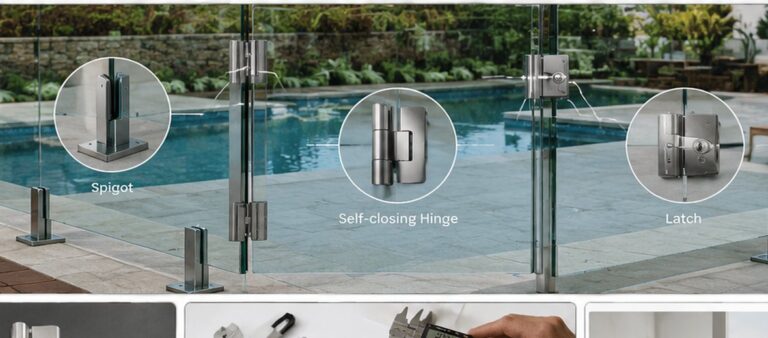
For complementary guidance, see Spigots, Hinges and Latches: Where Pool Fence Hardware Compatibility Goes Wrong.
Related guides and product references
For the next stage of pool fencing hardware selection, use these guides alongside the product catalogue. Catalogue references do not replace project-specific drawings or engineering approval.

Comments (2)