
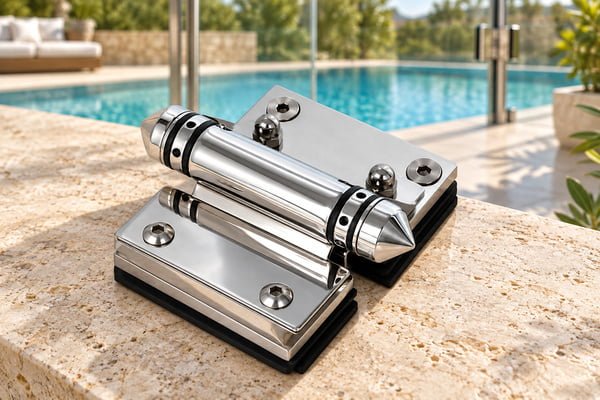
Quick answer — glass pool gate hinges and latches: Select glass pool gate hinges and latches as a coordinated gate assembly for the installation jurisdiction. State glass thickness, leaf dimensions, weight, handing and latch arrangement. Self-closing behaviour alone does not prove pool suitability, and a compatible glass range does not establish the gate’s required safety function.
This walkthrough is written for installers and project coordinators buying glass pool gate hardware. It follows the sequence from drawing review to handover so purchasing decisions support the final installation.
Stop 1: confirm the local acceptance requirements
Identify the jurisdiction and the party responsible for assessing the barrier. Read the CPSC residential-pool guidance for its US context and the NSW pool-owner guidance for its NSW context. Apply the requirements relevant to the actual project rather than mixing dimensions from different documents.
Confirm the glass selection and processing requirements. The AGWA glass-standard notice provides background for Australian projects, but the final gate must follow its own approved specification and current applicable rules.
Stop 2: inspect the drawing as an assembly
Elim catalogue comparison: Elim’s bolt-plate glass-to-glass hinge and inline metal-housing latch identify two separate roles in the gate. Catalogue inclusion does not establish that every combination meets local pool-gate requirements. Catalogue references: glass-to-glass gate hinge, inline gate latch.
Buying decision: Shortlist for the pool-gate application before comparing finish. Then reconcile hinge closing behaviour with the latch and strike geometry. A hinge that moves the leaf toward closed is not commercially useful if the proposed assembly cannot reliably engage its specified latch.
Request a complete parts list, including the specified liners, covers and fixing components. Name the responsible supplier for each item. Missing accessories should be resolved before installation rather than replaced with whatever fits on site.
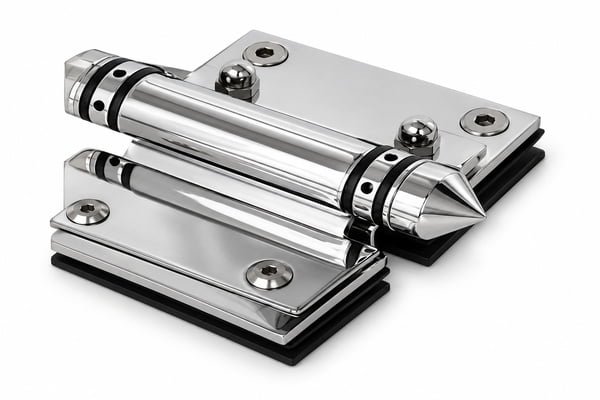
Catalogue reference: Bolt-Plate Glass-to-Glass Pool Gate Hinge. Appearance does not establish dimensions or performance.
Does a self-closing glass hinge automatically qualify for a pool gate?
No. CRL’s GH180LBS is a concrete warning against that assumption: it lists 10 or 12 mm tempered glass, a maximum gate width of 1.07 m and weight of 29.5 kg, yet explicitly excludes pool gates. These are that product’s limits, not Elim specifications.
| Gate-hardware enquiry | Specify separately |
|---|---|
| Leaf | Width, height, glass thickness and total weight |
| Hinge | Pool-gate application and closing behaviour |
| Latch | Compatible strike and required release arrangement |
Source: CRL GH180LBS application limits. Reference checked 27 September 2026.
Request a matched quotation: Send gate dimensions, weight and installation country for a pool-specific hinge-and-latch proposal..
Stop 3: review the support and fixing interfaces
Check whether the hinge support is suitable for the approved gate arrangement. Where anchors are involved, obtain the selected system’s design and installation information; Hilti’s technical library illustrates the product-specific nature of that evidence.
Use the pool hardware compatibility guide to coordinate related components. If the drawing requires a nonstandard interface, route the proposal through OEM development review before purchasing the glass or approving bulk quantities.
Stop 4: evaluate operation under the agreed procedure
Do not invent a universal cycle count or test opening angle for every jurisdiction and model. Use the applicable requirements and the approved manufacturer instructions. Recheck affected functions when a component, support detail or adjustment changes.
| Observation | Record rather than assume |
|---|---|
| Movement | Obstructions, rubbing and clearance |
| Closing | Procedure and observed result |
| Latching | Engagement and release behaviour |
| Fixings | Installed arrangement and inspection status |
| Identification | Component models and revisions |
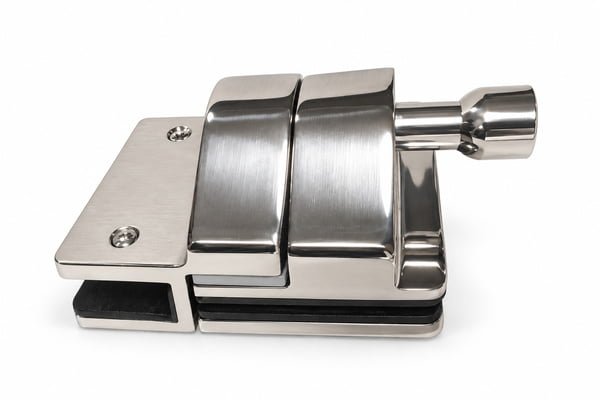
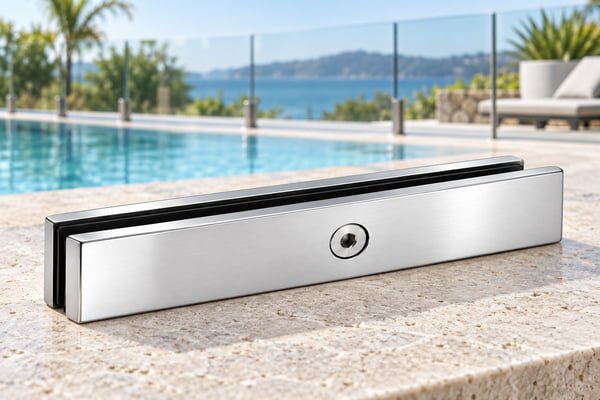
Catalogue reference: Inline Glass Pool Gate Latch with Metal Housing. Appearance does not establish dimensions or performance.
Stop 5: plan for the environment
State whether the gate is coastal, sheltered or exposed to deposits from the surrounding environment. IMOA’s coastal discussion and ASSDA’s tea-staining guidance provide material-selection background. A finish image is not corrosion-performance evidence.
Ask for maintenance and inspection information covering the supplied hardware. Ensure the property operator understands the relevant checks and knows whom to contact if closing or latching changes. Do not promise maintenance-free operation.
Continue the same project: Base-Plate vs. Core-Drill Pool Fence Spigots: What Buyers Should Specify covers the next related purchasing decision in this system.
Stop 6: receive and hand over the right components
Check labels against the approved schedule before installation starts. Protect mating surfaces and keep small accessories together. Use ISTA’s procedure overview for package-testing discussions and Trade.gov’s document guide to align shipment records with the packing list.
An illustrative two-gate delivery should have two separately identifiable gate kits if that is the approved packing arrangement. The example does not prescribe how many hinges each gate needs; hinge quantity and capacity come from the selected design.
Installation FAQ
Can a latch be selected by appearance alone? No. Confirm its mounting arrangement, intended operation and compatibility with the actual gate.
Does an ordinary hinge prove self-closing performance? No. Verify the specified closing mechanism and the assembled gate’s required behaviour.
Send the gate drawing, jurisdiction, glass details, component schedule and quantities through the pool hardware enquiry form. Ask for an assembly-focused quotation and a clear list of evidence still required before approval.
Comments (4)