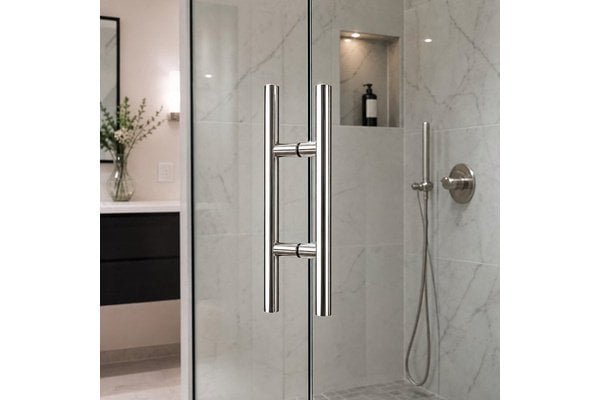
Back-to-back shower handles provide a pull on both faces of the glass; a single-sided arrangement uses a different opposite-face fixing or termination. Buyers should compare operating needs, projections and the complete fixing stack. The visible front handle is only part of the product.
For distributors selecting shower hardware, separate the handle format from its finish and construction. A product can look similar in a catalogue yet require different fixings or glass preparation.
What is included in one set?
Ask whether the quoted unit contains two pulls, one pull with opposite-face hardware, or another defined combination. List studs, sleeves, gaskets, washers and caps where supplied.
CRL’s standard pull range contains examples of different formats. Its hardware catalogue distinguishes specific assemblies and their dimensions. These are external market examples, not a statement that every Elim handle shares those interfaces.
A distributor’s comparison table
| Purchasing issue | Back-to-back arrangement | Single-sided arrangement |
|---|---|---|
| Operating surfaces | Pulls on both sides | Verify the opposite-side operation |
| Projection | Check both handle projections | Check handle and opposite fixing |
| Kit contents | Matched pair and fixing parts | Pull plus specified termination parts |
| Stock description | Identify a complete set | Avoid describing only the visible pull |
The right choice depends on the door layout and intended use. Do not assume a single-sided fitting is appropriate simply because it reduces the number of visible handles.
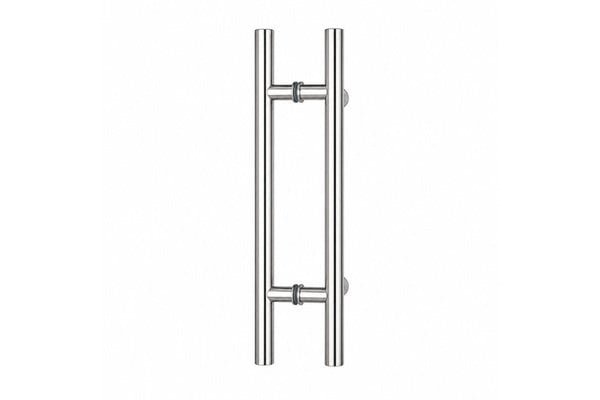
Catalogue illustration: Complete ladder-style shower door handle. Shown as a component reference, not an installation drawing or test result.
Start with the hole schedule
Use the handle hole-centre guide to record spacing, hole diameter and glass thickness. Add the handle projection and the opposite-face projection to the assembly drawing.
For an illustrative quotation, two handles might both use 200 mm hole centres but differ in stud length and opposite-face hardware. Matching centres alone would not establish interchangeability. The example is a purchasing comparison, not an Elim standard dimension.
If replacing existing hardware, obtain the original preparation drawing where possible. Do not modify already toughened glass to accommodate a different handle. Have a qualified glazing supplier assess any replacement requirement.
Can the user operate the door from both sides?
Review the complete opening arrangement. The U.S. Access Board door guidance and bathing room guidance provide examples of accessibility considerations where applicable. The responsible project team should determine the actual requirements.
Ask how the door is opened, closed and held from each side. A low-profile cap is not automatically an operating grip. Check clearance against walls and adjacent glass throughout the intended movement.
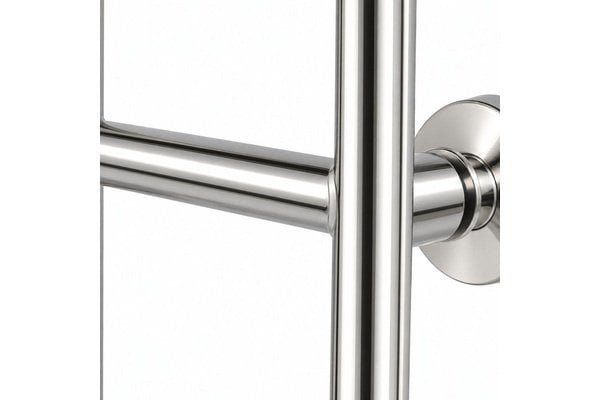
Catalogue illustration: Ladder-style shower handle cross-fixing detail. Shown as a component reference, not an installation drawing or test result.
Construction and appearance are separate decisions
The solid versus tubular pull comparison addresses construction. It does not decide whether a handle is single-sided or back-to-back. Keep those attributes in separate fields so the quotation is unambiguous.
Glass safety is another distinct issue. The CPSC glass alert provides background; it does not approve a handle’s local glass interface. Request the correct gaskets and sleeves for the supplied assembly.
Measure samples from defined reference points and retain the instrument record where required. NIST’s traceability explanation helps structure dimensional checks without implying that measurement alone proves overall performance.
Prevent a mixed-set shipment
Approve the complete appearance sample. ASSDA’s surface finish information provides terminology for stainless finishes, while the finish batch-matching guide explains why a named colour is not a complete acceptance criterion.
Use traceability principles to keep paired parts and their kit identity together. Pack each complete set so small fixing components do not migrate between cartons during receiving or installation.
Make spare kits identifiable
Keep a replacement fixing kit code alongside the complete handle code. State which glass thickness and handle version it serves, and include a small exploded drawing with the pack. This helps a service team distinguish a missing washer from an incompatible stud. It also prevents a distributor from supplying the right-looking handle with an opposite-face assembly intended for a different configuration.
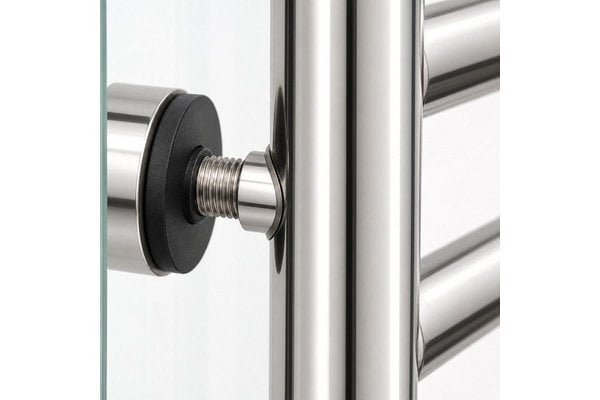
Catalogue illustration: Shower handle glass-contact fixing detail. Shown as a component reference, not an installation drawing or test result.
Send a quotation request that can be checked
Include handle format, glass thickness, hole preparation, projections, material, finish and quantity in complete sets. State whether replacement fixing kits are also required.
For a special format, use OEM review and confirm the relevant manufacturing capabilities. Request a sample quotation with an exploded parts list. Purchasing, quality and installation teams can then compare the same complete assembly instead of three different interpretations of one handle photograph.