Specify shower door opening direction from the complete enclosure layout, not from the hinge name alone. Inward, outward and two-way movement have different clearance and seal consequences. The selected hardware must support the intended motion and the applicable project requirements.
For buyers of shower system components, the order should include a door swing drawing. A photograph of a hinge does not establish its permitted opening range, closing behaviour or compatibility with the proposed glass.
Begin with the user’s path
Draw the enclosure in plan and show the door in closed and open positions. Include handles, nearby walls, fixtures and other obstacles. Consider how a person enters, exits and reaches the handle from each side.
The CRL shower hardware catalogue illustrates different hardware families. A 90-degree hinge listing and a 135-degree listing describe particular products; the angle in a product name should not be treated as a complete door-motion specification.
Our wall-mounted versus glass-mounted hinge guide addresses another distinction. Mounting configuration and opening direction must both be recorded.
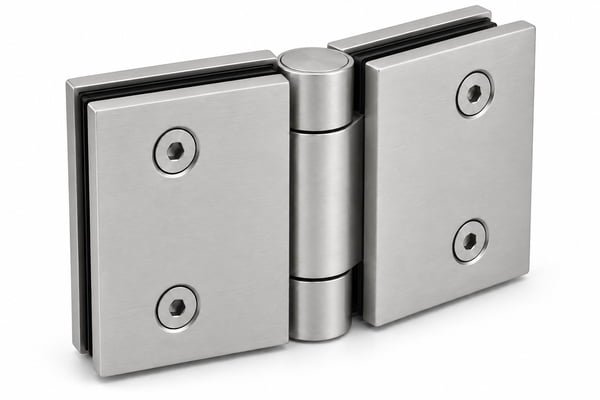
Catalogue illustration: Matte Silver 90 Degree Glass-to-Glass Shower Door Hinge — Finish Concept. Shown as a component reference, not an installation drawing or test result.
Compare the layout consequences
| Proposed movement | Check inside the enclosure | Check outside the enclosure |
|---|---|---|
| Inward | Fixtures, user space and seal behaviour | Access to the operating handle |
| Outward | Closed-position seal arrangement | Door sweep and adjacent obstructions |
| Two-way | Both travel paths | Both travel paths and stops |
This table is a layout checklist, not approval for any particular opening direction. The governing requirements and product instructions decide which arrangement is acceptable.
Keep clearance and accessibility specific
The U.S. Access Board door guide and bathing room guide provide examples of accessibility requirements where applicable. Have the project team determine which provisions apply to the actual facility and jurisdiction.
For an illustrative layout review, compare two otherwise identical plans with the door swing reversed. Mark every collision and unreachable operating point. This exercise can reveal a problem before glass preparation is released, but it does not replace a competent review of the enclosure.
Avoid solving clearance problems by reducing a required opening or changing hardware without checking the consequences. The design should be resolved before the purchasing schedule is finalized.
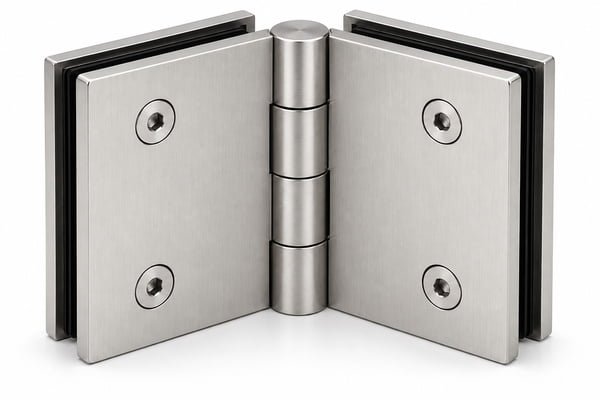
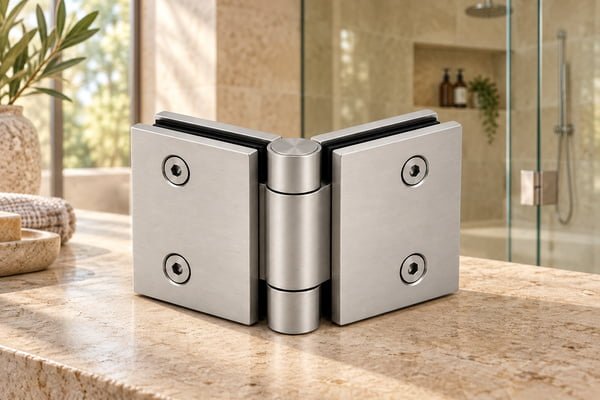
Catalogue illustration: 135 Degree Glass-to-Glass Shower Door Hinge. Shown as a component reference, not an installation drawing or test result.
Understand closing position and seals
The hinge closing-angle guide explains why the rest position and available adjustment need model-specific instructions. A hinge that moves in both directions may still have specific limitations on its closing position and use.
Glass specification remains separate. The CPSC glass safety alert is useful background, but it does not select the glass or hinge for a shower door.
Coordinate the bottom and vertical seals with the intended movement. Manufacturer seal information illustrates profile-specific details. Our bottom seal comparison helps buyers distinguish drip-control features from clearance and compatibility requirements.
Sample review before a bulk order
Request a representative assembly showing the selected hinge, handle and seals. Check the intended movement with the drawing and record any limitations. Do not assume a generic showroom door demonstrates the proposed configuration.
Record the model, glass preparation revision and complete parts list. Conformity assessment guidance helps define what the sample review establishes and what still requires separate evidence. An operational demonstration is not automatically a load or durability test.
Check the drawing issue
Before ordering, confirm that the architect, glass processor and hardware supplier hold the same drawing revision. Keep superseded layouts clearly marked so an earlier swing direction cannot be mistaken for the approved arrangement. Include the room reference on each drawing.
Coordinate the final order
Assign each door a location code and keep that code on the hardware kit. For rooms with mirrored layouts, attach separate plan views rather than relying on a verbal instruction to reverse the installation. Check that the selected seal and handle work in each arrangement. A purchasing schedule should make any differences visible before production, packing and glass processing are released to their respective suppliers.
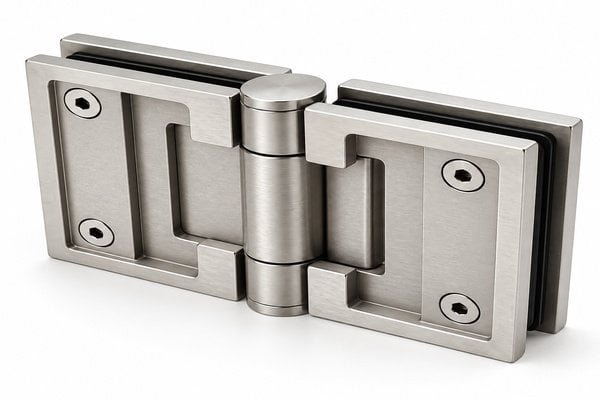
Catalogue illustration: Heavy-Duty Shower Door Hinge. Shown as a component reference, not an installation drawing or test result.
Three details to place on the purchase order
First, name the viewing direction used to describe the swing. Second, attach the plan and glass preparation drawing. Third, state the complete hinge, handle and seal combination, including handed or position-specific parts.
Discuss nonstandard layouts through OEM review, check available manufacturing support, and request a complete enclosure hardware quotation. Clear opening information reduces the risk of receiving individually correct components that do not work together in the intended room.