Wire rope length can change through recoverable elastic stretch, constructional settling and other permanent movement. These should not be treated as the same phenomenon. A useful purchasing specification states the measurement load, reference points and condition before comparing assembly lengths.
For buyers of wire rope systems, the key question is not simply whether cable stretches. It is how the approved assembly behaves under the defined conditions and whether the observed movement is acceptable for its application.
Three observations, different explanations
Sava’s cable information distinguishes constructional and elastic stretch. In broad terms, elastic extension is associated with loading and recovery, while constructional settling involves the arrangement of wires and strands. Do not assume that every residual change is harmless settling.
| Observation | What to investigate |
|---|---|
| Length increases under load and recovers | Elastic response under the specified conditions |
| Residual change after initial loading | Constructional settling or another source of movement |
| Unexpected continuing change | Terminals, support movement, damage or other causes |
This table is a diagnostic starting point, not an acceptance standard. The qualified test provider and responsible designer should interpret the actual results.
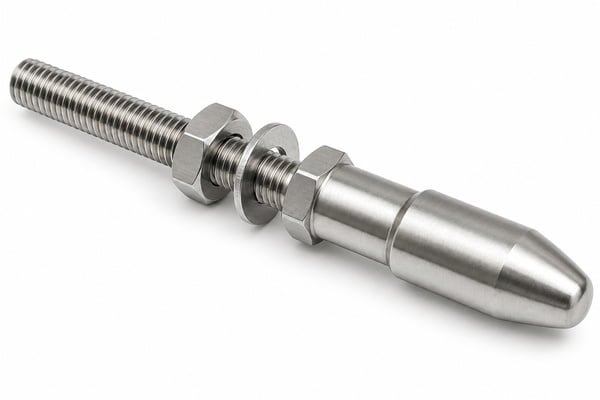
Catalogue illustration: Swage Stud Cable Terminal — WR096. Shown as a component reference, not an installation drawing or test result.
Measure a defined assembly
Our assembly-length guide explains why end references matter. A pin-centre measurement and an overall end-to-end measurement describe different dimensions. State whether the cable is unloaded, under a specified reference load or in another defined condition.
Record terminal adjustment positions as well. A tensioner moved between measurements can make an unchanged cable appear longer. Identify the whole assembly rather than recording only the nominal rope diameter.
The Sava FAQ provides additional manufacturer context. Its stated procedures and figures apply within that source’s scope; do not copy a proof-load percentage into an unrelated architectural assembly without approval.
Use a simple measurement record
An illustrative worksheet can contain baseline length, loaded length and length after unloading, all from the same reference points. Add the load, hold time, temperature where relevant and instrument identity. The numerical values and acceptance limits must come from the approved procedure.
Do not subtract measurements taken under different conditions and label the result permanent set. Repeatability and setup control are necessary before the difference can be meaningfully interpreted.
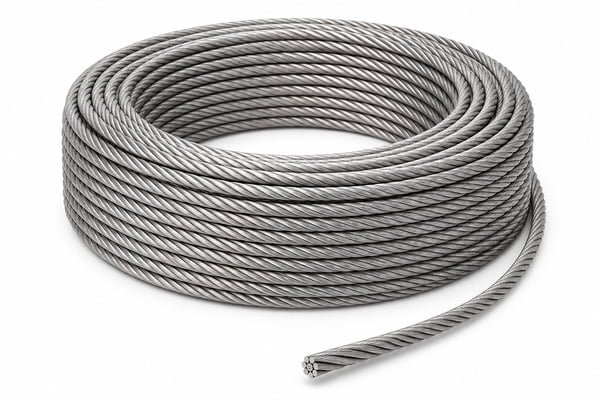
Catalogue illustration: 1×19 Stainless Steel Wire Rope — WR001. Shown as a component reference, not an installation drawing or test result.
Include the terminals and supports
Terminal design information helps frame questions about the end connection. The movement observed across an installation may include terminal seating, fitting movement or support displacement as well as cable extension.
An architectural cable catalogue describes a system context, not universal behaviour for every rope. Review the actual cable construction, terminals and supports together. Our proof-load and breaking-load comparison separates different test objectives.
A result from a bare cable is not automatically a result for the complete terminated assembly. Make the test boundary explicit in the order and report.
Plan adjustment without hiding a defect
Adjustment allowance may be part of the intended system, but it should not conceal unexplained ongoing movement. Retain initial settings and record subsequent changes. If adjustment is repeatedly consumed, investigate the cause rather than simply ordering a longer tensioner.
The tension-measurement guide covers the measurement of another relevant variable. NIST traceability guidance supports the instrument and record requirements. Cable length and tension data should be interpreted together only under a defined procedure.
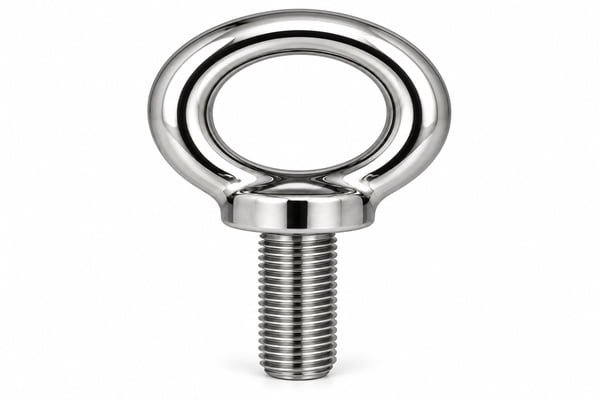
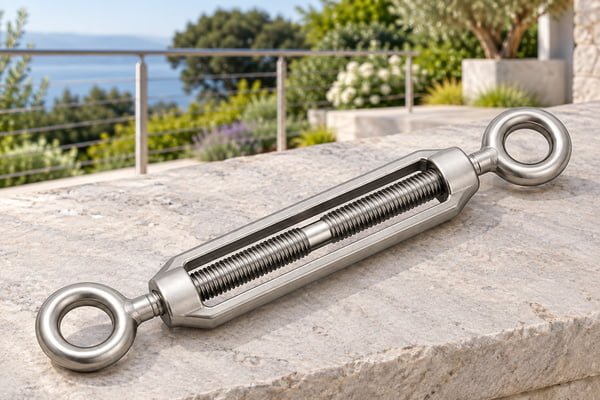
Catalogue illustration: Stainless Steel Wire Rope Eye Bolt — WR086. Shown as a component reference, not an installation drawing or test result.
What should the supplier report?
Request assembly identity, cable construction, terminal codes, test conditions, measurement references and acceptance decision. Use an appropriate sampling approach if lot acceptance relies on selected specimens. Preserve the link to production using traceability principles.
The report should explain any exclusions, such as supports not included in the test. Conformity-assessment guidance helps keep the claim within the actual evidence. Do not turn a dimensional observation into an unsupported lifetime-performance promise.
Does residual movement always mean the cable yielded? No. Several mechanisms can contribute. A competent investigation is needed to distinguish them.
Can all stretch be removed before installation? Do not promise that. Specify the required conditioning and performance for the actual assembly and retain the supplier’s limitations.
Discuss unusual requirements through OEM review, confirm manufacturing capabilities, and request a quotation with a clear length and test basis. That makes competing offers more comparable than a general request for non-stretch cable.