Request positive material identification, or PMI, when the purchasing risk requires verification of alloy identity beyond visual checks and paperwork alone. Specify the test method, components, sampling and acceptance criteria. PMI does not prove cable-assembly strength, heat treatment or service performance.
For stainless cable fittings, the important distinction is between identifying material and accepting the complete product. This guide is written for importers and quality managers planning a proportionate verification programme.
What question is the test answering?
A purchase order may require a particular stainless grade, while the shipment includes terminal bodies, studs, pins and other components. Decide which parts need identification. Testing the accessible outer body does not automatically identify every component inside an assembly.
ASSDA’s grade-confirmation guidance discusses the limits of different identification approaches. A magnet check alone is not a reliable substitute for a specified chemical identification method. Surface condition, geometry and manufacturing history can affect simple screening observations.
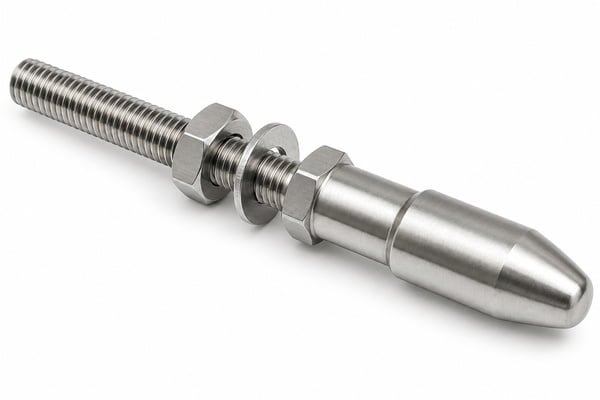
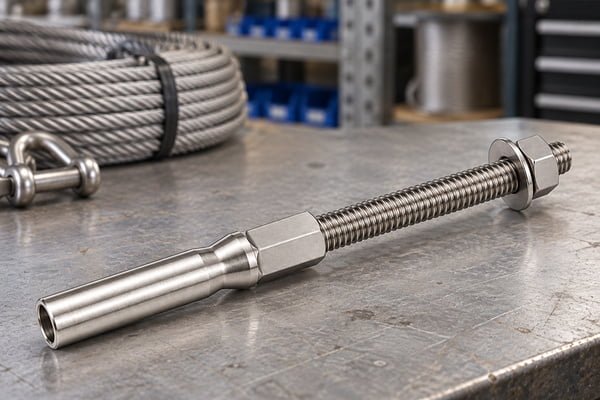
Catalogue illustration: Swage Stud Cable Terminal — WR096. Shown as a component reference, not an installation drawing or test result.
Match the method to the requirement
Ask the laboratory or qualified test provider which method can assess the elements relevant to the specified grade. Do not assume every handheld instrument distinguishes every grade variant. Where carbon content or another element outside the method’s capability matters, request an appropriate alternative.
| Requirement | Evidence to request |
|---|---|
| Alloy identity | Suitable analytical method and reported results |
| Heat or batch identity | Traceable link to the delivered parts |
| Mechanical properties | Applicable material or product test records |
| Assembly capacity | Relevant complete-assembly evidence |
| Surface condition | Separate finish and treatment inspection |
Use producer certificate information to understand the documentary chain. Our material-certificate checklist helps purchasers check whether a document actually describes their shipment. A certificate copied from an unrelated batch is not useful evidence.
Define the lot before selecting samples
Identify a lot by the agreed production and material controls, not merely by everything inside one delivery truck. If multiple heats or subcontracted components are involved, the sampling design must address that mixture.
Stainless producer product information provides material context; it is not certification of the fitting being purchased. Record the actual part code, supplier, material batch and test location. Use measurement traceability principles when evaluating how instruments and results are controlled.
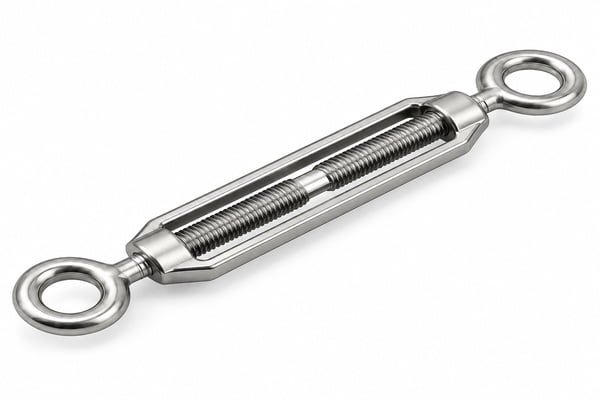
Catalogue illustration: Eye To Eye Turnbuckle — WR032. Shown as a component reference, not an installation drawing or test result.
Do not ask for a vague percentage
A statement such as test a few pieces leaves the selection method and response to failure undefined. Start with acceptance-sampling concepts, then choose a documented sampling plan suitable for the agreed risk and acceptance requirements.
State who selects samples, whether different component families are represented and what happens after an unexpected result. Where higher-risk applications require wider verification, establish that requirement before ordering rather than negotiating it after the shipment arrives.
Preserve tested-part identification. The wire rope traceability guide and GS1 traceability framework help organize the link between the report and delivered stock. A spreadsheet of readings without identifiable parts cannot support a useful receiving decision.
Handle an unexpected reading systematically
Isolate the affected material and record the test conditions. Ask the qualified provider to assess instrument suitability, surface preparation and whether confirmatory analysis is needed. Do not relabel the batch from a single unexplained screen result or conceal the discrepancy by averaging readings.
Keep the original result and the disposition together. If substitution is proposed, require the relevant technical and purchasing approvals before release. Material similarity is not proof of equivalent performance in the intended application.
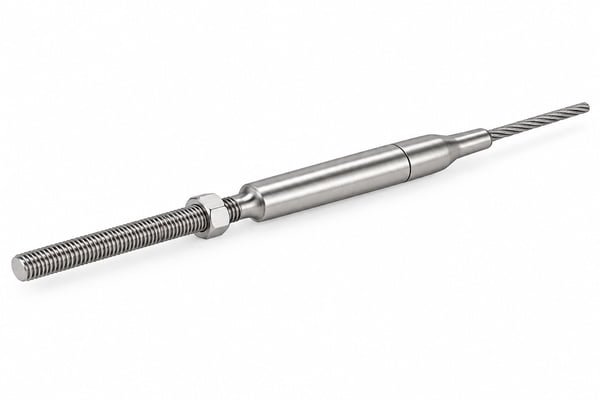
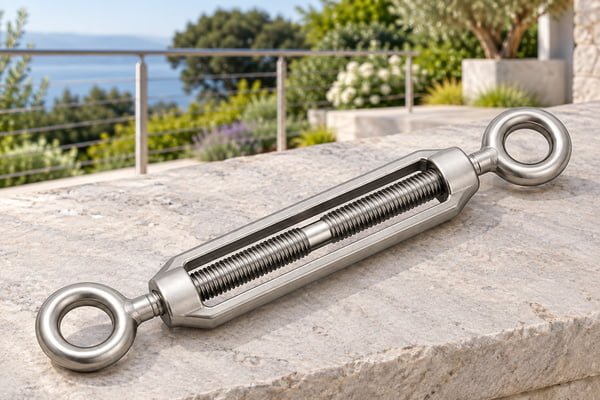
Catalogue illustration: Closed Body Cable Tensioner — WR011. Shown as a component reference, not an installation drawing or test result.
Questions to put in the RFQ
Does PMI replace a load test? No. Our proof-load and breaking-load comparison addresses a different requirement. Material identity alone does not validate cable construction, swaging or complete-assembly capacity.
Can one test certify an entire mixed shipment? Only the agreed sampling and acceptance framework determines what conclusions are supported. Do not expand a report beyond its stated scope.
Who should interpret the results? A competent provider using the applicable material specification and method. Conformity-assessment guidance helps distinguish test results, inspection decisions and certification claims.
Discuss special material requirements through OEM review, confirm the relevant manufacturing controls, and request a quotation with the test scope priced explicitly. That makes PMI a defined purchasing control rather than a reassuring but ambiguous label.