

Quick answer
Before importing shower hardware, confirm the model, material, dimensions, finish, glass interface, gaskets, accessories, packaging, inspection criteria and repeat-order specification. Use one revision-controlled approval record so the sample, quotation and delivered goods can be compared.
Shower hardware can look almost identical in supplier photos, but the real cost difference often hides inside the material, finish, accessories, and packaging. If buyers only compare price and appearance, small gaps may become leakage, missing parts, or installation complaints. I always treat pre-order confirmation as risk control.
Before importing shower hardware, buyers should confirm 10 manufacturing details: material grade, body dimensions and wall thickness, unit weight, surface finish, glass preparation, gaskets and seals, fixing components, accessory list, protective packaging, and inspection requirements. These details should be written into the quotation, approved sample record, purchase order, and pre-shipment inspection checklist.
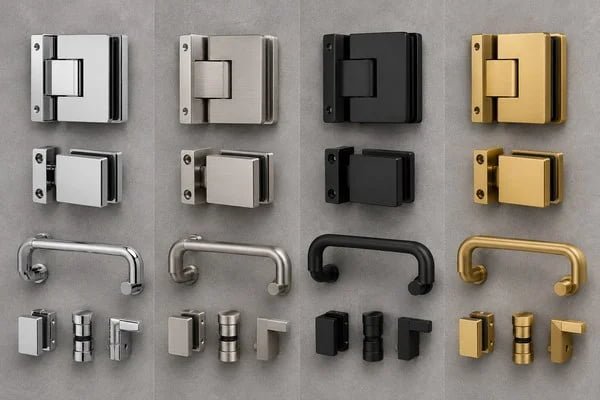
A product photograph can help identify a candidate model. Approve the material, fittings, dimensions and packaging separately against written requirements so that visual similarity is not treated as proof of equivalence.
Which Shower Hardware Material Details Should Buyers Confirm?
Material is the first risk point in shower hardware sourcing. Two products may share the same shape, but one may use better brass, thicker stainless steel, or a heavier zinc alloy body. The quotation should not simply say “good quality.”
Buyers should confirm material grade, thickness, and unit weight before approving shower hardware samples. These details affect durability, feel, installation stability, and price. If the supplier offers several grades, each option should be quoted separately and clearly marked.

For example, I usually ask suppliers these simple questions before sampling:
- What is the main body material?
- What is the wall thickness?
- What is the net product weight?
- Is the quoted price based on the same material as the sample?
- Can the supplier mark the material on the specification sheet?
| Detail | Why It Matters | What To Write Down |
|---|---|---|
| Material | Affects strength and cost | Brass, stainless steel, zinc alloy, ABS |
| Thickness | Affects durability | Measured range or drawing value |
| Weight | Helps compare quotations | Net unit weight |
| Finish base | Affects plating result | Polished, brushed, coated surface |
Low price is not always a problem. The real problem is unclear comparison. If one supplier quotes a brass body and another quotes zinc alloy, the cheaper price is not directly comparable.
For complementary guidance, see Why Shower Hinges Fail: Quality Checks Importers Should Make Before Shipping.
How Should Shower Hardware Surface Finish Be Specified?
Surface finish may affect both appearance and customer complaints. A glossy chrome finish, brushed nickel look, matte black coating, or gold finish can vary widely between suppliers. Buyers should not rely only on catalog photos.
The surface finish for shower hardware should be confirmed by finish name, color sample, process description, and acceptance standard. Buyers should keep an approved sample or color board, then use it during pre-shipment inspection.

In supplier discussions, I like to separate “color” from “process.” A matte black shower set may be painted, powder coated, or treated by another process. The visual effect may look close, but scratch resistance and batch consistency may differ.
Ask these questions:
- What is the exact finish name?
- Is the surface plated, painted, coated, or brushed?
- Can the supplier provide a finish sample before mass production?
- What defects are unacceptable?
- Will the bulk order match the approved sample?
Common finish issues include:
- Color difference between parts
- Scratches from poor packing
- Uneven coating around edges
- Fingerprints or stains after assembly
- Mixed finishes in one shipment
Buyers should also confirm whether any testing reports or compliance documents are available. However, these documents should be verified by the buyer or a qualified professional when the market requires specific standards.
For complementary guidance, see Matte Black, Brushed or PVD? Choosing Shower Hardware Finishes for Your Market.
What Shower Hardware Configuration Details Prevent Installation Problems?
Many shower hardware disputes come from missing or incompatible parts. A product may look complete in a photo, but the actual quotation may exclude brackets, gaskets, seals, connectors, screws, or instruction sheets.
Buyers should confirm the full accessory configuration for shower hardware before order confirmation. The accessory list should include hinge or clamp model, glass preparation, fixing size, gaskets, seals, washers, mounting parts, tools, and manuals if required.
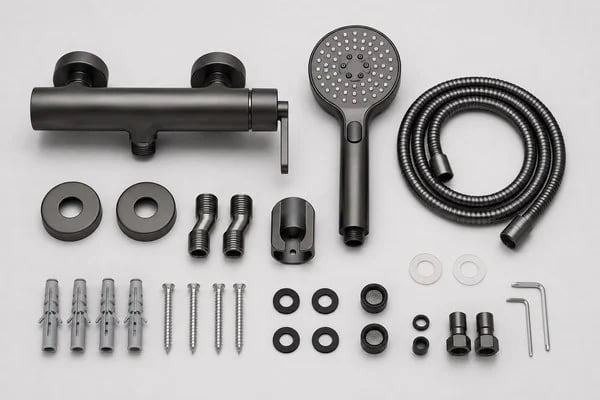
This step is especially important for importers and private-label buyers. Retail customers often judge the whole set, not just the main body. If one washer is missing, the product may be blamed for leakage even when the main part is acceptable.
A practical configuration checklist includes:
- Main shower body
- Hinge or clamp model and mounting arrangement
- Hand shower or head shower
- Glass preparation and gasket specification
- Connector size and thread standard
- Rubber seals and washers
- Wall brackets or holders
- Screws and anchors
- Installation manual
- Retail box, labels, and barcode
Product drawings should also include key installation dimensions. I recommend confirming hole positions, center distance, thread type, and tolerance range. A “basic drawing” may show overall size, but installation success depends on connection points.
If the supplier says “standard accessories,” I usually ask them to list every part in writing. “Standard” can mean different things in different factories.
For complementary guidance, see Building a Complete Frameless Shower Hardware Range for Your Wholesale Business.
How Should Packaging and Inspection for Shower Hardware Be Written?
Packaging is often treated as a final detail, but it directly affects claims after shipment. Heavy metal parts, sharp edges, and coated surfaces need proper protection. Weak packaging may cause scratches even when production quality is acceptable.
Packaging and inspection requirements for shower hardware should be confirmed before mass production. Buyers should define inner protection, carton strength, labeling, drop-test expectations if needed, and the pre-shipment inspection checklist.

For B2B orders, I suggest writing packaging requirements in simple, checkable language:
- Each part packed separately to avoid scratching
- Foam, bag, or insert protection for coated surfaces
- Clear accessory bag for small parts
- Master carton with shipping marks
- Barcode and private-label artwork if required
- Spare parts policy if agreed
Inspection should also match the order risk. A basic visual inspection may not be enough if the product has many fittings. The checklist should include:
| Inspection Item | Check Method |
|---|---|
| Appearance | Finish, scratches, dents |
| Quantity | Main product and accessories |
| Dimensions | Key installation sizes |
| Function | Basic assembly and movement |
| Packaging | Inner protection and carton marks |
| Sample match | Compare with approved sample |
The main goal is responsibility clarity. If the purchase order, sample approval, and inspection checklist all say the same thing, it is easier to handle problems fairly.
Frequently Asked Questions
Why do similar shower hardware products have very different prices?
Similar shower hardware may use different body materials, finish processes, hinge mechanisms, gaskets, connectors, seals, and packaging. Buyers should compare written specifications, not photos only.
Is a product photo enough for shower hardware approval?
No. A photo cannot confirm thickness, weight, thread size, seals, tolerance, finish process, or included accessories. Buyers should approve samples with written specifications.
What should be included in a shower hardware purchase order?
A purchase order should include material, finish, dimensions, tolerances, accessory list, packaging, labeling, approved sample reference, inspection method, and any market-specific document requirements.
Who should verify technical standards?
Buyers should ask suppliers for available documents, but application-specific standards should be reviewed by qualified testing bodies, engineers, or compliance professionals when required.
Manufacturing details: a practical decision record
Use this proposed worksheet to record a purchasing decision. It is an editorial checklist, not a completed project inspection or test result.
| Review step | What to record |
|---|---|
| Define the requirement | Record the exact material, body dimensions, unit weight and approved finish sample. |
| Resolve the interface | Attach the glass interface drawing, gasket specification, accessory list, protective packing plan and inspection criteria. |
Worked example: Inspection coverage
Illustrative assumptions only — not an actual order, measured result, price offer or engineering approval.
A purchase brief has 10 required fields for each of 4 models. There are 10 × 4 = 40 model-field checks. If 6 lack an agreed value, 34/40 = 85% are complete.
Decision: An 85% completion rate does not approve the order: resolve every critical interface before release.
Reference and applicability
CRL frameless shower hardware catalogue: Manufacturer catalogue for component families; its named products are not interchangeable with Elim parts without verification. Project-specific technical or regulatory requirements should be checked by the responsible qualified professional.
Editorial update: 25 September 2026. This update checks article structure, topic scope and the references identified above. It does not claim independent engineering certification.
Related guides and product references
For the next stage of shower hardware selection, use these guides alongside the product catalogue. Catalogue references do not replace project-specific drawings or engineering approval.
- What Glass Distributors Look for in a Reliable Frameless Shower Hardware Supplier
- Frameless Glass Shower Hardware: The Complete Buyer's Guide
- Shower hardware product range
- 135 Degree Glass-to-Glass Shower Door Hinge — catalogue reference
Conclusion
Importing shower hardware is not only a price decision. It is a pre-order confirmation process. Buyers should define material, finish, configuration, dimensions, packaging, and inspection rules before mass production begins. I recommend putting every key detail into the quotation, sample approval record, purchase order, and inspection checklist. If you are preparing a new sourcing project, start by turning supplier promises into written, checkable requirements.
Comments (5)