
Shower hinges fail when buyers treat them as simple hardware instead of shipment-risk products. A “good sample” may look fine, but one weak batch can cause installation delays, rework, missing-parts claims, customer complaints, and arguments about whether the problem came from production, transport, selection, or installation.
Shower hinges usually fail because the hinge does not match the real application, the mass-production quality is inconsistent, small accessories are wrong or missing, or pre-shipment checks are too light. Importers should verify fit, function, surface finish, accessories, packaging, and supplier responsibility before approving shipment.

In my export and inspection work, I have seen that hinge problems are rarely about one single number on a specification sheet. The safer approach is to check the full use case, then compare the approved sample with mass production before the goods leave the factory.
Why Do Shower Hinges Fail in Real Projects?
Shower hinges fail in real projects when the product, glass, wall, door size, and installation conditions do not match. This creates stress, noise, loose clamping, poor alignment, or early corrosion. The importer then faces complaints, even if the hinge body looked acceptable during sampling.
A buyer-side check should cover:
- Glass thickness, such as 6 mm, 8 mm, 10 mm, or 12 mm
- Door weight and door width
- Wall-to-glass or glass-to-glass structure
- Opening angle and direction
- Daily use frequency
- Wet-room corrosion risk
- Installer skill and site tolerance
A stainless steel grade or brass material claim is useful, but it is not enough. A load rating also needs context. Buyers should ask suppliers for records, drawings, test reports, or third-party verification where needed. I do not treat a printed “load capacity” as a guarantee. I treat it as one document to verify.
In complaint discussions, the problem is often not only the hinge body. It may be a rubber gasket that is too thin, screws that do not lock well, or a decorative cap that falls off after installation.
| Risk Point | What Importers Should Check | Why It Matters |
|---|---|---|
| Application fit | Glass thickness, door weight, opening type | Reduces wrong-selection claims |
| Function | Smooth opening, noise, rebound, angle holding | Reduces installation rejection |
| Surface | Scratches, pitting, color difference, plating quality | Protects brand appearance |
| Accessories | Screws, pads, caps, gaskets | Prevents missing-parts failures |
| Packaging | Moisture, separation, impact protection | Reduces transport damage |
What Shower Hinges Checks Should Importers Make Before Shipping?
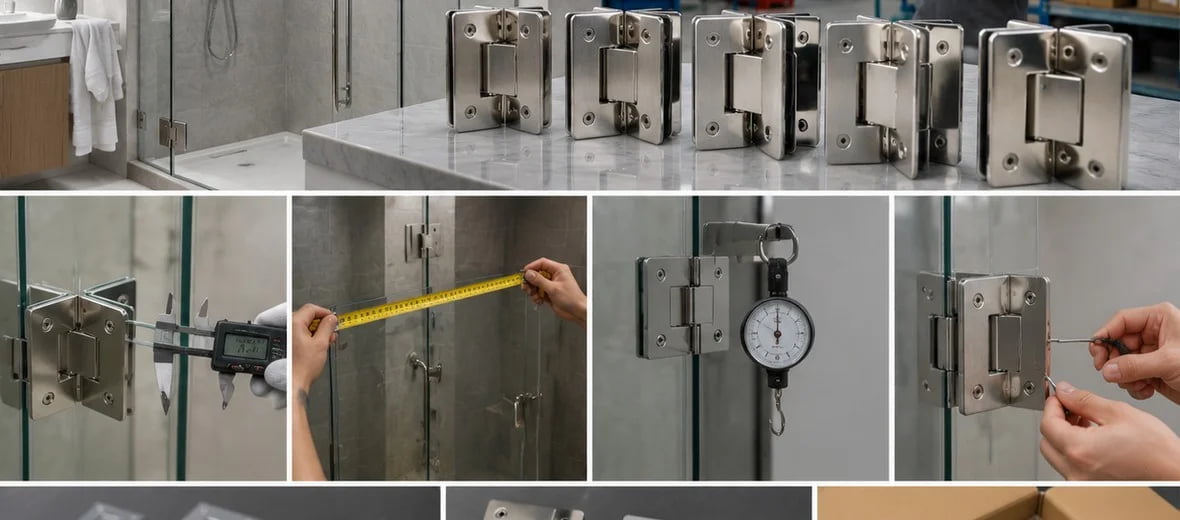
Importers should compare the approved sample with mass production before shipment. The check should include size, weight, surface finish, material marking, accessory list, opening and closing function, screw locking, clamping stability, packaging condition, and carton labeling.

A practical pre-shipment inspection does not need to be complicated, but it must be specific. I like to start with the approved sample on the table. Then I ask the inspector or supplier to compare real production pieces against it.
Key checks include:
Dimension check
Measure the hinge body, hole positions, plate thickness, and matching areas. Small differences can create site installation problems.Weight comparison
A large weight difference may suggest a material, casting, or machining change. It does not prove failure, but it is a warning signal.Function test
Open and close the hinge several times. Check smoothness, abnormal noise, rebound, angle positioning, and looseness.Screw and clamping check
Confirm that screws lock properly and pads hold firmly. A hinge that cannot clamp glass safely will become an after-sales issue fast.Surface check
Look for scratches, pitting, sharp edges, uneven plating, rust marks, color difference, or coating damage.Packaging check
Check whether parts are separated, dry, protected, and labeled. Moisture inside packaging can increase rust risk during sea shipment.
Small parts deserve serious attention. Screws, rubber pads, gaskets, washers, Allen keys, and decorative caps look minor, but they often decide whether installation succeeds. Missing or mismatched accessories can turn an acceptable hinge into a failed delivery.
How Should Importers Manage Shower Hinges Suppliers?
Importers should manage shower hinges with clear samples, written standards, batch sampling, photo records, defect rules, and responsibility boundaries. A qualified sample is only the starting point. The real risk is whether the supplier can repeat the same quality during mass production.
In pre-shipment checks, importers often find problems that could have been avoided with better supplier communication. For example, the supplier may change packaging, use another screw type, or adjust surface finishing without clear approval. These changes may look small at the factory, but they create real risk at the job site.
Before production, I recommend confirming:
- Approved sample with date and version
- Technical drawing or size sheet
- Surface finish standard
- Accessory list with quantities
- Packing method and carton marks
- Acceptable and unacceptable defect photos
- Sampling level and inspection timing
- Rework, replacement, or discount rules
A clear inspection standard protects both sides. It helps the buyer avoid vague complaints, and it helps the supplier understand what must not change.
Importers should also separate responsibility. Some failures come from wrong product selection. Some come from production defects. Some come from rough transport. Some come from incorrect installation. Clear records make later discussions more practical and less emotional.
Frequently Asked Questions
Are stainless steel shower hinges always better?
No. Stainless steel can be a good choice, but grade, processing, surface treatment, and application fit still matter. Buyers should verify supplier documents, corrosion requirements, and test records instead of relying only on the material name.
Can a load rating guarantee that shower hinges will not fail?
No. Load rating is only one reference point. Door width, glass thickness, installation quality, use frequency, and hinge structure also affect performance. For critical projects, buyers should request engineering or third-party evaluation.
What is the most common pre-shipment problem?
In my experience, accessories are a common risk. Missing screws, wrong gaskets, mixed caps, or poor packaging can cause installation failure even when the hinge body looks acceptable.
Should importers inspect every piece?
Not always. Many buyers use sampling inspection based on order size and risk level. However, high-value projects, new suppliers, or customized finishes may need stricter checks before shipment.
<!-- elim-blog-links-20260925 -->
Related guides and product references
For the next stage of shower hardware selection, use these guides alongside the product catalogue. Catalogue references do not replace project-specific drawings or engineering approval.
- Before Importing Shower Hardware, Confirm These 10 Manufacturing Details
- Matte Black, Brushed or PVD? Choosing Shower Hardware Finishes for Your Market
- Building a Complete Frameless Shower Hardware Range for Your Wholesale Business
- What Glass Distributors Look for in a Reliable Frameless Shower Hardware Supplier
- Frameless Glass Shower Hardware: The Complete Buyer's Guide
- Shower hardware product range
- 135 Degree Glass-to-Glass Shower Door Hinge — catalogue reference
<!-- /elim-blog-links-20260925 -->
Conclusion
Shower hinges fail for many reasons, not just poor material or low load capacity. Importers should check application fit, batch consistency, surface quality, accessories, packaging, and supplier records before shipment. A careful pre-shipment process reduces installation failure, after-sales claims, and responsibility disputes. If you are sourcing shower hardware from overseas suppliers, build a clear inspection checklist before you approve the next container.




Comments (2)