
A frameless shower hardware range can look complete on paper but still fail in daily wholesale sales. Buyers stock many hinges, clamps, handles, and seals, then discover that common installation combinations are missing. The better solution is to build the range around real shower scenarios first, then expand SKUs carefully.
A complete frameless shower hardware range should cover the main door types, opening methods, glass thicknesses, load requirements, and matching accessories that wholesalers repeatedly sell. It is not about having the most SKUs. It is about creating compatible, replenishable product combinations that dealers, installers, and downstream buyers can use with less confusion.

In my foreign trade sales conversations, many wholesale buyers ask for “a full range.” But after a few questions, the real need becomes clearer: they want fewer mistakes, faster quotation, stable replenishment, and products that can be sold together without creating after-sales problems.
What Makes a Frameless Shower Hardware Range Complete?
A frameless shower hardware range is complete when it covers common installation scenarios, not when it contains hundreds of unrelated items. The problem starts when buyers treat “complete” as “more choices.” That often leads to slow-moving stock, missing pairings, and confused sales teams.
A complete range should first match the main shower door structures: swing doors, sliding doors, fixed panels, glass-to-glass connections, wall-to-glass connections, and standard glass thicknesses such as 6 mm, 8 mm, 10 mm, and 12 mm, depending on the market and product design.
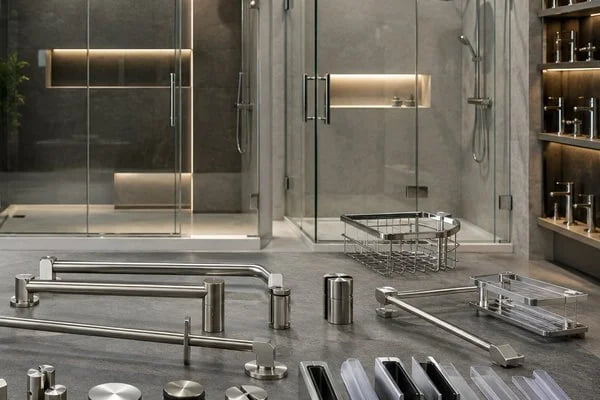
Start With Scenarios, Not SKUs
In buyer inquiries, the common confusion is simple: the buyer has a list of products but not a product system. A hinge is not only a hinge. It must match door weight, glass thickness, opening angle, fixing method, finish, and other hardware around it.
I usually suggest that wholesalers map demand like this:
| Scenario | Core Hardware | Key Buying Check |
|---|---|---|
| Swing shower door | Hinges, handle, seals, clamps | Door weight and glass thickness |
| Fixed glass panel | Clamps, support bar, seals | Wall condition and panel size |
| Sliding shower door | Roller, rail, stopper, guide | System compatibility |
| Corner shower | Hinges, connectors, seals | Opening direction and layout |
This method prevents a common inventory problem: stocking many attractive single items while missing the dependable combinations customers buy every month.
For example, a wholesaler may buy five handle styles but only one matching hinge grade. That creates a nice catalog but a weak selling range. A better approach is to build around fast-moving basics, then add finish options like chrome, matte black, brushed nickel, gold, or gunmetal only after the base structure is stable.
Why Does Compatibility Matter in a Frameless Shower Hardware Range?
Compatibility matters because wholesalers sell systems, even when they invoice single items. If a frameless shower hardware range includes disconnected low-cost parts, the buyer may save money at purchase but lose money through returns, complaints, and slow-moving inventory.
The right range should allow hinges, clamps, handles, seals, rollers, bars, and accessories to form practical combinations. Fit still depends on door type, glass thickness, opening method, and installation requirements, so buyers should verify specifications before ordering in bulk.

Think Like Your Downstream Customer
Your downstream customer rarely asks, “Do you have 80 hinge models?” They ask:
- “Can this hinge work with 10 mm glass?”
- “Do you have the matching clamp in the same finish?”
- “Can I reorder this item next month?”
- “Is there a full set for this shower layout?”
- “Can you support private-label packaging?”
This is why single-item price should not be the only purchasing standard. A very cheap part may still be useful, but only if it fits the range logic. If it does not match your main finishes, packaging style, glass thickness demand, or quality level, it can become dead stock.
A practical compatibility checklist includes:
- Glass thickness coverage: usually based on your local market demand.
- Finish consistency: color differences can create complaints.
- Load-related specification: buyers should verify supplier data and test reports where needed.
- Packaging logic: bulk pack, retail box, or private-label set.
- Replenishment stability: the supplier should support repeat orders, not only one-time deals.
I have seen buyers reduce SKU count but improve sales simply because their range became easier for dealers to understand.
How Should Wholesalers Build a Frameless Shower Hardware Range Step by Step?
Wholesalers should build a frameless shower hardware range in three stages: fast-moving basics first, controlled finish and size expansion second, and quality-level segmentation third. This keeps inventory cleaner and makes replenishment easier.
The goal is to avoid overstocking scattered items while missing the combinations installers and dealers repeatedly need. A controlled range is usually more profitable than a large but confusing range.

A Practical SKU-Building Logic
I like to use this simple structure when discussing range planning with buyers:
| Stage | Focus | Example |
|---|---|---|
| 1. Core basics | High-demand items | Standard hinges, clamps, handles, seals |
| 2. Controlled expansion | Sizes and finishes | Chrome, black, brushed nickel |
| 3. Range grading | Price and quality levels | Standard, premium, project grade |
| 4. Sales support | Packaging and sets | Dealer kits, labeled cartons, display samples |
This approach helps wholesalers avoid a dangerous mistake: buying too broadly before knowing which combinations actually move.
For example, if your market mainly sells 8 mm and 10 mm glass shower doors, it makes sense to build depth there before adding many rare sizes. If matte black is growing but chrome still sells fastest, you may keep chrome as the base finish and add black only to the best-selling models first.
Buyers should also ask suppliers for clear product drawings, material descriptions, surface finish information, packing details, and available inspection documents. Certifications and test reports should be treated as documents to verify, not slogans to accept blindly.
Frequently Asked Questions
What is the most important part of a frameless shower hardware range?
The most important part is not one product. It is the product structure. Hinges, clamps, handles, seals, and accessories should work together for common door types, glass thicknesses, finishes, and installation scenarios.
Should wholesalers choose the cheapest frameless shower hardware?
Price matters, but the cheapest option is not always the best buying decision. Wholesalers should compare compatibility, finish consistency, packaging, replenishment stability, and supplier documentation before placing large orders.
How many SKUs should a new wholesaler start with?
A new wholesaler should start with a focused core range rather than a huge catalog. The exact number depends on market demand, but the first goal should be covering common shower scenarios with reliable repeat-order items.
Can one hardware range fit all shower installations?
No. Fit depends on variables such as door type, glass thickness, opening method, wall condition, panel size, and installation requirements. Buyers should confirm technical details and seek qualified professional evaluation for project-specific decisions.
<!-- elim-blog-links-20260925 -->
Related guides and product references
For the next stage of shower hardware selection, use these guides alongside the product catalogue. Catalogue references do not replace project-specific drawings or engineering approval.
- Before Importing Shower Hardware, Confirm These 10 Manufacturing Details
- Why Shower Hinges Fail: Quality Checks Importers Should Make Before Shipping
- Matte Black, Brushed or PVD? Choosing Shower Hardware Finishes for Your Market
- What Glass Distributors Look for in a Reliable Frameless Shower Hardware Supplier
- Frameless Glass Shower Hardware: The Complete Buyer's Guide
- Shower hardware product range
- 135 Degree Glass-to-Glass Shower Door Hinge — catalogue reference
<!-- /elim-blog-links-20260925 -->
Conclusion
A strong frameless shower hardware range is built through scenario coverage, compatibility, and controlled SKU expansion. Wholesalers do not need endless items. They need dependable combinations that customers can understand, buy, install, and reorder. If you are refining your wholesale range, start by mapping your main shower layouts, glass thicknesses, finishes, and replenishment needs. Then work with suppliers who can support clear specifications, stable quality control, and practical product development.