Whether a glass railing needs a top rail depends on the adopted building requirements and the documented glass-guard system. “Frameless” describes an appearance; it is not permission to omit a structural or safety component. This decision guide helps buyers ask the right questions before removing top rails from a quotation.
First identify what the rail does
A top cap, a structural rail and a graspable handrail may perform different functions. Some project details combine functions in one member; others require separate components. Do not decide from the product name alone. Mark the intended role on the railing drawing and procurement schedule.
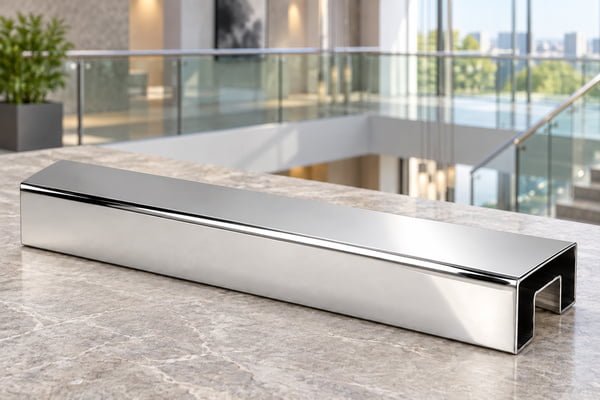
Review the relevant glass balustrade components, including the rail and its supports. Our slotted handrail guide helps identify tube, insert and corner interfaces, but component compatibility is only one part of determining whether a rail is required.
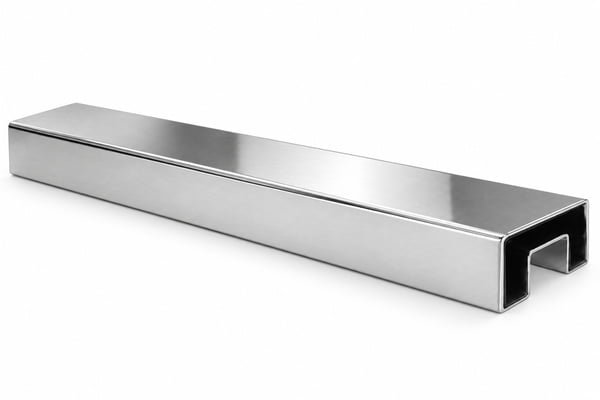
Catalogue illustration: Reflective Silver Square Slotted Glass Handrail Tube. Shown as a component reference, not an installation drawing or test result.
Use a documented decision sequence
| Question | Record needed before ordering |
|---|---|
| Which rules govern the project? | Adopted code edition, local amendments and project requirements |
| What is the guard arrangement? | Glass type, support system and overall geometry |
| What function does the top member perform? | Structural, retention, handrail or decorative role |
| Is an exception being relied upon? | Applicable provision and documented project approval |
| Does evidence match the assembly? | Test or engineering documentation for the stated configuration |
The ICC code library is a starting point for US code research; the locally adopted requirements must be identified rather than assumed from the newest online edition. AGWA’s glass-standard discussion provides Australian context. These resources are not interchangeable approvals for every project location.
Laminated glass does not answer every question
The word laminated does not describe all relevant glass properties or support conditions. Record the plies, treatment, interlayer and assembly configuration. Our laminated-glass specification guide sets out the purchasing inputs, while the Kuraray interlayer resource explains the existence of different interlayer families.
If the project relies on a particular post-breakage behaviour, request the evidence and the responsible designer’s review. Do not infer that behaviour from total glass thickness or from a photograph showing a rail-free installation elsewhere.
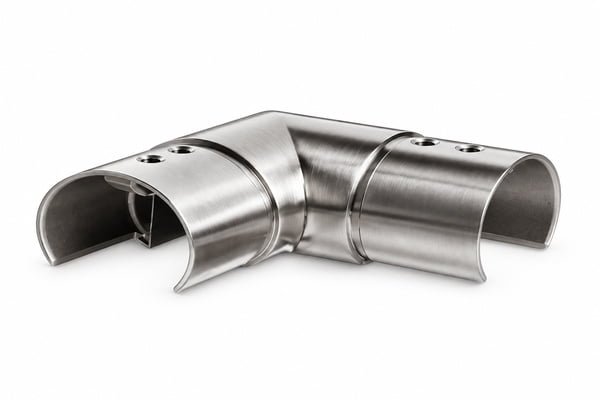
Catalogue illustration: Horizontal Corner Connector for Round Slotted Handrail. Shown as a component reference, not an installation drawing or test result.
Distinguish the guard from the handrail
A guard addresses protection at an edge; a handrail may have separate requirements associated with a stair or ramp. The US Access Board stairway guide provides accessibility context for its applicable framework. Removing a glass top cap does not remove any independently applicable handrail requirement.
Ask the designer to mark grasping surfaces, continuity, terminations and support details where relevant. Procurement should then quote the indicated components without silently substituting a decorative profile for a specified functional member.
Read assembly evidence carefully
Our load-test report checklist helps compare glass, supports, rail connections and boundary conditions with the proposed order. The scope of ASTM E2353 provides technical test-method context. It does not mean every product bearing the word railing has been evaluated under that method.
The CRL fittings catalogue shows third-party component arrangements. Treat it as a design-reference resource, not proof that another manufacturer’s assembly is interchangeable. Ask for documentation tied to the supplier, model and revision actually being purchased.
What changes when the rail is added?
Adding a rail can introduce splices, corners, terminations and contact materials. Coordinate how it meets the glass and adjacent walls. A late change may affect glass preparation or installation access, so release the complete drawing set together.
The CPSC glass safety alert is relevant when changes could involve finished tempered glass. For custom connections, submit the detail through OEM development. Review the manufacturing capabilities against the requested scope, while keeping project-design approval distinct from fabrication capability.
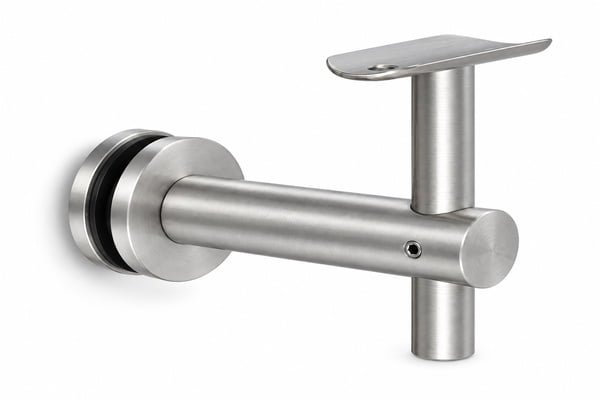
Catalogue illustration: Matte Silver Straight-arm Glass-mounted Handrail Bracket. Shown as a component reference, not an installation drawing or test result.
Procurement answers
Can the buyer omit the rail to reduce cost? Only after the responsible project team documents that the resulting assembly satisfies its applicable requirements. Commercial preference alone does not settle the technical question.
Does a test certificate for glass cover the entire guard? Not automatically. NIST’s conformity-assessment overview helps distinguish the scope of different evidence types. Review what was actually evaluated.
To request a coordinated railing quotation, send the adopted design requirements, approved glass build-up, support arrangement and top-rail decision. Include the rail’s intended role and any required evidence so every supplier prices the same complete system.