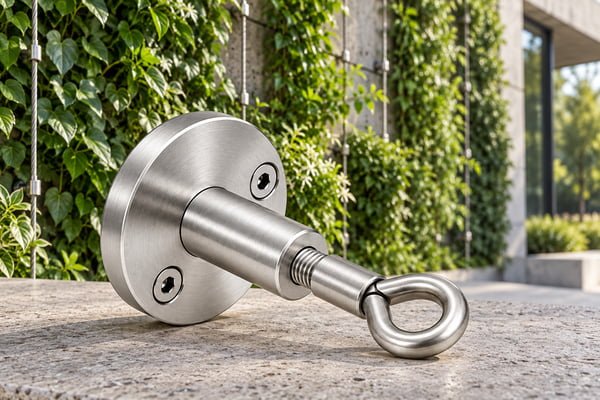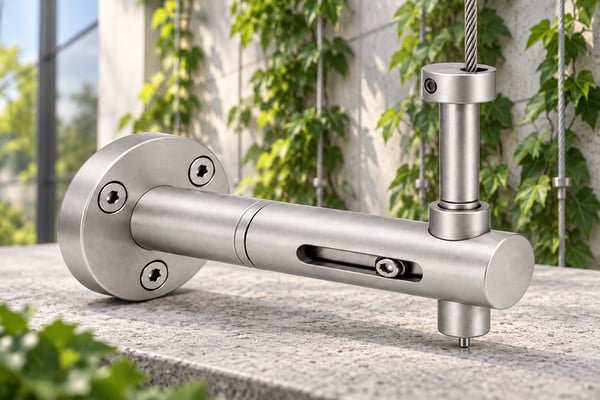
Green wall brackets that cross an insulated building envelope should be reviewed as potential thermal bridges as well as structural connections. Specify the complete wall build-up and ask for an approved connection detail. A generic plastic washer is not evidence that a bracket has an effective or structurally suitable thermal break.
For buyers of green wall hardware, the correct procurement sequence brings the facade designer and fixing supplier together before quantities are released. This article explains the information exchange, not a universal bracket design.
Why the wall section matters
A fixing can create a localized heat-flow path through insulation. Schock’s thermal-insulation explanation describes the general problem. The consequence depends on the connection geometry and building conditions, so a thermal claim must be tied to a specific detail.
Draw the substrate, insulation, cavity, cladding, membranes and bracket projection. Identify the point where loads enter the structure. Our insulated-facade anchor guide covers the fixing interface; this review adds the thermal requirements that must be coordinated with it.
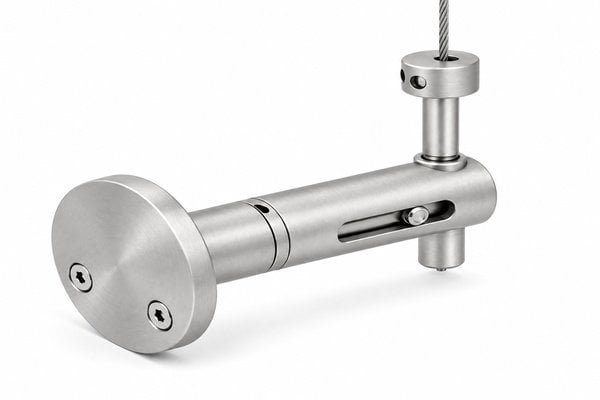
Catalogue illustration: Slotted Adjustable Cable Support — Matte silver appearance. Shown as a component reference, not an installation drawing or test result.
Do not confuse an example with an approved substitute
Schock Isolink is an example of a proprietary thermally separating facade connection. Its materials, approvals and application scope belong to that system. It is not an automatic replacement for a green wall bracket, nor evidence that Elim hardware has the same performance.
Likewise, a green facade technical catalogue helps identify cable-system components, but the complete building-envelope connection needs project-specific coordination. Ask who takes responsibility for the interface between those two systems.
Build a joint review schedule
| Information | Responsible input |
|---|---|
| Wall build-up | Facade designer or project drawings |
| Required actions and load path | Responsible structural designer |
| Connection geometry | Selected fixing-system documentation |
| Thermal assessment | Qualified building-envelope specialist |
| Membrane and water detail | Facade design and installation requirements |
| Product identity | Supplier codes and approved revisions |
The schedule should connect each input to the same drawing revision. A thermal model of an earlier bracket position is not necessarily evidence for the revised assembly.
Assess thermal and structural requirements together
Reducing metal cross-section or introducing a separating component can alter stiffness, bearing or other connection behaviour. Do not optimize heat flow by making an unreviewed physical change. Ask for the complete proposed detail and the evidence supporting its intended application.
EOTA technical reports provide access to relevant assessment methods where applicable. Anchor technical guides address selected fixing systems. Their scopes must be checked against the actual substrate and configuration rather than cited as blanket approval.
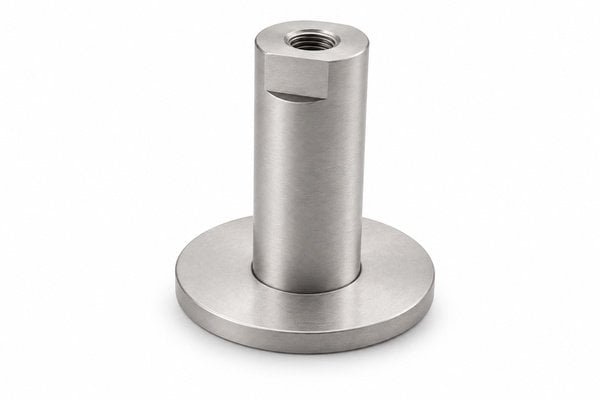
Catalogue illustration: Female Threaded Standoff Foot — Matte silver appearance. Shown as a component reference, not an installation drawing or test result.
Check durability and compatibility
A separating layer may serve thermal, electrical or weathering purposes, but those roles are not interchangeable. The dissimilar-metal connection guide and ASSDA corrosion reference address compatibility questions that remain even after a thermal detail is proposed.
State exposure, irrigation proximity and maintenance access. Ask how the approved detail protects membranes and drains water. Avoid compressing unspecified insulation beneath a load-bearing plate simply because it appears to interrupt the metal path.
The green wall load guide also matters: the final system must consider the agreed plant and environmental actions. A thermally attractive connection is not useful if it does not support the approved load path.
What should accompany a quotation?
Request the connection drawing, product codes, scope of assessment, installation instructions and any limits affecting the project. Where building-code requirements apply, identify the jurisdiction and adopted rules through the responsible designer; ICC resources are one reference point, not a global approval.
Separate a supplier’s technical proposal from accepted project documentation. Conformity-assessment guidance helps clarify the difference between a calculated value, a test report and a certification claim.
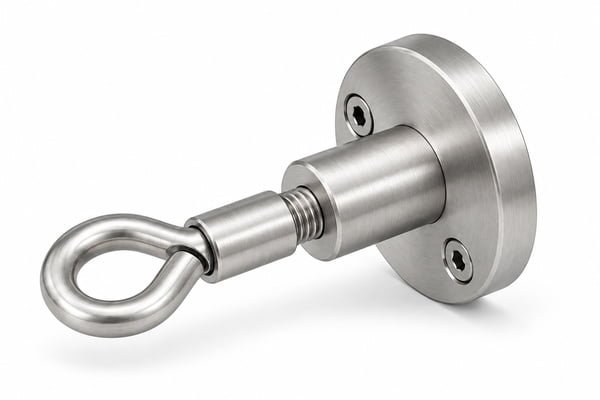
Catalogue illustration: Round Flange Eye Cable Anchor — Fine brushed silver appearance. Shown as a component reference, not an installation drawing or test result.
Two frequent questions
Does stainless steel eliminate thermal bridging? No. Material selection is only part of the heat-flow path. Geometry and the complete wall connection still require review.
Can a thermal pad be added after ordering? Only after the effect on the approved assembly is assessed. Added thickness can change projection, thread engagement and bearing conditions.
For procurement, keep a hold point until the interface drawing is accepted. This prevents separate suppliers from each excluding the most important connection detail from their scope.
Send the coordinated wall section for OEM review, discuss manufacturing capabilities, and request the hardware quotation against the approved detail. That makes the thermal and structural assumptions visible before production.