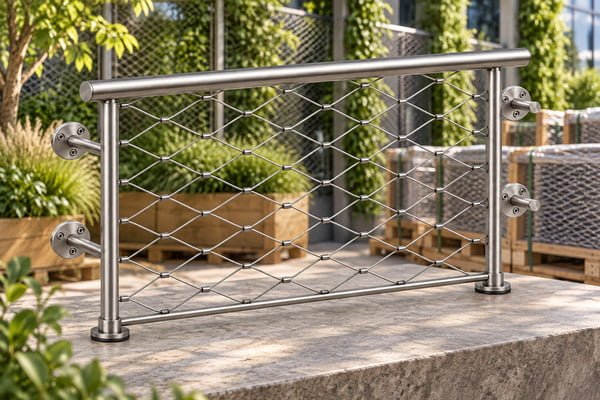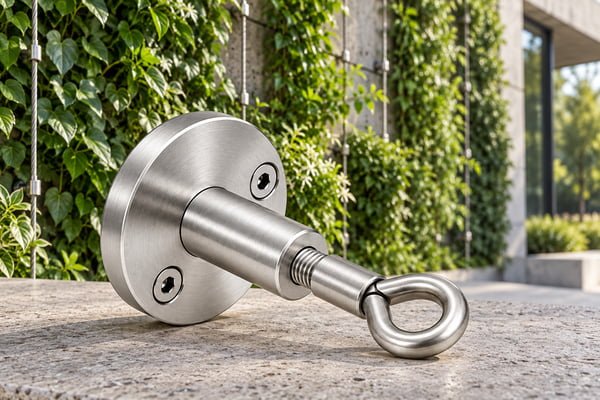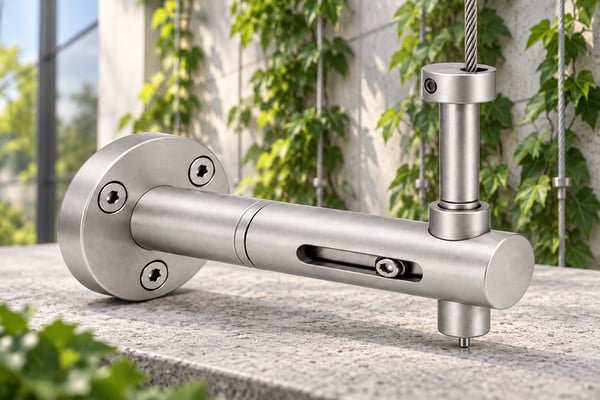
When stainless green wall fixings connect to other metals, buyers should review moisture exposure and the complete electrical contact path. Selecting stainless hardware alone does not resolve the interface. Isolation components, drainage and inspection access need to be considered together.
Use the green wall hardware range to identify each bracket, fastener and support involved. Then draw the connection through its full thickness, including the supporting frame and any coating.
Why a mixed-metal joint needs its own detail
ASSDA’s galvanic corrosion guidance explains that conductive moisture and electrical contact are central conditions for galvanic corrosion. A washer may separate two visible faces while a bolt still connects the metals elsewhere. Paint alone should not be assumed to provide durable electrical isolation at a loaded fixing.
Broader stainless corrosion information helps place this mechanism alongside other corrosion risks. Keep the causes distinct: a crevice, contaminated surface and galvanic connection are not interchangeable explanations for every mark on a component.
Map the interface before choosing a remedy
| Interface item | Purchasing question |
|---|---|
| Bracket and frame | Which metals are actually touching? |
| Bolt and hole | Is there a contact path through the shank? |
| Washer or sleeve | Is its material and geometry specified? |
| Water exposure | Can rain or irrigation remain in the joint? |
| Access | Can the interface be inspected later? |
List the actual alloys and finishes where known. Do not replace that information with the word metal or assume that two silver-coloured parts have the same composition.
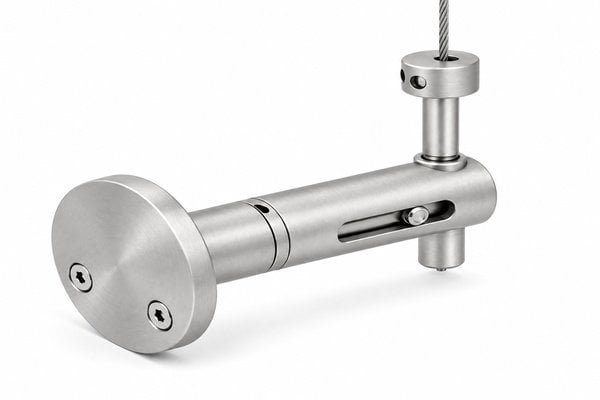
Catalogue illustration: Slotted Adjustable Cable Support — Matte silver appearance. Shown as a component reference, not an installation drawing or test result.
Consider irrigation and deposits
Green walls can introduce wetting patterns that differ from a bare facade. Review the irrigation corrosion guide with the planting and maintenance team. Record intended cleaning products and whether fertilizer-bearing water may reach the connection.
IMOA’s coastal salt guidance adds context for saline exposure. It does not establish the service life of a particular green wall fixing. Avoid promising that a named stainless grade eliminates maintenance in every environment.
Isolation must remain mechanically suitable
A non-metallic separator changes the joint stack. Its thickness, compression behaviour, durability and installation method need technical review. Do not insert an unspecified soft washer into a load-bearing connection simply to separate the visible faces.
Jakob’s GreenBlock technical information and GreenSolutions catalogue show examples of defined system arrangements. Use the documentation for the actual selected product rather than borrowing dimensions from a superficially similar support.
For connections through facade layers, review green wall anchor interfaces. The structural support and weathering detail must remain coordinated when an isolation component is added.
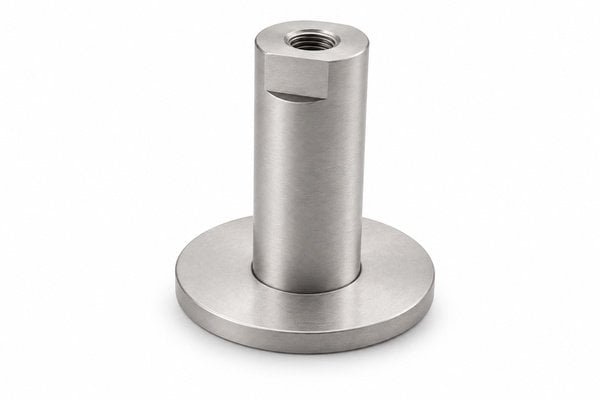
Catalogue illustration: Female Threaded Standoff Foot — Matte silver appearance. Shown as a component reference, not an installation drawing or test result.
A purchasing example
Suppose a project connects a stainless bracket to a coated aluminium frame. The enquiry should show the bracket face, bolt, frame hole and proposed separators. Ask the responsible technical party to identify every contact path and the required joint design.
That is a review workflow, not a universal material prescription. The answer depends on exposure, geometry and the approved assembly. A coating colour or a photograph cannot supply the missing information.
Plan cleaning access using ASSDA’s exterior maintenance guidance. Where elastomers are proposed, Parker’s material handbook can support material questions, but it does not approve an arbitrary isolation pad for structural use.
Preserve the interface in future repairs
Keep sleeves and washers in the spare-parts definition. The zone-based spare kit guide helps prevent a maintenance replacement from omitting a small but important component.
Require drawings and inspection records to identify the approved stack. Conformity assessment guidance helps distinguish a documented component check from an unsupported durability claim.
Inspect the complete kit
At receiving, compare the supplied sleeves and washers with the approved parts list as carefully as the metal bracket. A missing small separator can change the intended interface even when the main hardware is correct. Keep spare components identified by material and size; an unmarked bag of similar-looking washers is a weak basis for future repairs or replacement orders on an established planted facade.
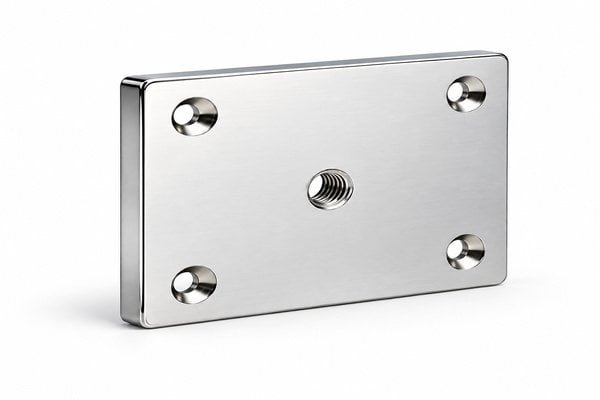
Catalogue illustration: Rectangular Threaded Mounting Plate — Polished silver appearance. Shown as a component reference, not an installation drawing or test result.
For a quotation, submit the support material, exposure description, connection section and estimated quantity through OEM review. Check available manufacturing capabilities, then request the complete fixing assembly, including specified separators. The objective is a connection whose materials and maintenance needs remain clear after the plants have grown around it.