
Plan green wall spare kits by installation zone and component identity. Separate parts that are genuinely interchangeable from cables or brackets tied to a specific location. This makes maintenance orders more reliable than keeping an unlabelled box of similar-looking fittings.
This operations worksheet is for owners and contractors maintaining green wall cable systems after project handover. It focuses on identification, storage and replacement coordination rather than prescribing a universal spare percentage.
Give every zone a practical name
Use identifiers that maintenance staff can locate on the building. A zone might correspond to an elevation, level or independently serviced planting section. Keep the naming consistent across drawings, cable schedules and kit labels.
Our phased installation guide provides a useful starting point if the original delivery already used section codes. The Jakob GreenSolutions catalogue is external system context; use the actual supplied component list for the spare schedule.
| Spare schedule column | Purpose |
|---|---|
| Zone | Shows where the component belongs |
| Part and revision | Distinguishes similar but incompatible items |
| Quantity held | Records the agreed service stock |
| Storage location | Makes the spare retrievable |
| Replacement reference | Links to instructions and drawings |
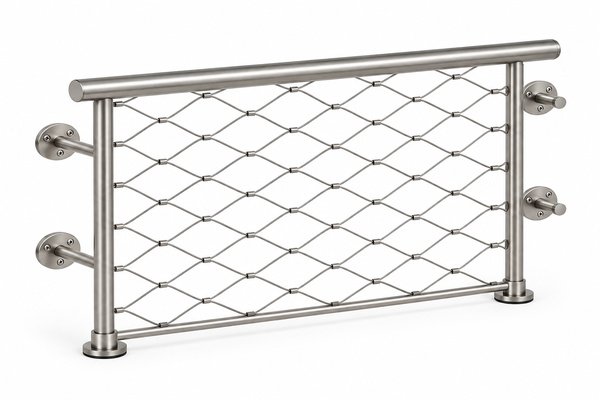
Catalogue illustration: Tubular Rail Cable Mesh Panel — Matte silver appearance. Shown as a component reference, not an installation drawing or test result.
Separate common parts from location-specific items
A standard connector may be shared across several zones, while a finished cable length may fit only one position. Confirm interchangeability through the approved records rather than visual similarity. Our repairable cable section guide explains why replacement planning starts with the assembly design.
The Jakob Webnet assembly instructions illustrate the importance of system-specific procedures. They should not be applied to another supplier’s system without the appropriate instructions. Keep the relevant installation and maintenance documents with the kit register.
Decide quantities from the maintenance plan
Do not choose a stock percentage simply because it is easy to calculate. Consider the number of repeated parts, replacement lead time, access restrictions and consequences of a delay. The owner and responsible maintenance team should agree the stock strategy.
For a hypothetical register, zones A and B might share a connector code while their cable lengths have separate codes. List those distinctions explicitly. The example describes a labelling method, not a claim about an installed Elim project or a recommended stocking quantity.
GS1 traceability guidance supports linking identifiers to supplied batches and later replacements. Record any approved substitution so the register remains a usable record rather than a copy of the original invoice.
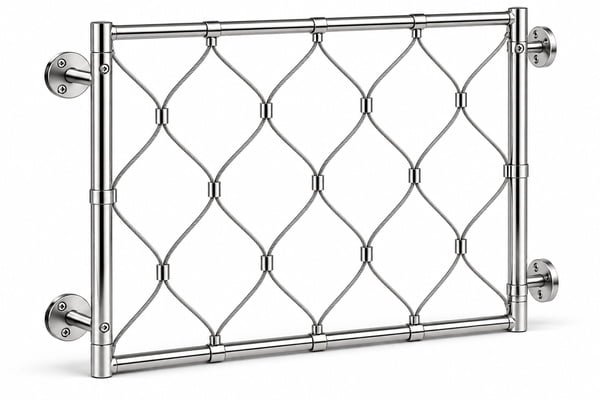
Catalogue illustration: Ferruled Cable Mesh Frame — Polished silver appearance. Shown as a component reference, not an installation drawing or test result.
Coordinate replacement with the planting
Access changes as plants mature. RHS climber information and tying-in guidance provide horticultural background for the landscape team. Replacement may require plant management as well as hardware work, so include both responsibilities in the maintenance plan.
Our plant-removal planning guide helps identify these interfaces. Do not assume a stored spare can be installed immediately without following the system’s safe replacement procedure. A kit supports the work; it does not define the method.
Store spares so they remain identifiable
Keep components clean, protected and separated by code. Retain finish and material records. IMOA coastal guidance provides exposure context, while ISTA procedures can inform agreed packaging evaluations for transport. Neither source proves that a specific storage package has been tested.
For labelled service kits, discuss OEM/ODM supply and review the relevant manufacturing capabilities. Ask which labels, packing lists and replacement identifiers can be supplied as part of the order.
At an annual stock review, compare the register with the parts physically held. Check labels, protective packaging and whether any revisions have become obsolete. Investigate unexplained differences before reordering. A spare that cannot be identified confidently should not be issued merely because its dimensions look close to the part requested by the maintenance team.
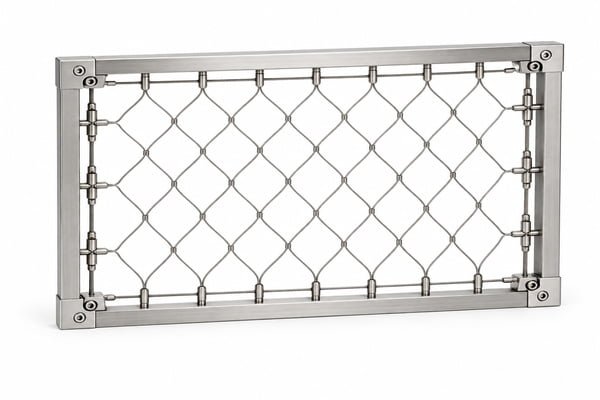
Catalogue illustration: Perimeter Tensioned Cable Net Panel — Fine brushed silver appearance. Shown as a component reference, not an installation drawing or test result.
The NIST conformity assessment overview helps describe incoming checks accurately. Confirm that delivered spares match the ordered codes and condition requirements. A receiving check is not a new structural qualification for a substituted component.
Keep the register alive
Update the balance whenever a spare is used. Record the installed location and the reason for replacement, then decide whether the stock should be replenished. Review the register when drawings or component revisions change.
Can one spare kit serve the whole building? Only if the records identify which parts are compatible with each zone.
What should an enquiry include? The zone schedule, part codes, revisions, desired quantities and packing requirements. Send the service-kit list so the supplier can quote identified replacements rather than a generic selection of green wall fittings.